Editorial Board
MusicWeb International
Founding Editor Rob Barnett Editor in Chief
John Quinn Contributing Editor Ralph Moore Webmaster
David Barker Postmaster
Jonathan Woolf MusicWeb Founder Len Mullenger
Samuel Coleridge-Taylor (1875-1912) Piano Quintet in G minor Op.1 (1893) [26:23]
Ballade in C minor for violin and piano Op.73 (1907) [13:00]
Clarinet Quintet in F sharp minor Op.10 (1896) [29:56] Nash Ensemble
(Richard Hosford (clarinet); Ian Brown (piano); Marianne
Thorsen (violin); Malin Broman (violin) (Piano Quintet);
Benjamin Nabarro (violin) (Clarinet Quintet); Lawrence Power
(viola); Paul Watkins (cello)).
rec. Henry Wood Hall, London, 26-28 January 2007. HYPERION
CDA67590 [69:20]
My first introduction to the music of Samuel Coleridge-Taylor
was one of the Dream Dances for piano. For many years
this was the only work I had heard. I recall my father talking
favourably about a pre-war performance of Hiawatha which
he and his father and brother had attended. I later discovered
the ‘light’ Petite Suite and some more piano pieces.
However it was not until I heard the relatively recent recordings
of the Violin Concerto and the Symphony in A minor that
I sat up and took notice.
The present release simply confirms what I have come to believe – that
Samuel Coleridge-Taylor may not be the brightest star in
the firmament of British Music - but ‘by gum’ he is seriously
underrated and well deserves to be better known and represented
in the concert hall and the recording industry.
There are three works given here: one is quite a late piece,
written just a few years before Coleridge-Taylor’s untimely
death. The other two are effectively student works. All three
are minor masterpieces – at least to this listener.
The sleeve-notes explain that the Piano Quintet in G minor received
its first performance in Croydon on 9 October 1893. It was
a concert that consisted entirely of works by Coleridge-Taylor. Lionel
Harrison notes that the piece was probably not heard again
for more than a century.
The influences here are Brahms, Dvořák and Schubert,
yet elements of Coleridge-Taylor’s mature style are already
evident. This is a big-boned work that is full of romantic
gestures and passionate outbursts. The Editor has written
that this Quintet is a ‘real discovery’ (in relation
to an earlier recording - see review) and he compares it
with the Ireland Sextet and
the Stanford Serenade.
In Mr Barnett’s opinion this present work ‘towers in this
company.’
The Quintet is written in four movements with the
slow movement coming second in order. A turbulent ‘allegro’ is
followed by the deep and measured ‘larghetto’ which explores
a wide range of emotion. The ‘Scherzo’ is a driving piece
full of energy. It is here that I feel the individual voice
of the composer is best heard. The last movement could be
described as eerie, dark and unsettling: indeed, there are
a few places where this penumbra is drawn aside, but typically
this music is disturbing.
The critical thing is that this multi-faceted work is the
creation of an eighteen year old student: seen in this light
it is an absolute masterpiece.
The Clarinet Quintet in F# minor has an unusual history.
Apparently Charles Villiers Stanford commented that ‘after
Brahms produced his Clarinet Quintet, no one would
be able to compose another that did not show Brahms’s influence.’ The
young Coleridge-Taylor took this as a personal challenge
and wrote the present number. Stanford is reputed to have
said, on perusing the score, “You’ve done it, me bhoy.’ However,
what is not owed to the German is most probably due to Dvořák.
Yet this is not a pastiche – there are elements of melody
and design that defy classification and belong solely to
the creative mind of this composer.
Interestingly, I detect a few passages that would seem be
imbued with an ‘Englishness’ more often associated with the
so called ‘Pastoral’ school of composition. This is altogether
the most important work of Coleridge-Taylor’s student days.
The latest work on this disc is the Ballade in C minor for
violin and piano. It was composed in 1907 and dedicated to
the Russian-born violinist Michael Zacherewitsch. The title
of Ballade was in the air at this time with works
by Grieg and Debussy for violin and piano being possible
exemplars; however the tone of Coleridge-Taylor’s work nods
more to Tchaikovsky. This is a great work that is full of
melancholy and passion. Yet it is not without its less dark
moments – with the work finally ending in C major. The virtuosity
of the solo part is never in doubt.
This Hyperion CD cannot be faulted and it seems almost redundant
to state the obvious fact that the performance by the Nash
Ensemble is fine indeed. The programme notes would be better
defined as an essay - it tells me everything I need to know
about these three (to me) unknown works. And what more can
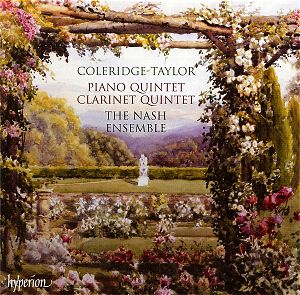
one ask? I am not convinced by the rather chintzy sleeve
design however it is based on an original painting, The
Rose Garden by Robert Atkinson (1863-1896)
The bottom line is that this is an excellent recording of
some stunning repertoire that is little known – even amongst
enthusiasts of British music. Let us hope that there is plenty
more by Coleridge-Taylor in the ‘in-boxes’ of the record
companies.
John France
Please support our advertisers below by clicking on the logos for further information.

























 Nash Ensemble
(Richard Hosford (clarinet); Ian Brown (piano); Marianne
Thorsen (violin); Malin Broman (violin) (Piano Quintet);
Benjamin Nabarro (violin) (Clarinet Quintet); Lawrence Power
(viola); Paul Watkins (cello)).
Nash Ensemble
(Richard Hosford (clarinet); Ian Brown (piano); Marianne
Thorsen (violin); Malin Broman (violin) (Piano Quintet);
Benjamin Nabarro (violin) (Clarinet Quintet); Lawrence Power
(viola); Paul Watkins (cello)).