Unlike many nineteenth
century operatic transcriptions, Giuliani’s versions from Rossini
have nothing of the routine about them, no sense that they are
dutiful pieces of work made to meet a demand (real or hoped
for). Here there is, on the other hand, a genuine sense of involvement
and pleasure, a love for the material.
No doubt it is relevant
to know that Rossini and Giuliani were acquaintances. In 1820,
Rossini and Paganini were in Rome, Rossini involved in preparations
for the premiere, in February 1821, of his opera Matilde
di Shabran. In the same month, Giuliani was writing to his
editor Giovanni Ricordi explaining that he had got to know Rossini
and that reporting that he “has favoured me with many originals
from which I can arrange everything that appeals to me”. Giuliani,
Paganini and Rossini spent a good deal of time together, socialising
and making music (as detailed in Giancarlo Conestabile’s Vita
di Niccolò Paganini published in Perugia in 1851).
There is real understanding,
partly explicable at this biographical level, in the way in
which Giuliani handles Rossini’s music. He knits together themes
from different works in a way which results in the creation
of something which goes beyond mere transcription or arrangement;
nor is it quite a matter of Giuliani’s writing variations. In
effect what he does is to write music which is in dialogue with
the materials he borrows from Rossini and, by the very way he
juxtaposes the Rossinian themes he points out musical connections
between them. I am also beginning to realise that the unheard
words are not irrelevant – there are places where the connections
are implicit in the texts sung in the operas, but not, of course,
heard in Giuliani’s versions for guitar. Some, at least, of
those who heard Giuliani play what he called his “pot-pourris”
of/from Rossini would certainly have known the words of the
arias whose melodies they were rehearing, and would have made
the connections.
In the first of
the Rossiniane, for example, an introduction which doesn’t appear
to have a specific source in Rossini, is followed by versions
of ‘Deh calma ciel’ from Otello, ‘Arditi all’ire farem
ritorno’ from Armida, ‘Non piu mesta’ from La
Cenerentola, ‘Di piacer mi balza il cor’ from La gazza
ladra, before concluding with ‘Miei rampolli femminini’
(from La Cenerentola once more). There are, of course,
changes of mood and tone here, but also a kind of continuity
both musical and (implicitly) textual. As well as pleasing the
ears, each of the Rossiniane invites us to think about the works
on which it draws.
The fine Japanese
guitarist Shin-ichi Fukuda’s perfomance of the first three of
the sic Rossiniane (plus Giuliani’s version of the cavatina ‘Bel
raggio lusingier’ from Semiramide (which seems to have
been one of Giuliani’s favourites amongst Rossini’s operas) has
clarity and lucidity on its side. Technically assured, Fukuda’s
melodic lines are sharply etched and his rhythms are precise.
I’m not quite sure, however, that he really does full justice
to the Italianate warmth of this music. He is recorded very closely
and the acoustic, though very faithful to the instrumental sound,
is rather unforgiving. Amongst other recent versions, I am inclined
to prefer the complete set by Frédéric Zigante on ARTS 447146-2
and 447147-2 (see review),
though the recording quality is not all it might be. But Fukuda
is well worth hearing too; this is music which readily sustains
and rewards alternate readings.
Glyn Pursglove
























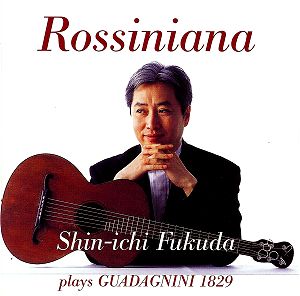

 Shin-ichi Fukuda
(guitar)
Shin-ichi Fukuda
(guitar)