Editorial Board
MusicWeb International
Founding Editor Rob Barnett Editor in Chief
John Quinn Contributing Editor Ralph Moore Webmaster
David Barker Postmaster
Jonathan Woolf MusicWeb Founder Len Mullenger
Ned ROREM (b.
1923)
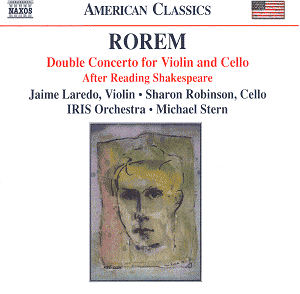
Double Concerto for Violin, Cello and Orchestra (1998) [32:21] After Reading Shakespeare (1981) [21:53] Jaime Laredo (violin); Sharon
Robinson (cello)
IRIS Orchestra/Michael Stern
rec. 4 April 2004, Germantown Performing Arts Center, Tennessee (concerto); 23-24
March 1982, Astoria Studios, New York (Shakespeare) NAXOS 8.559316 [54:14]
Naxos has been doing sterling service in recent years by issuing
recordings of music by Ned Rorem in their American Classics series.
This is at least the fifth Rorem volume (link
to all Rorem reviews).
Naxos is not the only label to issue Rorem recordings but they’ve
done more than most to expand the audience for his music.
I’ve come to admire Rorem’s music very much but I must say that the
Double Concerto has particularly impressed me. He’s been
a friend of the violinist, Jaime Laredo, and his cellist
wife, Sharon Robinson, for many years and that friendship
has already brought forth the Violin
Concerto (1985) and it led also to the composition of After
Reading Shakespeare. However, it was not until 1998 that
a commission from the Indianapolis Symphony gave Rorem the
impetus and opportunity to write something for them to play
together. The resulting concerto is a very fine achievement.
The work is cast in eight movements, several of them quite
short. Rorem gave these movements titles “just to get the [compositional?]
juices flowing”, he writes. He says in his booklet note that
these titles “connote whatever the listener chooses”. I found
the titles rather helpful in approaching the music for the
first time but, importantly, the titles didn’t fetter my
imagination as I listened. Although there are a good number
of places in the score where Rorem writes dynamically and
with great rhythmic vitality it’s clear that he’s been inspired
above all by the capacity of both solo instruments to sing.
So there’s a good deal of warm, lyrical writing, just as
one would expect from the man who became widely regarded
as one of the leading composers of art songs in the twentieth
century.
The lyrical vein is well to the fore in ‘Their Accord’, the fifth
movement, in which the soloists combine in music that’s lyrical
and full of repose. I loved this movement and also its immediate
predecessor, ‘Staying on Alone’, in which the violin is silent
and the cellist muses wistfully, with a touch of melancholy.
The heart of the work is the seventh movement, ‘Conversation at Midnight’.
In this performance this plays for 14:27, whereas the next
longest movement is a “mere” 5:30. ‘Conversation at Midnight’ is
a real achievement, for in it Rorem conveys in abstract the
ebb and flow, the cut and thrust, of a dialogue. The two
soloists are the protagonists, of course, and they are supported
by an inventive orchestral accompaniment. The music is searching.
It’s dissonant at times but predominantly the mood is lyrical,
featuring some long, lyrical lines for the soloists. There’s
a quite passionate section between about 7:00 and 8:15, followed
by a much quicker section; I wondered if this represented
some form of argument. Calm is restored by 10:36 and gradually
the music winds down to a peaceful end. Do the two participants
in this late night dialogue drift off to sleep, I wonder?
The final section, ‘Flight’ is one of several where the music is busy,
the rhythms jagged and propulsive. The work hurtles to an
emphatic conclusion on a sustained major chord. This concerto
is a very fine piece and one that I’m delighted to have got
to know through this recording. If I describe it as entertaining
I don’t mean to imply for a second that there’s anything
trivial about the music but it’s a rewarding and enjoyable
listen. So far as I can tell, not having previously encountered
the piece, the performance is superb. Jaime Laredo and Sharon
Robinson clearly love the music and they play it with passion,
conviction and no little virtuosity. I’m sure they must have
relished the opportunity to play as partners in a work expressly
designed, surely, to match and reflect their personalities.
The orchestral support, under Michael Stern’s leadership,
is deft and sensitive. It’s clear from a comment in the booklet
that Ned Rorem was delighted by this recording and I’m not
surprised.
After Reading Shakespeare is a somewhat
earlier piece – on the jewel case Naxos date it from 1981
although in his note Rorem says 1980. There are nine short
sections and once again Rorem has given each one a title.
However, he says, “The individual titles were not fixed notions
around which I framed the music; they emerged, as titles
for non-vocal music so often do, during the composition.” And,
in fact, he goes on to state that some of the titles were
only added after the music had been written. It’s interesting,
in this context, to note that although both the first and
third sections are entitled ‘Lear’ the music is quite different
in each section. The first ‘Lear’ is vigorous and very passionate.
The second is quite spiky, with a good deal of pizzicato.
I was intrigued by ‘Caliban’. At one level one might have expected
ugly music, since Caliban is not physically prepossessing,
but Rorem has responded more to the sense that Caliban is
an outsider - so the movement is built round a melancholy
melody. ‘Portia’ is portrayed – if that’s the appropriate
word – as a woman of dignity. The penultimate movement is
entitled ’Remembrance of things past’. This is highly eloquent
music, tapping a rich vein of emotion, and Sharon Robinson
plays with deep feeling. The concluding section is ‘Iago
and Othello’ and, as you might expect, the music is highly
charged but ends, rather surprisingly, almost in mid-air.
After Reading Shakespeare is a most interesting
and inventive score in which the listener’s attention is
securely held from start to finish. It helps, I’m sure, that
the music receives such committed advocacy as that provided
by Sharon Robinson. I’m certain that it’s highly demanding,
both technically and psychologically – after all, the performer
must respond to a series of different moods in the various
sections. It’s a challenging work but one that’s very definitely
worth getting to know.
This is a fine issue, making available two very individual
and worthwhile works by one of America’s leading composers.

























 Jaime Laredo (violin); Sharon
Robinson (cello)
Jaime Laredo (violin); Sharon
Robinson (cello)