Rodrigo’s El
hijo fingido (‘The Feigned Son’) was premiered on 5 December
1964 at the Teatro de la Zarzuela in Madrid. But before that
it had a long and fairly complicated genesis. In her memoirs,
Joaquin Rodrigo’s wife Victoria Kamhi recalls how in 1955 the
librettist and dramatist Jesús Arazomena (1918-1972) visited
the composer at his house in Torreledones (near Madrid), with
the proposal that Rodrigo write some incidental music to an
adaptation by Arazomena of a comedy (¡De cuándo acá
nos vino!) by Lope de Vega and that the resulting work be
entered for a state-run competition then in progress. The work
was completed by the following year, but failed to win any of
the prizes on offer. Later Rodrigo composed more numbers and
Kamhi herself adapted and added to Arazomena’s book (he seems
to have lost interest in the project and Kamhi is less than
complimentary about him). In her revisions and expansions she
added material from another of Lope de Vega’s comedies, Los
ramilletes de Madrid. It was in this form that
the work was eventually performed in Madrid, some nine years
after its conception.
Rodrigo and Khami
described the work as a Lyric Comedy; it is clearly heavily
indebted to the tradition of the zarzuela. Since the
present CD contains the libretto only in the original Spanish,
and lacks even a plot summary in English, it may be worth offering
a summary of sorts. The story concerns the amorous adventures
of Lieutenant Leonardo, a handsome young man serving in the
Spanish army in Flanders, under the command of one Captain Fajardo.
Leonardo returns to Spain, bearing letters of introduction and
recommendation from Fajardo. One of these is addressed to Doña
Barbara, sister of Fajardo. She is a young and attractive widow
and mother of Angela (who, naturally, is also very attractive).
Leonardo tampers with his letter, so that it gives the impression
that he is actually Fajardo’s son. Treated now as a relative,
Doña Barbara offers him lodgings – and both she and her daughter
fall in love with him. Both make their love known; Doña Barbara
tries to outwit her daughter by persuading her that Leonardo
is actually her brother and that love between them is therefore
impossible. But the arrival of Captain Fajardo effects a solution.
At first Leonardo runs away, but it is clear that he is sorry
for his actions and the Captain first forgives him and then
adopts him as true son; a marriage between Leonardo and Angela.
Rodrigo’s music
is everywhere tuneful and attractively airy – it breathes a
kind of aural sunshine and clarity of light. Essentially this
is a kind of neo-classical updating of the idioms of eighteenth-century
opera buffa. In an interview given at the time of the
work’s premiere, Rodrigo himself said, aptly enough, that the
work “follows the same course pursued by the mischievous undertakings
of 18th century opera buffa, which were followed
by Mozart’s sweet smile and Rossini’s picaresque one, and which
in the 19th century. mitigated the dejection of Romanticism,
gladdening its score with the charm of our popular music”.
As is often the
case, Rodrigo’s music is at its most thoroughly attractive and
characteristic in the orchestral writing; I have never found
him, much as I love his work, an especially successful writer
for the voice. The Overture is a well made piece of theatrical
music, opening and closing with vivace writing framing a lyrical
middle section. There are reminiscences of Fantasía para
un gentilhombre in the brief orchestral Canario which
follows. The short orchestral introduction to Act I has some
lovely idiomatically Spanish inflections in the string writing
and the prelude to Act II provides a lovely set of variations
(on ‘Guádarme les vacs’) with the harp of Florence Dumont foregrounded.
There is forceful, even passionate (within the generic confines
of lyric comedy) orchestral writing in the Act II duet (‘¿Por
qué no qieres?’) between Ángela and Doña Bárbara. The second
Act intermezzo is delightfully echoic of Spanish Renaissance
dance music.
All the vocal writing
is highly competent, though only parts of the score have the
real vitality and crispness of Rodrigo’s very best orchestral
writing. Doña Bárbara’s Act I canción ‘Vivo, y es mucho
deciros, junto a la Plaza Mayor’’ is delightful, liltingly melodious;
the Act I duet (‘Ramilettes de Madrid’) of Ángela and Leonardo
is an attractive, vivacious piece. In Act II the very best music
comes towards the end, with Leonardo’s romanza ‘¿Dónde
me encontrarás, alba?’, Ángela’s exquisite ‘Yo pagaré la posada’,
sung to the accompaniment of cello alone (charmingly played
by John Stokes) and a rousing concertante to close ‘Yo es ruego’).
The more I listened
to this recording, the more solid and rewarding the piece seemed.
Relatively free of grand gestures, El hijo fingido has
a charm which, without the advantages of seeing it performed,
doesn’t necessarily strike one immediately. But performed with
the thorough knowledge of the idiom which the artists of Madrid’s
specialist theatre bring to it, this is a real delight. Miguel
Roa’s conducting and the work of orchestra and chorus are utterly
assured and sympathetic; of the soloists, María Rodríguez is impressive
both in terms of voice and characterisation, comic roles are pleasingly
articulated by Emilio Sánchez and Enrique del Portal; as Leonardo,
Miquel Ramón makes some lovely contributions in his more lyrical
numbers.
Glyn Pursglove
























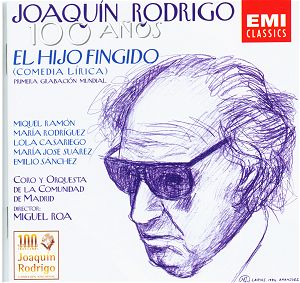

 Miquel Ramón
(baritone) – Leonardo; María Rodríguez (soprano) – Ángela; Lola Casariego
(mezzo) – Doña Bárbara; María José Suárez (contralto) – Rosita, la
Inca; María Rey-Joly (soprano) – Dominga; Emilio Sánchez (tenor) –
Beltrán; Enrique del Portal (tenor) – Don Octavio; Luis Álvarez (bass)
– Don Ventura; Carlos López (bass) – Capitán Fajardo; Carmen Haro
(singing actress) – Basilisia
Miquel Ramón
(baritone) – Leonardo; María Rodríguez (soprano) – Ángela; Lola Casariego
(mezzo) – Doña Bárbara; María José Suárez (contralto) – Rosita, la
Inca; María Rey-Joly (soprano) – Dominga; Emilio Sánchez (tenor) –
Beltrán; Enrique del Portal (tenor) – Don Octavio; Luis Álvarez (bass)
– Don Ventura; Carlos López (bass) – Capitán Fajardo; Carmen Haro
(singing actress) – Basilisia  [78:12]