The
ensemble Charivari Agréable is one of
many groups in the early music scene
but it stands out from the crowd. A
magazine labelled it "one of the
most original and versatile groups on
the Early Music scene today". This
disc testifies to that once more. It
pays attention to an aspect of English
music of the 17th century which has
been almost completely overlooked. Its
importance is twofold: firstly it presents
religious repertoire written for domestic
use, whereas most recordings concentrate
on music which was to be performed
in cathedrals or at court. Secondly
it shows that the Italian style made
an earlier entrance in England than
many think.
The
Book of Psalms has always played an important role in the Christian
Church. Whereas in the Middle Ages non-biblical texts were frequently
used in the liturgy it was the Reformation which restored the
predominance of the Psalms. As the Reformers believed that not
only professional singers should sing in church but also the
congregation, poets and composers collaborated in creating metrical
psalms in the vernacular. These could be sung by common believers.
The best-known example is the Huguenot Psalter which came into
existence in the late 16th century.
In
England several collections of metrical Psalms were published
from the end of the 16th century onwards. The present disc contains
a number of compositions on Psalm texts, some of which are also
metrical. The title is explained by Kah-Ming Ng in the booklet:
"Most of the composers have some connection with Oxford,
be it academic, professional, or, more tenuously, fraternal."
It focuses on "sacred songs and non-liturgical anthems
for domestic consumption, 'fitt for private Chappels or other
private meetings', to cite a rubric from William Child's only
publication 'The First Set of Psalmes of III Voyces' (1639)".
Religious music specifically written for domestic use is a phenomenon
which wasn't restricted to England: in Germany a large amount
of this kind of music was written, in particular under the influence
of Pietism.
As
far as the repertoire on this disc is concerned, the interesting
thing is that here we find early influences of the modern Italian
style which were largely absent in repertoire written for cathedrals
or in secular music. Matthew Locke wasn't the only one who had
a rather negative view on Italian - or any non-English - music
as this quotation shows: "I never yet saw any foreign composition
worthy an English man's transcribing." Therefore it is
quite remarkable that William Child, one of the English composers
of the 17th century who is now paid little attention, wrote
that his psalms were "newly composed after the Italian
way". And the pieces performed here show that he mastered
that style quite well. It is a shame that only a small proportion
of his collection is performed here. But the rest of the disc
is equally interesting, for instance the compositions of William
Lawes. They come from his collection 'Psalmes for 1, 2 and 3
partes, to the comon tunes'. The reference to "common tunes"
has given rise to the suggestion that these psalms could have
been sung in church, but there is no firm evidence to support
this. The fact is that alongside free composed passages for
solo voices Lawes also gives a simple melody, which seems meant
to be sung by a congregation, and is performed here with the
three voices singing unisono.
The
Italian influence, which even appears in Locke's music, is reflected
in three things: firstly the three-part texture, in the way
of the Italian trio-sonata, which results in settings for three
voices, mostly alto, tenor and bass; secondly the addition of
a basso continuo part; and thirdly the declamatory character
of the vocal parts. Of course, Henry Purcell is the best-known
representative of the true baroque style in England in the 17th
century. He composed a number of devotional songs, two of which
are recorded here. Neither these nor the piece by the hardly
known George Jeffreys set metrical texts.
The
latest piece on this disc is by Jeremiah Clarke, who was a highly
gifted composer who could have had a great career if he hadn't
had a melancholic nature which finally led him to commit suicide.
His hymn 'Blest be those sweet Regions' was written as he was
sworn in – together with William Croft – as Gentleman-Extraordinary
of the Chapel Royal. This hymn "is a veritable cantata
in miniature, featuring an aria-like refrain, around which are
woven arioso passages, presaging the arrival of Handel's Italianate
idiom".
Listening
to the programme on this disc one gets a fairly good impression
of how the Italian style gradually gained ground in a part of
composing and music-making which took place more or less out
of the limelight, and as a result is largely overlooked in our
own time. It is the great virtue of this recording that this
chapter in English music history is saved from oblivion. I am
happy to add that the performers give splendid interpretations
of this repertoire. There were times when I would have liked
a little less vibrato, in particular from Simon Beston, but
on the whole I thoroughly enjoyed the performances of both singers
and players. In the unisono passages the three voices blend
very well. All singers deliver the texts in true declamatory
style, without exaggeration. They are well aware of the fact
that this music was written for domestic use, which makes a
display of virtuosity inappropriate. It was a good decision
to use a tenor for the upper (alto) part, and Rodrigo Del Pozo
has exactly the right type of voice for this.
Various
instrumental items are interspersed amongst the rest. Again
they are rather uncommon pieces, performed here with imagination
by the instrumentalists of the ensemble.
I
strongly recommend this disc, which is of far more than historical
importance; it also has great musical value. I hope that this
area of repertoire is going to be explored more extensively in
the near future.
Johan van Veen
























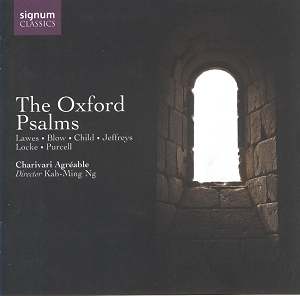

 Charivari Agréable
(Rodrigo Del Pozo, Simon Beston (tenor), Nicholas Perfect (bass),
Susanne Heinrich (bass viol, consort bass), Richard Sweeney (theorbo),
Kah-Ming Ng (harpsichord, organ))/Kah-Ming Ng
Charivari Agréable
(Rodrigo Del Pozo, Simon Beston (tenor), Nicholas Perfect (bass),
Susanne Heinrich (bass viol, consort bass), Richard Sweeney (theorbo),
Kah-Ming Ng (harpsichord, organ))/Kah-Ming Ng