This is The three concertos played here are the first half
of a marathon concert in celebration of Mozart’s 250th
anniversary and Rudolf Buchbinder’s 60th birthday.
Buchbinder’s Concerto 23 is striking for its lightness and brightness
of texture and the lilting quality of the orchestral introduction.
The sound is that of a chamber orchestra yet with a gleaming,
golden character. The piano tone is more bright and distinct
than smooth.
I compared the 1989
recording on CD by the Berliner Philharmoniker/Daniel Barenboim
(piano, conductor) (Elatus 2564 61174-2). Here for comparison,
as throughout this review, are the actual music timings of both
accounts:
Timings
|
I
|
II
|
III
|
Total
|
Buchbinder
|
10:40
|
5:42
|
7:36
|
23:58
|
Barenboim
|
11:25
|
7:20
|
8:10
|
26:55
|
There’s more momentum
about Buchbinder’s first movement yet he still finds a more
gliding second theme by contrast (tr. 2 1:52) where Barenboim,
usually more measured, is more tripping. Barenboim’s phrasing
of the piano solos is more poised and crafted where Buchbinder
emphasises progression within a more even line. His reading
of Mozart’s cadenza is similarly evenly fluent where Barenboim
contrasts more strongly its bustling outer and poised inner
sections.
Buchbinder’s slow
movement begins with subdued piano tone and a still fluent approach.
Clarinet and flute dominate violins overmuch in presenting the
second theme (tr. 3 12:34 in continuous timing), but its upfront,
aching character makes an interesting contrast to the piano’s
beginning. The third theme (13:52) provides a brief relief after
which the return of the opening seems sadder and more sullen.
Buchbinder over ornaments the repeated phrase at the end (15:34),
filling in the dramatic wide leaps in the melody, shifting the
focus away from emotion to technique and artifice.
Barenboim is slower
and more intense in this movement, closer to Mozart’s marking
of Adagio while Buchbinder seems to favour the early
printed edition’s Andante. Where Barenboim thereby gazes
forlornly into an expanse, something of the emotion is blunted
in Buchbinder’s account. Barenboim’s plainer return of the opening
theme creates a sense of stark, irreconcilable tragedy.
Buchbinder’s rondo
finale is an appropriately brisk Allegro assai. His opening
solo creates an impetuous, headlong quality. The whole breezes
along with irrepressible joie de vivre. Buchbinder’s face in
addressing the orchestra is eager and grinning, that indeed
of a birthday boy in seventh heaven getting all the treats.
Barenboim presents the finale crisply articulated and rhythmically
very clear. He offers mellow consideration in place of Buchbinder’s
attractive spontaneity.
Buchbinder’s Concerto
22 has again a striking orchestral introduction of light, clear
articulation, lithe phrasing and tuttis which are resplendent
without bombast. There’s a poised opening piano solo with the
emphasis on melody but also a playful edge. The second theme
(tr. 5 30:56) has in Buchbinder’s hands an appealing, jaunty
touch. The development (32:53) is fluent but the piano over
masks the woodwind backcloth. The unidentified cadenza, not
by Mozart, has a lyrical centre encased in bravura writing.
I compared the concert
on DVD by the Berliner Philharmoniker/Daniel Barenboim (piano
conductor) (Euroarts 2055308, review)
just 6 days before Buchbinder’s.
Timings
|
I
|
II
|
III
|
Total
|
Buchbinder
|
12:39
|
8:22
|
10:04
|
31:05
|
Barenboim
|
13:19
|
9:36
|
11:20
|
34:15
|
Barenboim goes for
grander orchestral tuttis with more drive. His opening
piano solo has more weight and density. His cadenza is more
volatile in its alternation of kinetic energy and stillness.
His approach is more romantic, Buchbinder’s more classical with
a keen sense of the progression of the musical line and the
lyricism within this. He also seems more in conversation with
the orchestra; Barenboim seems more set apart.
There’s an emotive
warmth to the muted strings’ introduction in Buchbinder’s approach
to the sorrowful slow movement yet also one of flow and shape,
of clear sighted intelligence. The piano solo first variation
has an initial breadth to its sympathetic response which allows
Buchbinder to become more urgent as he continues. The first
episode (tr. 6 42:00) with woodwind in the limelight is freer
and happier but it too has urgency and still more so does the
piano’s second variation (43:04). The flute and bassoon duet
of the second episode (44:04) is more honeyed but those muted
strings are still evident, affecting the overall impression
and making a logical progression to the involvement of all in
a starkly tragic yet also careworn third variation (44:51).
Equally logically Buchbinder’s coda (46:25) has a kind of resigned
relaxation, underlined by a magical, albeit unmarked, slowing
of tempo for the piano’s closing phase of expressiveness (47:07).
Barenboim’s slow movement has an even warmer, more spacious,
sultry introduction but the rich, upholstered tone makes the
sorrow more abstract. Buchbinder’s emphasis on movement, rhythm
and sforzandi conveys more direct sorrow to more poignant
effect.
Buchbinder’s finale
has pace, lightness of touch yet zip to the progression. He
has a ball and you get caught up in his enthusiasm. His repeats
of the rondo theme are increasingly outlandishly ornamented.
The second theme (tr. 7 50:20) has a happy momentum. The Andantino
cantabile central Minuet (52:18) is warm and mellifluous.
In the repeat of the melody a solo violin, rather than first
violins, doubles the piano: an agreeable touch. A fast cadenza,
again the composer isn’t identified, leads to an emphatic affirmation
of the rondo theme rhythm. The unadorned return of the theme
is extremely effective after the previously ornamented versions.
Barenboim’s finale is sprightly yet melodious. His broader second
theme is more humorous and his Andantino cantabile more
serene. Buchbinder is more animated.
Buchbinder’s Concerto
24 has an orchestral introduction of energy and heroic quality.
Even the subsidiary theme (tr. 8 61:32) has purpose, momentum
and allure. The piano solo starts with some breadth but by the
time it reaches the second theme (63:12) it’s tripping along
in happy make believe. The unidentified cadenza starts grandly
and is then more fluent and even musing before acquiring more
bounce.
I compared the 1988
recording on CD by the Berliner Philharmoniker/Daniel Barenboim
(piano conductor) (Elatus 2564 61358-2).
Timings
|
I
|
II
|
III
|
Total
|
Buchbinder
|
12:38
|
6:53
|
7:56
|
27:27
|
Barenboim
|
13:54
|
8:05
|
9:28
|
31:27
|
Barenboim’s introduction
has a more measured, brooding nature. Barenboim’s piano solo
is more reflective. His own cadenza is highly charged and romantic.
Buchbinder’s emphasis from the start on the staccato element
at the end of the main motif points an abrupt and fickle character
which makes the recurring sunny material, tellingly shaped,
a logical part of the whole rather than a striking contrast.
Buchbinder’s slow
movement is smooth, flowing and balmy. Its first episode (tr.
9 64:22) supplies a little disturbance in the woodwind but just
as much florid effect which the piano repetitions calm down.
The second episode (66:07) is perhaps over eager but this makes
the markedly slower return of the opening refrain all the more
refreshing. The coda (68:51) then speeds up a little. In this
movement Barenboim is throughout calm, poised and stately, with
a first episode more absorbed than disturbed, a blithe second
episode and gently decorated return of the opening refrain.
To the finale Buchbinder
brings a thrillingly manic element. The theme is straightforwardly
presented but the piano’s first variation (tr. 10 70:53) is
a spiky attack with repeats decorated. This inspires the woodwind
in variation 2 (71:39). Variation 3’s martial strut (72:26)
is all bounce and fervour. In variation 4 (73:16) the piano
gives the stressed phrase ends a swagger. Variation 5’s compact,
complex argument Buchbinder presents with admirable fluency.
Variation 6 (75:02) is the sunny interlude in C major but Buchbinder’s
pace points its ephemeral nature. Variation 7 (76:03) re-establishes
the initial mood before the piano dominance and volatility of
variation 8 (76:39) creates a pacy, quixotic close. Beside Buchbinder’s
greater animation Barenboim seems rather staid.
Buchbinder’s are
attractive performances with a keen sense of line and progression,
but the pace of the slow movements is controversial.
Michael Greenhalgh
























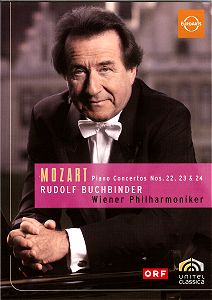

 Wiener Philharmoniker/Rudolf Buchbinder (piano, conductor)
  [90:46]