These
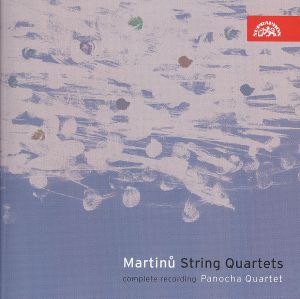
are recordings made by the Panocha between
1979 and 1982 and reissued now in a
three CD set. The Martinů quartets
are seldom presented as an integral
collection and one or two single
discs, which one might have hoped would
have progressed to include the full
seven quartets, seem to have stopped
in their tracks – the Emperor on BIS
and the Kocian on Praga for instance.
The biggest early problem
centres on a quartet’s corporate response
to the early 1918 quartet. On a rival
set the Stamitz [Brilliant Classics
6473] go for bulk and take it to
the forty-minute mark. The Panocha clip
four minutes off that timing and even
then it’s still an ungainly work. But
differences of detail are telling, above
matters of tempo. The Stamitz bring
greater mystery whilst the Panocha tends
to stress the sap, urgency and youthfulness
of the writing. The corollary is that
the Stamitz perhaps bring a greater
yearning and warmth to the music. This
though is not typical of the two quartet’s
approaches to the later works
The Stamitz were recorded
in a drier acoustic than that of the
Panocha and it doesn’t always flatter
their sonority. Both take No.2 well
though. The Stamitz establishes a more
tense and expectant feel, emphasising
those stabbing lines in the slow movement.
The Panocha tends to be more introverted
and less inclined to probe vertically.
In the finale the Stamitz sound outsize,
expanding almost to the sound of a chamber
orchestra – big, powerful playing.
The qualities of tone
and sonority are of course important;
so too matters of rhythmic emphases
in these of all quartets. So one finds
that in No.3 that the Panocha usurps
the Stamitz in matters of tensile grip.
They play with real bite whilst the
Stamitz are less immediate and more
recessive, partly as a result of the
recording quality it should be noted.
The Stamitz are gawkier than the Panocha
here, more ungainly tonally, and not
as focused either. Some may actually
respond well to this kind of playing
and it’s certainly vibrant in its own
way and it contrasts with the more cosmopolitan
sound of their rivals. I prefer the
Stamitz’s woozy suspensions in the slow
movement but admire the smoother sound
of the Panocha generally.
Things are even in
the Fourth. The Stamitz are faster in
the fast movements but slower in the
Adagio. The one thing that counts against
the Stamitz yet again is the blunting
of their corporate attacks by the recording
– a pity. The Fifth of 1938 inspires
both groups to valid differences. The
Panocha sings beautifully in the opening
Allegro ma non troppo
whilst true to form the Stamitz are
more abrupt and less ingratiating tonally.
The Panocha seems to want to emphasise
the Janáček-like turns of
the Adagio and their finale is
etched bigger than their compatriots
with a greater sense of keening. If
you prefer the more equable and gimlet
response of the Stamitz you will also
be rewarded.
The Sixth is the first
of his two post-War quartets. Here the
Stamitz prefer ruggedly expressive playing,
the Panocha a more withdrawn, more suave
viewpoint. The Stamitz enjoy the slow
movement’s shifting harmonies more than
the Panocha, or at least emphasise then
more richly. No.7 dates from 1947 and
marks the end of the quartet cycle.
True to form, and consonant with their
two cycles, we find the Stamitz generally
etching more strongly – they’re more
determined, more alive and quicker.
Not that the Panocha lacks rich qualities
here as well. I’m sure that many will
prefer their chaste refinement and the
elegance of their phrasing and tonal
cohesion to the more rough-hewn Stamitz.
You can follow a more
detailed review by me of the Stamitz
performances here.
They’re part of a Czech Masters
box with the seven Martinů quartets,
the Madrigals for Violin and Viola,
String Trio No. 2, both Janáček
quartets and the two by Smetana. It’s
a Brilliant Classics five CD box, at
bargain price.
My own preference would
be the Stamitz though I appreciate that
this complicates things given the nature
of their box set. The Panocha are splendidly
warm and elegant proponents and one
admires them. What I miss in some of
their performances, finally, is grit
and an element of rhythmic charge. I
do find those qualities in the Stamitz
so, in default of hearing the eponymous
Martinů
quartet performances on Naxos, it’s
to them that I would go.
Jonathan Woolf
























 for details
 Panocha String Quartet