The Lucerne Festival
Orchestra isn't any ordinary orchestra. It's an ensemble made
up of the finest players in Europe, many of them big names on
their own, but this is no rock star type line-up. What makes
an orchestra is the players’ ability to interact in ensemble.
Many of these musicians play together regularly at Lucerne but
not always in the same combination. The mixture seems to ignite
because the atmosphere, at Lucerne, is electric. These are players
who can achieve with chamber-like intimacy, yet understand their
role in the broad sweep of orchestral perspective. In Mahler's
own time, orchestral standards were not as high as they are
now, and the music relatively unfamiliar. Musicianship like
this shows just how visionary Mahler was, for players like these
are so technically assured that they can focus on the spirit
of the music. The more we know Mahler, the more, perhaps, we
can appreciate the intelligence and complexity in his music.
The joy of this
DVD is that we can watch the orchestra interact as they play.
We can see the body language, and the little flashes of unconscious
communication. Indeed, because the camera can close-up on Abbado's
face and hands, we can see more on film than we might in the
amphitheatre: it's more like being among the musicians, seeing
and hearing what they hear while they are in the process of
playing. It really does add to the experience when you can watch
the musicians as they play. You can see the string players’
individual fingering and understand how it affects the sound
they make. It's fascinating to watch how the wind-players move,
how their muscles and deftness of touch affect what they do.
Most of us get our music via recordings, so it's all too easy
to think of music in terms of technical values. Yet, without
musicians, there'd “be” no music. Music existed long before
recording. Films like this are an important reminder that it
is fundamentally a human and creative process.
The filming here
is musically informed. These cameramen know the music well,
so they know what to pick up on and when. It's almost as if
they are part of the process because they reveal telling details
within the whole. For example, there is a close-up of the triangle
being beaten. It's a humble instrument, easily lost in the mass,
but this film emphasises its significance in creating the “Alpine
motif”, for it extends the sounds of cowbells. It might even
evoke the ticking of a clock, a reasonable image, given the
possible meaning of this symphony. Mahler as orchestral colourist
knew what he was doing, and this film director understood. This
sort of musical sensitivity shows just how far the filming of
music has progressed over the years. This is a valuable recording
because it “is” filmed, and by people who know the music.
Freed of technical
limitations, Abbado can rely on the response of his players,
as artists, to achieve this interpretation. It's certainly different,
for what he emphasises is the lucidity in the score, without
exaggerating the excessive “emotionalism” that some performances
fall back on. This is not to say that Abbado isn't emotional
– far from it – but the quality of emotion is directed towards
a specific purpose. Abbado's Mahler recognises the advances
we've had in understanding Mahler over the last few years and
takes its cue from the score in that light. For Mahler awareness
of death enhanced his love of life. Abbado himself knows only
too well how the hammer-blows of fate can suddenly strike people
down, so, perhaps, like Mahler, the life-enhancing aspects of
the music mean all the more. From time to time, Abbado bursts
into beaming smiles, if only to acknowledge his appreciation
of what his players are doing. But make no mistake, these smiles
have been hard-won.
However, as Donald
Mitchell, in an essay reprinted in ‘Discovering Mahler’ (Boydell,
2007) says, “it is the Sixth alone among all Mahler's symphonies
and song-cycles in which death triumphs”. That's why I approached
this performance with some trepidation, although I love the transcendence
with which Abbado infuses the Second, Third and even the Ninth
Symphonies. The relative lack of grim fatalism is compensated
by some particularly vivid string playing where the “finger of
death” seems almost palpable. Horror doesn't “have” to be heavy-handed.
These icy strings are definitely chilling, almost shrill in their
intensity. The Lucerne hammer-blows may not knock you out of your
seat, but you don't need to be reminded, if you've been listening
to how Abbado has built up the tension. And as Mitchell also notes,
Mahler is “imagining” death, rather than building a case in its
favour, so Abbado's approach isn't out of line.
At the end of the
performance, the camera pans again over the audience, lingering
for a moment on two musicians who have been closely associated
with Abbado for many years, Daniel Harding and Thomas Quasthoff.
In the UK, much has been made of Harding's early years with Rattle,
but it is in fact Abbado with whom he has had the more important
relationship. The various orchestras Abbado has formed are extremely
important to him, and to his vision of musicianship. It is extremely
significant that since 1998, he's had Harding at the helm of his
Mahler Chamber Orchestra, which is intricately related to the
Lucerne Festival Orchestra in Abbado's own “system” of connected
orchestras. With conductors like Abbado and Boulez, I do believe
we are on the verge of a deeper understanding of Mahler's work.
Like all things new, it will take time before the impact is fully
absorbed, but it is important, I think, to appreciate that there
are many ways to approach Mahler, some of which we haven't even
started to comprehend.
I'll probably
go back to Abbado's audio recording of the Sixth with the Berlin
Philharmonic Orchestra for regular listening, but this film is
a very valuable contribution to ”how” we listen to Mahler. There
may be more striking performances, but this is special because
it is a film, and sheds a uniquely sensitive light on the musicianship
that makes music possible.
Anne Ozorio
























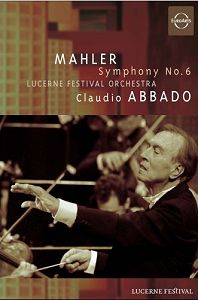

 Lucerne Festival
Orchestra/Claudio Abbado
Lucerne Festival
Orchestra/Claudio Abbado [89:00]