“A man is in reality worth only what
he is considered to be in the eyes of
God!” Liszt
One
immediately notices that this version
of Christus on MDG disappointingly
lacks English texts. This omission made
the score extremely difficult to follow
and detracted considerably from my enjoyment
and understanding of the score. If booklet
space was the issue I would have swapped
the rather workaday essay in favour
of a synopsis and an English translation
of the text. The rival account from
Helmuth Rilling on Brilliant Classics
is only a marginal improvement as it
contains a synopsis in English but only
Latin and German texts. I do not know
whether Helmuth Rilling’s release of
the same performance on Hänssler Classics
[footnote]
or Antal Dorati’s account on
Hungaroton contain English translations.
A helpful source of assistance in understanding
the proceedings of Christus is
Alan Walker’s biography of Liszt, volume
3 ‘The Final Years 1861-1886’.A
Liszt’s
first oratorio Saint Elizabeth (Legend
of Saint Elizabeth), S.2 was written
between 1857 and 1862. As early
as 1853 he was planning his second oratorio,
Christus; a work based
on the conventional scenario of Christ’s
life. A deeply religious man Liszt joined
the Franciscan order in 1865, receiving
the tonsure and four minor orders of
the Catholic priesthood. The Abbé Liszt
composed the massive fourteen movement
score to Christus between 1855
and 1867. Some of it was written at
the Madonna del Rosario monastery in
Rome. Alan Walker wrote that, “No
other composition cost him nearly so
much labour or was composed over such
a long period of time.”A
Musicologist Edward Dannreuther was
greatly impressed with Christus describing
the score as, “the largest and most
sustained of Liszt’s efforts, and the
magnum opus of his later years.”B
Various
parts of Christus had been performed
over a number of years; serving as previews
of the completed oratorio. For example
The Beatitudes was conducted
in 1859 at Weimar; Giovanni Sgambati
conducted Part 1, The Christmas Oratorio
in Rome in 1867 and Anton Rubinstein
conducted The Christmas Oratorio
in Vienna in 1871 with eminent support
from Anton Bruckner playing the organ.
After
the publication of Christus by
Julius Schuberth in 1872, Liszt took
the podium himself at the première with
reportedly three hundred performers.
It was given to a capacity audience
in the Protestant Herder Church in Weimar
in 1873. For this performance Liszt
made a number of extensive cuts. It
seems that the sum of the considerable
abridgements, some 800 measures, is
equal to the length of some of his symphonic
poems. A sensation was caused by the
attendance at the Weimar church of Richard
and Cosima Wagner; the occasion of Wagner’s
first public meeting with Liszt since
their well publicised breakdown in relations.
Steeped
in Roman Catholic devotional spirit
and liturgy the style of Christus
ranges from Gregorian plain-chant to
high Romantic orchestral colour. Although
regarded by some commentators as rather
inconsistent in quality one cannot doubt
the sincerity and forward-thinking of
the inspiration. Sadly the work suffered
from the forceful and enduring backlash
against things perceived as Germanic
and Victorian that prevailed in Britain
following the outbreak of the Great
War. This coupled with the general decline
in the choral tradition has meant that
Christus has virtually disappeared
from the repertoire.
A
performance of Christus can take
around three hours and requires massive
orchestral forces, including extra percussion,
harp and organ, with as many as six
vocal soloists and a large mixed chorus.
Aside from being part of an unfashionable
genre the economics and logistics of
the massive forces required are major
factors telling against performances.
Liszt
headed the score with the following
quotation from the Letter of St. Paul
to the Ephesians, Chapter 4.15:
Veritatem
autem facientes in caritate crescamus
in illo per omnia qui est caput Christus
(But speaking the truth in charity/love,
may we grow up into him in all things,
who is the head, the Christ).
Cast in three substantial parts the
score represents the main phases of
the life of Christ:
Part 1) Christmas Oratorio (Representing
Christ’s birth)
I. Introduction
II. The pastorale and annunciation of
the angels
III. Stabat Mater speciosa (The
beautiful Mother stood), hymn
IV. Song of the shepherds at the manger
V. The three holy kings, march
Part 2) After Epiphany (The principal
events in Christ’s life)
VI. The Beatitudes
VII. The Lord's prayer: Pater nosta
VIII. The foundation of the church
IX. The miracle
X. The entry into Jerusalem
Part 3) Passion and Resurrection (Devoted
to Christ’s passion and resurrection)
XI. Tristis est anima mea (Sorrowful
is my soul)
XII. Stabat Mater dolorosa (The
grieving Mother stood)
XIII. O filii et filiae (O, sons
and daughters), Easter hymn
XIV. Resurrexit! (He has risen!)
The
Introduction to Part 1 of the Christmas
Oratorio comprises two rather overlong
orchestral passages that are full of
simple and appealing melodies portraying
the Nativity. In the opening Andante
sostenuto we hear slow orchestral
music suffused with plainchant style.
Increasing in intensity the music seems
to represent the expectancy of Advent
developing towards the bright new dawn
associated with the coming of the Saviour.
The lengthy Allegretto moderato has
a predominance of woodwind which imparts
both a rustic character and a relaxing
chamber quality.
In the Pastorale and Annunciation of
the Angels the opening passage is superbly
sung by the soprano Franziska Hirzel
and from 3:25 (track 3, CD1) the tenor
Donald Kaasch communicates freshness
and sensitivity. I enjoyed the excellent
violin solo from point 7:20-8.29 that
concludes the section. The extended
hymn Stabat Mater speciosa (The
beautiful Mother stood) contains
music that grows dramatically. The organ
and percussion added to the splendid
Czech Philharmonic Choir Brno make colourful
accompaniment.
The
instrumental section Hirtengesang
an der Krippe (Song of the shepherds
at the manger) is dominated by reedy
woodwind, providing a convincing bucolic
feel that pervades the movement. From
1:38 (track 5, CD1) the strings take
centre-stage interspersed with woodwind
contributions. The lengthy instrumental
Quasi Andante, pastoral
section has a character comparable to
the preceding Hirtengesang and
is just as expertly performed by the
Bonn players.
In
the writing of Die heiligen drei
Könige (The three holy kings) a
march, Liszt was, according to Dannreuther,
inspired by the magnificence of Cologne
Cathedral.B There is a distinctly
Hungarian character to the march and
one notices the prominent role of the
woodwind. Marking a change of mood the
following Adagio sostenuto is
a moving slow movement for orchestra.
From 5:01 (track 8, CD1) one notices
the music growing in intensity and the
brass and percussion brings the first
part of Christus to an end on
a jubilant note.
In
Part 2, After Epiphany the opening movement
Die Seligpreisungen. Andante,
‘Beati Pauperes Spiritu’
is a marvellous creation known as the
Beatitudes. Baritone Ralf Lukas blends
beautifully with the celestial choir
and organ; stunning and affecting music.
The section closes with a convincingly
moving pianissimo. The Lord's
Prayer: Pater nosta, Andante
pietoso section for choir and organ,
another highlight, is interpreted with
a satisfying blend of reverence and
drama.
The
expressive and melodic nature of the
Foundation of the Church, Andante
maestoso assai for choir and orchestra
makes a significant impact here expertly
sung by the Brno choir. The Miracle,
marked Agitato comes across as
a convincing forward-looking evocation
of riding through the tempestuous waves
and violent winds; a great storm followed
by nervous calm. Part two of Christus
ends with the Entry into Jerusalem,
marked Allegro moderato. This
pageant-like, jubilant music develops
characteristically into a more serious
vein with the entry of impressive alto
Birgit Remmert at 4:51-7:12 (track 5,
CD2). A splendid and highly dramatic
choral and orchestral climax.
Part
3, the Passion and Resurrection opens
with the movement Tristis est anima
mea (Sorrowful is my soul). This
sevres as Liszt’s personal affirmation
of pain and anguish for Christ’s agony
in the Garden of Gethsemane. It is sympathetically
and devoutly put across by baritone
Ralf Lukas and the Bonn orchestra.
One
of the main highlights is the Stabat
Mater dolorosa (The grieving Mother
stood). It is described by Alan Walker
as, “monumental …Liszt was truly
inspired when he penned this movement,
which offers some of the best choral
writing to come out of the nineteenth
century.”A Lasting around forty-four minutes
this colossal episode is designed in
seven sections for the soloists, chorus
and orchestra and could easily serve
as a standalone score. Kofman delivers
a particularly magisterial reading of
the Fac me cruce custoridi section
(track 7, CD3).
Providing
a calming contrast after the Stabat
Mater dolorosa the short Easter
hymn O filii et filiae (O, sons
and daughters) is presented here by
female choir with harmonium accompaniment.
The movement is successfully communicated
as a pious prayer with the effect of
being heard in the distance. Christus
concludes with the movement Resurrexit!
(He has risen!). Kofman closes the score
with a massive brass-dominated triumphant
fugue - a device that Liszt only
rarely employed.
I
played this SACD recorded in an evidently
ecclesiastical acoustic on my standard
units. I found the sonics warm and well-balanced
but I would have welcomed a slightly
sharper clarity. There are a
handful of alternative recent recordings
of Christus. I can highly recommend
the version from choral specialist Helmuth
Rilling conducting the Gächinger Kantorei,
Stuttgart; Krakauer Kammerchor and the
Stuttgart Radio Symphony Orchestra.
Rilling’s carefully chosen quartet of
soloists are Henriette Bonde-Hansen
(soprano); Iris Vermillion (mezzo-soprano);
Michael Schade (tenor) and Andreas Schmidt
(bass). The digital recording was taken
down at the Beethovensaal Liederhalle,
Stuttgart in 1997 and has the advantage
over Kofman by virtue of a closer, brighter
and more vivid sound quality in addition
to an excellent balance. The Rilling
is available on a three disc set on
Brilliant Classics 99951 and the same
performance is also to be had on Hänssler
Classics 98121.
Another
recording of Christus, although
one that I am not too familiar with,
is from Antal Dorati and the Hungarian
State Orchestra with the Hungarian Radio
and Television Chorus. Dorati’s team
was: Sandor Solyom-Nagy (baritone);
Veronika Kincses (soprano); Klara Takacs
(mezzo-soprano); Janos B. Nagy (tenor)
and László Polgár (bass). The digital
recording from circa 1985 is on Hungaroton
HCD 12831-33. I am also aware of versions
from Miklós Forrai and the Hungarian
State Orchestra on Hungaroton HRC 184/5/6
and also from conductor James Conlon
with the Rotterdam Philharmonic Orchestra
on Warner
Apex 2564 61167-2 (also available
on Erato ECD 88231).
Liszt’s sacred choral legacy is well served
by splendid recordings of Christus
from Kofman and Rilling.
It is hard to separate these two superbly
performed versions. I will treasure
both sets but if I had to select only
one it would be that from Helmuth
Rilling.
Michael Cookson
AFranz Liszt (Volume 3),
‘The Final Years 1861-1886’ by
Alan Walker. Publisher: Cornell University
Press (1997) ISBN 0-8014-8453-7. Pg.
255, 263.
BOxford History of Music,
Vol. VI, ‘The Romantic Period’
by Edward Dannreuther. Publisher: Clarendon
Press, Oxford (1905). Pg. 209, 213.
Note:
As part of the International Music Score
Library Project, Wikipedia (the free
on-line encyclopedia) hold a detailed
and helpful ‘List of Compositions
by Franz Liszt’ that evidently contains
additions to Searle’s 1966 list made
by Sharon Winklhofer and Leslie Howard.
In two sections the list of Searle numbers
(S) run from S.1-S.350 and S.351-S.999.
Although not definitive a list on Wikipedia
proves to be valuable tool for Lisztians.
Footnote
We
have been informed by a reader that
the Haenssler recording offers full
text in English, German, French and
Spanish.
























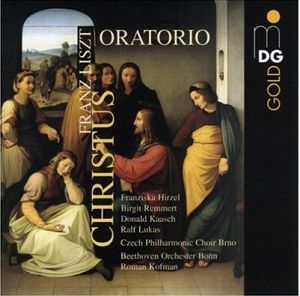

 Franziska Hirzel (soprano)