Russian music was
one of the specialities of Serge Koussevitzky. He is, perhaps,
less celebrated as a champion of British music. However, in the
interesting note accompanying this CD Robert Matthew-Walker points
out that the maestro led the American première of Walton’s Belshazzar’s
Feast in 1932 – I’ll bet that was exciting – and commissioned
both Peter Grimes and Spring Symphony from Benjamin
Britten. During his tenure of the Boston podium he conducted symphonies
by Bax and Vaughan Williams. Nonetheless, I was surprised to find
him leading RVW’s Fifth for, superficially, I’d have expected
him to be more attuned to the more volatile Fourth or Sixth.
However, on receiving
this CD for review I couldn’t help but play first Francesca
da Rimini. This is one of my favourite Tchaikovsky scores
and I’ve heard some notable recordings of it down the years, including
readings by Barbirolli and Stokowski. This urgent, incandescent
reading by Koussevitzky will become another personal favourite,
I’m sure, despite the inevitable sonic limitations. Koussevitzky
generates tremendous excitement in the turbulent outer sections
of the work. In between, the great central love melody has wonderful
sweep and passion. This is a virtuoso performance by a virtuoso
conductor and it’s thrilling. Unfortunately the sound is cut off
with an almost brutal abruptness after the last chord – something
which afflicts all the recordings on this disc. It comes as quite
a shock to have the ambience ended in this way. I wonder if this
is a feature of the original sources with which the Guild transfer
engineers had to work?
The Mussorgsky pieces
also fare very well in Koussevitzky’s hands. He generates demonic
energy in the first few minutes of A Night on the Bare Mountain.
The Boston heavy brass and percussion play with great power
and the high woodwinds screech away. In the visceral excitement
a few momentary imprecisions are of little consequence. After
the chimes of the dawn bell [7:06] there’s an uneasy calm about
the performance. The principal clarinet contributes a doleful
solo – I wonder if it’s the same player who made a notable showing
in the central section of Francesca? I should say that
surface noise is quite intrusive in the last few minutes of
this piece.
The Khovanshchina
Prelude is another success. Here Koussevitzky distils excellent
atmosphere and the BSO playing is highly concentrated, not least
in the fine oboe solo. The hushed ending, starting with a pianissimo
clarinet solo, is really well managed; it’s just a shame that
the Boston audience make such a bronchial contribution to the
proceedings.
But, since Russian
music was very much Koussevitzky’s métier, I suspect that
for many collectors the prime interest in this release will lie,
as it did for me, in the reading of the Vaughan Williams symphony.
This, we are told, is one of two performances of the work that
Koussevitzky gave in the 1946/7 season. One thing that it’s important
to note is that this performance was given within four years of
the first unveiling of the work in public so Koussevitzky’s reading
is, at best, lightly influenced by precedent. To me it felt very
idiomatic.
The first movement
has breadth but the music is also invested with the requisite
flow. Perhaps there isn’t quite the degree of gentle rubato, an
easing here and there, that we’ve become used to by hearing conductors
like Boult unfold the work but it still sounds pretty convincing
to me. The BSO strings sound radiant, even through the elderly
recording. When, in the passage between 4:45 and 6:20 in this
performance, the music becomes appreciably faster there’s admirable
urgency and tautness in the playing. The main climax (from 7:24)
is noble but, very rightly, Koussevitzky maintains forward impetus.
The gossamer lightness
that’s essential to a successful rendition of the scherzo is
splendidly realised here. The luminous string chords that usher
in the glorious slow movement are weighted to perfection. The
playing in this third movement is wonderful all round – the
wind soloists are particularly distinguished – not for nothing
is the BSO regarded as the aristocrat of American orchestras.
The climax of the movement, around 8:30 is majestic and then
the music ends as serenely as it began. Once again, I’m afraid,
the coughers in the audience do their best to distract us.
The finale is quite
fleet and there’s an urgency to the performance that I like very
much and find refreshing. I admire Koussevitzky’s approach to
this movement, which reminds us that even in his seventies RVW
and his music still possessed great vigour. Eventually, conductor
and orchestra give us a serene survey of the closing pages of
the symphony (from 5:40 and, even more, from 6:18). The strings
phrase generously and the very end of the work glows beautifully.
Overall this is a very convincing performance of the symphony.
I don’t know if it has circulated on unofficial labels in the
past but I’m only sorry that it’s taken sixty years for this reading
to become generally available.
Guild offer us here
an excellent collection of Koussevitzky performances. It’s no
surprise to find him in his element in Russian repertoire but
it’s marvellous to find him equally effective in a quintessentially
English score. The sound isn’t ideal but, given its age and that
these are not studio recordings, it’s perfectly adequate. The
excellence and excitement of these performances, which I presume
were all given in Symphony Hall, Boston come across very well.
This valuable collection gives us another reminder of how formidable
was the partnership between Serge Koussevitzky and the orchestra
he led with such distinction for a quarter of a century.
John Quinn
























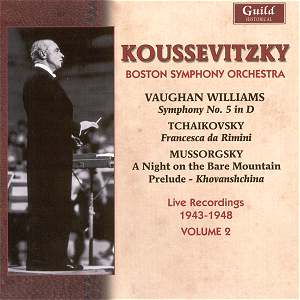

 Boston Symphony Orchestra/Serge
Koussevitzky
Boston Symphony Orchestra/Serge
Koussevitzky