Magdalena
Kožená has built up a varied and much-praised
discography over the last ten years.
I have personally encountered only one
of her discs, dedicated to Mozart, Gluck
and Mysliveček, which I
found warmly enjoyable. I seem not to
be alone in questioning whether she
is really a mezzo-soprano but there
appears to be general agreement about
her beauty of tone and refined interpretations.
My previous encounter did not prepare
me in any way for the present disc which
quite simply sent me reeling.
Not, perhaps, from
the word go. In the opening aria from
"Alcina" I admired once again
the golden limpidity of her timbre,
which I still found more soprano-like.
I also noted that she was using more
vibrato than is normal in "historically
informed practice" (henceforth
HIP). Later on in the disc, however,
I found that
Kožená can equally eschew vibrato altogether.
But
this was just the calm before the storm.
In Dejanira’s mad scene from “Hercules”,
Andrea Marcon’s period band kicks off
with a rasping, saw-like sound. Thereafter
Kožená ranges through a gamut of shrieks,
shouts, gasps and deep growls. Here
and in the "Orlando" excerpt,
Handel is wrenched into the world of
stark, expressionist music theatre.
It’s a phenomenal, gripping experience.
Hereafter,
Kožená finds a different vocal style
for each character. She shows
in Ariodante’s "Dopo notte"
that she can throw off fast coloratura
with pin-point accuracy, yet meaningfully.
The familiar "Lascia ch’io pianga"
which closes the recital is deliberately
given a more broken line than we normally
hear. It is strangely affecting. It
is fascinating, too, to hear extracts
from two of the English oratorios sounding
so utterly un-English. The well-known
"Oh! Had I Jubal’s lyre" presses
ahead urgently, the lament from "Theodora"
assumes almost Mahlerian grief. Again,
the word expressionist came to mind.
At
this point I would like to quote from
Kožená herself:
"In Baroque
music sometimes I can sing alto,
sometimes soprano; I love to use
the range of my voice to express
colour. If I sing ‘Oh! Had I Jubal’s
lyre’, it should be an angelic voice,
whereas for Orlando’s mad scene,
you can allow even slightly ugly
sounds, because that says something
about his state of mind". Such
is her passion for getting to the
heart of a character that
Kožená is prepared to take risks
that other singers might not attempt
– going deep into the chest voice,
for example. “… I can do the extremes,
the very low and very high notes,
but it’s not my natural range. So
you get a sound that may not be
so lovely yet says so much
more about the text … I personally
get bored after ten minutes of listening
to a singer who produces just a
beautiful sound!".
I would not describe
this as HIP singing – it is simply sui
generis. Yet it takes its inspiration
from HIP and I cannot imagine it working
with a smooth modern orchestra. The
Venice Baroque Orchestra make a very
positive contribution. I’ve already
pointed out their ugly rasps in the
mad scenes, but they also create moments
of breathtaking beauty, the wind soloists
producing an ethereal, disembodied sound
– the oboe obbligato in the "Agrippina"
aria, for instance.
Time was, we "knew"
that Handel wrote in long, flowing lines,
his personality dominated by his noble
simplicity and dignity of utterance.
For better or for worse, there’s not
a trace of that here. What there is
instead is utterly convincing and compelling.
I would need a few days’ rest before
I could take older performances on their
own terms. I tried, in fact, putting
on the version of the "Orlando"
scene by
James Bowman and Christopher Hogwood.
It sounded bland and after a while I
had to take it off. And yet these were
trend-setters in their day! Compared
with Kožená and company they sound like
cleaned-up Sir Malcolm Sargent.
Perhaps
Kožená will revolutionize Handel
interpretation. She certainly seems
to have revolutionized her own interpretation
to date in so far as I know it. My only
concern is that I wouldn’t like to hear
this manner adopted by someone who did
it badly. And I should think it would
be an excellent way to ruin your voice
in six weeks if you don’t know exactly
what you’re doing, as Kožená
clearly does.
The booklet gives full
texts with translations into English
(where not the original language), French
and German. The interview which I quote
from above is not included as such but
the introductory essay by Nick Kimberley
reports its most revealing passages.
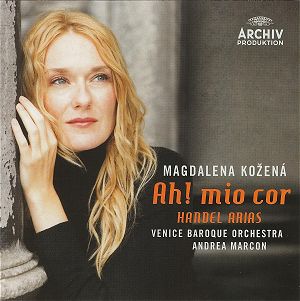
Those following the singer's much commented
photographic image should not be disappointed
by the latest examples in which, cover
excepted, her "golden" image
is cunningly exploited in black and
white. Oh, and I nearly forgot: the
recording has magnificent presence.
So clear away preconceptions
and be prepared for one of the most
extraordinary vocal displays to have
been issued in recent years.
Christopher Howell

























 Magdalena Kožená (mezzo)