Bruckner’s masses
date from the mid-1860s, the period when he had just finished
his seven-year period of study with Simon Sechter. The symphonies
nos. 0 and 1 also date from this period. Bruckner had not yet
developed his feel for the development of large-scale forms.
He had only just begun to discover Wagner and his models were
still essentially classical.
Of the three masses,
those in D minor and F minor are very much based on the classical
models of Haydn and Mozart. But in the Mass in E minor, Bruckner
experimented with new textures and new ideas. The mass is written
for choir and wind band, rather than full orchestra, and in
construction it looks both backward and forward. The mass is
heavily indebted to Bruckner’s studies of Palestrina and even
quotes from Palestrina's Missa Brevis. But the long suspensions,
floating harmony and clear sense of space look forward to Bruckner’s
larger-scale symphonies.
The choir is not
strictly accompanied by the wind band. Bruckner brings the instruments
in and out of the textures quite often leaving the singers unsupported.
In many ways his use of accompaniment is reminiscent of Liszt’s
motets and Missa Choralis, where the organ is used with
a similar sense of flexibility.
Sometimes the instruments
support the singers and sometimes they comment on what is happening.
In many ways, Bruckner uses the wind band rather like a second
choir.
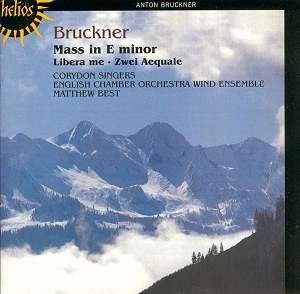
This recording of
the E minor Mass has been in the catalogue for over twenty years.
It has now been re-issued by Hyperion on their budget-priced
Helios label – a repackaging which is very useful given that
the original CD was rather short at 53 minutes running time.
Matthew Best and
his choir give one of the finest performances off the mass on
disc. There is no doubt that the Corydon Singers give a finely
crafted and expressive performance, beautifully shaping Bruckner’s
lines and fearlessly handling the trickier aspects of the vocal
writing. If you do not possess a copy of this mass, then this
disc is the one for you.
But, listening to
the recording again I became aware that the performance is not
quite perfect. There are one or two little slips which don’t
really matter at all. More importantly, there is the issue of
the size of the choir. This is a performance by a chamber choir
and given the work’s instrumental forces, this is perfectly
possible. The gains, in terms of flexibility and unanimity of
purpose, are very great; thanks to the finely honed nature of
the choir. Best can shapes the music in a quite beautiful manner.
But as I listened
I was aware that there were occasions when the choir sounded
stretched. This came at points where Bruckner’s music would
have responded to the greater amplitude of tone that a larger
group could give. Of course, working with a larger choral group
would mean that the conductor would not necessarily have the
amount of control that Best has on this disc.
Another issue is
the very English tone of the choir. This applies both to their
style of singing and to their diction. The sound-world is very
much English choral and beautiful though this is, it might not
be what you want in a Bruckner mass. Also the choir sing the
Latin in standard English/Italianate Latin whereas I would have
thought that Germanic pronunciation might have been a little
more appropriate.
The mass is accompanied
by a nice sequence of the two Aequalis for trombones
and the motet, Libera me, for choir, trombones, cello,
double bass and organ. By placing the motet between the two
Aequalis, Best gives these short pieces the weight they
lack on their own and also sets the lovely motet off quite beautifully.
These are fine performances
which have stood the test of time. Perhaps not quite blemish
free, but pretty near perfect given the taxing nature of Bruckner’s
writing.
Robert Hugill