Editorial Board
MusicWeb International
Founding Editor Rob Barnett Editor in Chief
John Quinn Contributing Editor Ralph Moore Webmaster
David Barker Postmaster
Jonathan Woolf MusicWeb Founder Len Mullenger
Havergal BRIAN (1876-1972)
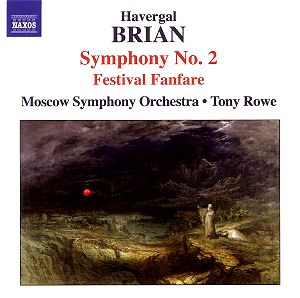
Symphony No. 2 in E minor (1930-31) [53:28] Festival Fanfare (1967) [1:44] Moscow Symphony
Orchestra/Tony Rowe. DDD
rec. Mosfilm Studio, Moscow, May 1996 NAXOS 8.570506 [55:12]
After
welcoming Brian's Fourth Symphony recently (8.570308 - see
review), it is a pleasure to report on a further reissue of the
music of this important composer. Originally on Marco Polo 8.223790,
this Second Symphony becomes a must-buy at the cheaper price
tag.
We
begin, though, with the 1967 Festival
Fanfare, Brian’s
one brass-only work. It is one of the last works we know
of by the composer. Its argument is terse but confident.
The performance here mirrors this confidence.
The
earlier Second Symphony (1930/31) is scored for typically
huge orchestra, including two pianos, three sets of timpani,
organ and 16 horns - although strangely only eight are used
in the present recording. Although in four movements, Naxos
has allocated several track points to each movement, a real
help when interacting with Malcom MacDonald's superb notes.
Inspired
by Goethe, specifically the early drama, Götz von
Berlichingen, each movement allegedly concerns
a specific character trait of Götz: the first,
resolution; the second, domestic piety; the third, battle;
the fourth, death. Textures are often complex but never blurred.
Some
of the playing leaves a little to be desired, but Brian's
demands are harsh, after all. The mysterious foreboding of
the symphony’s opening leads to some strained playing from
the strings but
there is no denying that the atmosphere is there.
There are contrasts in this first movement, but they have
to be heard in context; thus the second subject, whilst suave
and delicate, never really gives any true balm or hope. Brian’s
inspiration takes flight in the Andante sostenuto e molto
espressivo second movement, where there is a lovely use
of solo violin, although the soloist seems rather recessed
in the overall sound picture.
By far the briefest
movement, the Scherzo only lasts around six minutes. The horns
come into their own here, with antiphonal calls chasing each
other over string poundings. MacDonald is absolutely correct
to identify the Wagnerian elements in the finale: “Siegfried’s
Funeral March” from Götterdämmerung. Brian plans the music
so it moves towards a massive climax that is cruelly cut short,
to be followed by some stunningly beautiful harmonies in the
lower strings. The haunting end leaves one in a sort of stunned
reverie.
I keep on asking
myself is there no end to Brian's invention? We are privileged
to be able to hear these scores at all, and it is good that
the Moscow Orchestra gives its all for the Brianesque cause.
We need much more of the same ...
Colin Clarke

























 Moscow Symphony
Orchestra/Tony Rowe. DDD
Moscow Symphony
Orchestra/Tony Rowe. DDD