Editorial Board
MusicWeb International
Founding Editor Rob Barnett Editor in Chief
John Quinn Contributing Editor Ralph Moore Webmaster
David Barker Postmaster
Jonathan Woolf MusicWeb Founder Len Mullenger
Havergal BRIAN (1876-1972)
Symphony No. 4, 'Das Siegeslied' (1932-33) [49:49]
Symphony No. 12 (1957) [11:08] Jana
Valásová (soprano); Slovak Philharmonic
Choir; Slovak National Opera Chorus; Echo
Youth Choir; Cantus Mixed Choir; Czech
Philharmonic Choir (4), Brno
Slovak Radio Symphony Orchestra/Adrian Leaper.
rec. Slovak Radio, Bratislava, 3-8 February 1992 (4); 10 February
1992 (12). DDD NAXOS 8.570308 [60:57]
I have always been
fascinated by the music of Havergal Brian. I remember with
affection the Charles Groves/RLPO recordings on LP, now available
as part of an EMI
twofer (5757822). I am more partial to this music than
is my colleague Michael Cookson in his review.
The EMI set contains symphonies Nos. 7-9 and 31, plus the Comedy
Overture, The Tinker's Wedding. The present release,
too, is a reissue as it originally appeared on Marco Polo 8.223447.
The Fourth Symphony is
one of Brian's works that tends towards the gargantuan; his Gothic Symphony
is the most famous example of this from his pen. For this Symphony,
Brian chooses to set the 68th Psalm, and he sets
it in German. The text thereof is rather complex in that it
includes passages of darkness, violence and doom … all the
ingredients for a varied musical ride, then! The fate of unbelievers
in the Almighty is not a pleasant one in this particular vision.
Here, the 'rebellious dwell in a dry Land' and 'the wicked
perish at the presence of the Lord'; not much sweet Jesus forgiveness
around here, then. Moreover, 'God shall wound the head of his
enemies' and 'their feet will be dipped in the blood of thine
enemies, and the tongue of thy dogs in the same' (track 10).
Like Beethoven and, especially, Brahms, Brian was not of the
received wisdom school of religiosity but sought instead to
find a spirituality of his own.
The orchestra includes
basset-clarinets, alto flute, two oboi d'amore, bass oboe,
pedal clarinet, to name but a few, all in addition to the several
choruses! Brian is a master orchestrator, though, and deploys
his forces with the skill of a Mahler. The first movement,
marked Maestoso, actually begins in the style of a hugely-orchestrated
military march before the chorus opens with its announcement,
'Ein Psalmslied Davids, vorzusingen' ('To the Chief Musician – A
Psalm of David'). True, the orchestral strings sound a little
stretched at first and the recording seems a tad congested
- believe me, you need all the clarity you can get here! -
but neither aspect is overly disruptive. In fact, one might
argue - somewhat tenuously! - that the shortcomings actually
help the words of the second stanza, 'As smoke is driven away' … The
choruses sings superbly at the dynamically contrasting (quiet)
'Du gabst, O Gott, einen gnädigen Regen' ('Thou, O God, didst
send a plentiful rain'). It’s a shame that their words are
garbled at the faster following lines, 'Der Herr gab das Wort'
('The Lord gave the word'). Indeed, track 4 seems rather scrambled
and unsure of itself throughout its brief duration. Better
is the uncredited placatory solo violin at track 5 that ushers
in the solo soprano and subsequently duets with her. Vlasková is
adequate rather than radiant here.
Interestingly,
Brian opts to paint the Chariots of God with high dissonance
- using his edgiest harmonies so far - before composing a graphic
and near-mechanistic depiction of their arrival. An imposing
organ introduces the words of the Lord: the rather revolting
tongues of dogs passage quoted above.
Towards the end,
there is a little more of the crowding to the recording noticed
earlier (tr. 11). But, to compensate, there is a moment of
pure silken magic at 'Die Fürsten von Ägypten werden kommen'
('The Princes shall come out from Egypt').
The Twelfth Symphony,
on the surface, could hardly be more different. It lasts just
over ten minutes, and is in five sections. The Introduction
is gorgeously light-of-foot and yet mysterious, leading to
a contrapuntal Allegro maestoso. Most impressive here is the
transition to the A Tempo Marcia Lento. MacDonald's description
of 'a shadow falls across the music' is very apt. The Funeral
March has an internal momentum - Brian says a lot in a short
space of time here – that leads into the string-based, placatory
Adagio espressivo. Well performed - each note 'placed' - brass
fanfares lead into the brief finale, full of jagged themes
that give the rather bizarre effect of a danse macabre trying
desperately to find some joie de vivre!. The work's final gesture
is a masterstroke … and I won't spoil it for you.
Detailed and perceptive booklet notes from
Malcolm MacDonald complete an important release. A companion
Naxos disc, comprising the Violin Concerto and the Jolly
Miller Overture (8.557775),
makes for similarly stimulating listening. The famous Gothic
Symphony is on 8.557418/19.
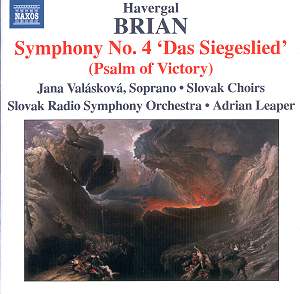
The use of Charles Mottram's painting, The
Great Day of His Wrath on the front cover seems remarkably
apposite to the disc's contents. An intensely valuable disc.
Colin Clarke British Composers on Naxos page
Reviews
from previous months Join the mailing list and receive a hyperlinked weekly update on the
discs reviewed. details We welcome feedback on our reviews. Please use the Bulletin
Board
Please paste in the first line of your comments the URL of the review to
which you refer.













 Jana
Valásová (soprano); Slovak Philharmonic
Choir; Slovak National Opera Chorus; Echo
Youth Choir; Cantus Mixed Choir; Czech
Philharmonic Choir (4), Brno
Slovak Radio Symphony Orchestra/Adrian Leaper.
Jana
Valásová (soprano); Slovak Philharmonic
Choir; Slovak National Opera Chorus; Echo
Youth Choir; Cantus Mixed Choir; Czech
Philharmonic Choir (4), Brno
Slovak Radio Symphony Orchestra/Adrian Leaper.