Editorial Board
MusicWeb International
Founding Editor Rob Barnett Editor in Chief
John Quinn Contributing Editor Ralph Moore Webmaster
David Barker Postmaster
Jonathan Woolf MusicWeb Founder Len Mullenger
Sawallisch was born
in Munich in 1923. Attending a performance of Humperdinck's Hansel
and Gretel at the age of 11 determined him on a life
of music-making. He served in the Wehrmacht 1942-46 and was
taken prisoner in Italy. His progress as music director took
him from Augsburg to Salzburg, Aachen, Wiesbaden, Köln, Vienna
(with the Symphony, not the Phil) and Brahms' 'own' Hamburg.
He also established a strong connection with Philadelphia
although towards the end of his time there in 2003 ill health
made his concerts increasingly rare.
Reticent and unflamboyant
Sawallisch has never relished or courted for himself the
dazzle and glamour of a Bernstein, a Karajan or a Stokowski.
His virtues are bound up with his fidelity to the score;
more of a Boult then. He conducts without the score in front
of him. His reflexes are good and there is electricity in
his control of pacing. More than many he also impresses with
his careful attention to harmony as the wind playing at the
start of the finales of the First and Second Symphonies pays
warm testimony.
The Third - a particular
favourite of mine - is relaxed and I did not find it as strong
as I was hoping especially in the first movement. The third
and fourth movements are fluent and gracious. Overall, deliberation
is too much in the ascendant here. This does not dislodge
my reference version - Walter and the CBS Symphony - though
the EMI sound is much more civilised.
The snappier episodes
in the Haydn Variations are rattled through with virility
and at a speed that prompts surprising parallel-drawing with
Mendelssohn and even Berlioz. The attack at the start of
the Tragic Overture is gripping and Sawallisch brings
out the same darker shadows we also experience in Dvořák's
Seventh Symphony - he has recorded the later Dvořáks
for Philips. At other points, as in the great yelping cry
of the violins in the peroration to the finale of the First
Symphony, Sawallisch turns away from piercing intensity.
The brass are made
very pleasingly 'present' by the EMI engineers even when
not centre-stage and this facet can be heard again in the
finale of the Third Symphony which grasps splendour more
than once. It is also immanent in the Fourth which scorches
along exactly as it should. In the finale it is brassily
Gothic - autumnally spacious without dawdling.
I am not sure what
has happened to these recordings for they appear to have
had little in the way of a first issue life. They re-emerged
as part of a much bigger Brahms-Sawallisch EMI box and later
in a bargain basement box from Brilliant Classics. Perhaps
their shelf life will now be as long as Sawallisch’s never-out-of-the-catalogue
EMI set of Schumann symphonies with the Dresden Staatskapelle.
Sawallisch emerges
from this set undemonstrative but with honours high.
Rob Barnett
Please support our advertisers below by clicking on the logos for further information.
























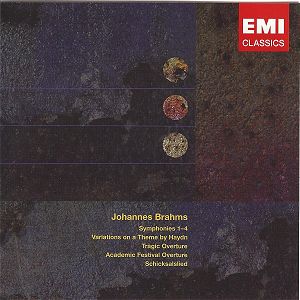

 London Philharmonic Orchestra/Wolfgang
Sawallisch
London Philharmonic Orchestra/Wolfgang
Sawallisch