MusicWeb is not a subscription site and it is these advertisers that pay for it. Please visit their sites regularly to see if anything might interest you. Purchasing from them keeps MusicWeb free.

Classical Editor: Rob Barnett                               Founder Len Mullenger


CD REVIEW


Online Count. There are currently : visitors. What this means.
Site Map

More Reviews

How to find a review

Classical CD Review Archive

Book Reviews

Film Music Reviews

Jazz CD Reviews

Nostalgia

Comment

Norman Lebrecht Weekly

Arthur Butterworth Writes

Phil Scowcroft's Garlands

Classical blogs

Reviewers Logs

Announcements

Don't Go Here!

Community

Bulletin Board

Web Ring

Reviewers

Helpers invited!

Resources

Quiz

British Composers

British Light Music Composers

Other composers

Indexes
   Label
   Masterwork

Discographies

On-line Music
[Download sites]

Themed Review pages

Our Classic Classics

Online books
MWI Classical
     Encyclopaedia

Gilder Dictionary of
     Composers

MWI Pop
     Encyclopedia

Other Complete Books

Programme Notes


British Music Society
Performers
The BBC Proms
Musical WWW pages
Classical Music Online

Recording Companies and Retailers
Agents and Marketing
Publishers
Non-Classical Web pages
Orchestra Web Sites
Newsgroups
Web News sites etc


Editorial Board
Classical Editor
   
Rob Barnett
Seen & Heard
Editor and Webmaster
   Bill Kenny
MusicWeb Webmaster
   Len Mullenger
Assistant Webmasters
   Patrick Waller
   David Barker

PotPourri
A pot-pourri of articles

MW Listening Room
MW Office
Helping MusicWeb
Advice to Windows Vista users  
Questionnaire    
Site History  
What they say about us
What we say about us!
Where to get help on the Internet
CD orders By Special Request
Graphics archive
Currency Converter
Dictionary
Magazines
Newsfeed  
Web Ring
Translation Service

Rules for potential reviewers :-)
Do Not Go Here!
April Fools

Would you like a hyperlinked weekly summary of the CDs we have reviewed?
Click for further details

Sample: See what you will get

alternatively AmazonUK   AmazonUS


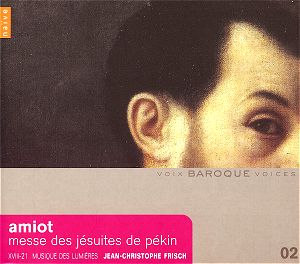
Charles D'AMBLEVILLE (late 16th century–1637)
Mass (transc. Joseph-Marie AMIOT (1718–1793)
Actiones nostras; Acte d'humilite; Prelude "Pin, bamboo, prunus"; Aspersion de l'eau; Elevation de l'hostie; Elevation du calice; Salve Regina; L'ois qui se pose; Sanctissima; Pater; Communion; Prière à Jésus-Christ; Prière au Saint Sacrement; Prière après l'Office; Ave Maria
Simon BOYLEAU (1544-1586) Per la Nativita della Beata Vergine
Teodorico PEDRINI (1641-1746) Sonata XII (adagio and pastorale)
Francois Picard (orgue a bouche sheng, flute vertical ziao, hautbois guanzi)
Ensemble Meihua Fleur de Prunus
Choeur du Centre Catholique Chinois de Paris
XVIII-21 Musique des Lumières/Jean-Christophe Frisch (flute, clavecin)
rec. Temple Bon Secours, Paris, June 1998, originally issued on Auvidis Astrée
NAIVE E8910 [79.25]


The Jesuits arrived in Peking in 1589. Surprisingly quite a lot is known about the form of services and music used during the 17th and 18th centuries at the Jesuit mission. Like many of the Catholic Church's foreign missions, an attempt was made to include music using the words and musical styles of the local population. 

In 1779 Father Joseph-Marie Amiot sent four books of manuscript music to the French King's Librarian. Amiot had probably had the books written by a Chinese scholar. The music is notated twice, once in Western musical notation and the other in Chinese. The first three books contain pieces written for the entertainment of the Manchu court but the fourth book comprises thirteen canticles set to Chinese music. Amiot wrote that these prayers were sung by the Neophytes during the office on days of great solemnity. 

It is these canticles which form the back-bone of this reconstruction of a Jesuit mass from Peking. The mass setting used is by the Jesuit Charles d'Ambleville, taken from a pair of substantial books published in the 17th century. These contained all the psalms, hymns and antiphons required by the liturgy and each finished with a mass. The music is relatively straightforward, much of it suitable for amateurs. Probably the Jesuits financed the publication so that the music could be used in their Missions.

The Chinese music of these canticles is reminiscent of Kungqu classical opera and so the performers have used this as the inspiration for the instrumentation on the disc. The canticles are sung in Chinese with some of the Latin words transcribed. 

The performance on this disc is based around the ensemble XVII-21 Musique des Lumières directed by Jean-Christophe Frisch. The ensemble includes four singers: Bruno Boterf (tenor), Pierre Sciama (counter-tenor), Christophe Einhorn (tenor), Philippe Cantor (baritone) all of whom sing in the Latin pieces on the disc. 

The Chinese pieces are sung by the choir of the Chinese Catholic Centre in Paris and accompanied by the Ensemble Meihua Fleur de Prunus. The result is convincing and fascinating as it mixes Western and Eastern styles and orchestrations. The Western music is attractive but not overly complex and, having no really strong personality of its own, works well as a foil for the Chinese music. 

Listening to the performances I was aware that in the Chinese sections the choir sounds a little underpowered with the balance favouring the instruments. This may be deliberate but I would have preferred the voices to predominate. At times the high voices from the Chinese choir sound a little weak and I wished that a stronger group of performers could have been found. 

The performance of the mass and the Latin motets is idiomatic and well presented; the four male voices have strong personalities and sometimes individual voices can dominate, but the results are always musical. 

The overall effect of this disc is fascinating. It reveals to us the extent to which the Catholic Missions would incorporate the music of the local population in a bid to getting them involved. This also entailed much liturgy and music in the vernacular at a time when this would have been frowned upon in Europe. 

The disc is not strictly a mass reconstruction, but intersperses Chinese canticles within the structure of the sung ordinary of the mass. A pair of sonatas by the Lazarist missionary Teodorico Pedrini are also included as surviving written sources talk about instrumental sonatas being played during the services. 

The CD booklet contains excellent articles on the music performed and the performance decisions made by the ensembles. There are no sung texts. 

This disc is not perfect, but it mixes scholarship with charm and intelligence in a way which illuminates a forgotten corner of Sino-European musical cross-fertilization. 

Robert Hugill 



Advertising Rates
Visitor stats
MusicWeb International
has over 21,000 Classical CD reviews on offer


Gerard Hoffnung Concerts &
The Bricklayer Story

Naxos Classical 

Australian Eloquence CDs on Buywell.com


New Releases

Hyperion
New Releases


Guild Music


23rd-27th May


MusicWeb sells the Polish
catalogue CDAccord
£10.50 post free W-W


MusicWeb sells the
Arcodiva catalogue
£12.00 post free W-W


Price Reduction: £11.75
post-free


Bull Horn
Price comparison Website


MusicWeb can now offer you discs from the following catalogues:
Prices include postage

[Acte Préalable £13.50]
[Arcodiva £12.00]
[Ashgate Music Books]
[Avie from £6.25]
[British Music Society £13.49]
[CDACCORD from £10.50 ]
[Hortus £14.99 ]
[Lyrita ONLY £11.75 ]
[Onyx £12.00
]
[REDCLIFFE £11 ]
[Tactus £11.50 ]
[Talent from £12.00 ]
[Toccata Classics £12.50 ]

MusicWeb Recommended Recordings 2007

DISCS OF THE YEAR 2007


Return to Review Index


Reviews from previous months
Join the mailing list and receive a hyperlinked weekly update on the discs reviewed. details
We welcome feedback on our reviews. Please use the Bulletin Board.  Please paste in the first line of your comments the URL of the review to which you refer..


You can purchase CDs and Save around 22% with these retailers: