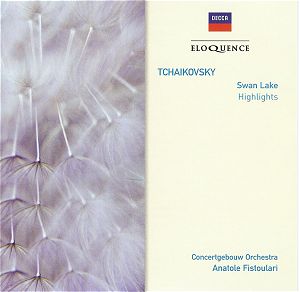
Fistoulari’s Decca
mono recording of "Swan Lake"
(1952) was a mainstay of the early LP
catalogue and continued to do yeoman’s
service during the 1960s on the Ace
of Clubs label. It was on two LPs and
announced as "complete", though
this claim was soon dropped. Apparently
it played the score used at Covent Garden
in those days, about half-an-hour short
by modern standards.
With the advent of
stereo Decca came out with a new almost-complete
2-disc version under Ansermet. It seems
that Fistoulari’s return to the score
was virtually an accident. The sessions
for Solti’s Mahler 4 had gone so well,
according to an Internet source, that
there were two sessions to spare. So
Fistoulari was rustled up for this single-disc
selection. About a decade later he returned
to the work with the Netherlands Radio
Orchestra on Decca Phase Four. This
was again "complete", though
I don’t know which "complete"
score was used.
Those content to have
just one LP of Swan Lake highlights
in 1962 would have had to make up their
minds between this and the recent (1958)
HMV selection with the Philharmonia
under Efrem Kurtz. For better or for
worse I chose the latter in its Classics
for Pleasure reincarnation, and found
it amiable rather than inspired. Kurtz
and Fistoulari were both noted ballet
conductors so one might expect to find
them much of a muchness.
This proves not to
be so. In each of the movements they
have in common – not all that many –
Fistoulari, with a slight tweak of the
tempo faster or slower, with sharper
articulation, more detailed phrasing
and greater appreciation of the orchestral
colour, brings the music into focus.
You feel that he is challenging and
stretching the orchestra to the brink
while Kurtz just lets them play. Not
to beat about the bush, this is the
sort of utterly Russian Tchaikovsky
playing, passionate and tense but not
hysterical, lush but not indulgent,
rhythmical but not rigid, which we expect
from the likes of Mravinsky or Kondrashin.
The Concertgebouw are in fantastic form
and the recording is amazingly fine,
while the Kurtz comes more into the
"excellent for the date" category.
Though to be fair, I’m listening to
the Kurtz on LP not CD. Whatever the
ultimate judgement on Fistoulari as
a conductor, here he made a great disc.
Those who chose Kurtz
were probably tempted by the presence
of Yehudi Menuhin, who played the violin
solos. He was still at his best in those
years and his playing has a vocal, intensely
human quality, while he is unruffled
by the "Russian Dance". For
this, at least, I am still glad to have
the Kurtz to hand. Fistoulari has the
orchestra’s leader, Steven Staryk. He
is excellent but without the sort of
personality that makes him stand out
from the rest of the performances. Soloists
with big personalities do tend to spread
themselves, however. I daresay the more
elegant, balletic feel to these movements
in the Amsterdam version is the way
Fistoulari wanted it.
Funnily enough, the
only time I actually saw Fistoulari
conduct, Steven Staryk was again the
soloist. I was barely a teenager and
it was one of the occasional visits
the RPO made to the Leas Cliff Hall,
Folkestone, usually with "second-stream"
conductors and soloists. After a distinguished
career as orchestral leader – the Concertgebouw
was preceded by Beecham’s RPO and Reiner’s
Chicago SO – Steven Staryk decided to
go solo. It didn’t work out. No one
denied him the technique but he evidently
lacked a solo personality. As I recall,
he made a disc of Wienawski for a mid-price
HMV label, played a bit out-of-town
and then disappeared. If I remember
the Folkestone concert at all it’s because
of the way he started – he was doing
the Mendelssohn. As readers will know,
the orchestra has a mere few seconds
to set the atmosphere before the violin
comes in. Most soloists have the instrument
under their chin and are nervously fingering
the neck of the violin even before the
conductor raises his baton. Instead,
Staryk had his violin in a "resting"
position with a far-away expression
– I was sitting very near the front
– just as if there was a whole long
orchestral exposition before he had
to do anything. Fistoulari gave him
a rather puzzled look. Staryk gave a
little nod to confirm he was ready,
Fistoulari gave him another puzzled
look then turned his back on him entirely
as though to say "well, if that’s
how he wants it … " and started
the orchestra. At the very last minute
Staryk whipped his violin into position,
chin and bow making simultaneous contact
with it. A nice bit of showmanship and
the only thing I remember from the performance.
I do remember that
Fistoulari’s baton seemed more concerned
with rhythm than expression – though
expression emerged – and at climaxes
he appeared to be mouthing the rhythm
at the brass. I was bowled over by his
Brahms 1, but as it was the first time
I heard it I daresay any middling-to-decent
performance would have bowled me over.
I thought some of it sounded rather
Russian. In so far as my youthful memories
have any value, I may have been responding
to his way of stretching the orchestra
to the brink at climaxes, as noted above.
Anatole Fistoulari
(1907-1995) initially had a highly promising
career. The son of a conductor, he is
said to have conducted the "Pathétique"
in public himself at the age of seven.
Like so many Russians without Socialist
leanings, his family made for Paris
after the Revolution. Fistoulari attracted
the attention of Chaliapin as a conductor
who could actually keep with his rhythmic
vagaries and became conductor of the
Grande Opéra Russe (1933). He
started working with the Ballets Russe
in 1938 and this led to tours on both
sides of the Atlantic. In 1943 he came
to England to take up the conductorship
of the London Philharmonic Orchestra.
In England he also met Mahler’s daughter
Anna and quickly became her fourth husband
(out of five). Their marriage lasted
a few years, which was good going by
Anna Mahler’s standards, and produced
a daughter. He later married a Scottish
violinist, Elisabeth Lockhart.
Thus far his career
had been on the up-and-up, but the LPO
appointment was not a success. Crazily,
he was contracted to do 120 concerts
in a single year. His symphonic repertoire
was not broadly-based enough to provide
so much music and he allegedly resorted
to swotting up the scores by practicing
his gestures in front of a mirror while
another conductor’s gramophone record
was playing. Orchestras know in an instant
if the conductor has only a superficial
knowledge of the score and no excuses
are accepted – not even the fact that
they had imposed such a ridiculous schedule
on him themselves in the first place.
His contract was not renewed and the
orchestra’s jubilee programme in 1982
even omitted his name from the "complete"
list of their principal conductors.
In 1956 Sir Adrian Boult had been kinder,
choosing Fistoulari and George Hurst
to share the conducting of the LPO’s
Russian tour.
After the LPO debacle
Fistoulari struggled along for a time
with a "London International Orchestra"
– a pick-up professional band managed
by John Amis, to whose "Independent"
obituary I owe most of what I am now
writing. He remained in England for
the rest of his life but had no further
permanent appointments. He was, however,
appreciated as a ballet conductor –
his tempi were apparently infallibly
danceable – and international soloists
were happy to have him on the rostrum
on account of his ability to follow
the most wayward rubato. He is remembered
on disc, in fact, for his recordings
of ballet music, particularly for Decca
and Mercury, and for collaborations
with such artists as Curzon, Milstein
and Ashkenazy.
I can’t find when he
retired from conducting but his name
gradually faded away and he suffered
from severe arthritis in his last years.
Christopher Howell
























 Steven Staryk (violin); Tibor de Machula
(violoncello)
Steven Staryk (violin); Tibor de Machula
(violoncello)