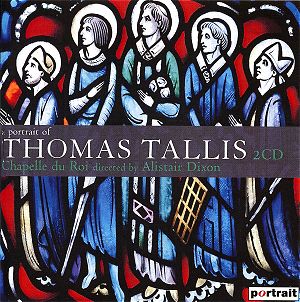
The provenance of this
2-CD set guarantees its quality: licensed by a division of Regis
from Signum’s excellent 9-CD survey of Tallis’s music.
CD1 opens with two of the
Marian antiphons from SIGCD001, music composed in the early
part of Tallis’s long career. These antiphons would have been
sung at the end of Compline, the forerunners of the Anthem at
the end of Evensong in the Anglican rite, though their Mariolatry
did not, of course, survive the Reformation. At this stage
Tallis was the largely unknown organist of Dover Priory and
later director of a choir in Billingsgate, London. His move
to the Augustinian abbey at Waltham Cross was especially inauspicious:
he had hardly arrived there before it was closed in the Dissolution.
The music is attractive enough – very much in the manner of
that of his contemporaries, though no match for what Taverner
and Sheppard were producing – so there is not too much lost
by having only two pieces from this first Signum CD.
The next four pieces, from
SIGCD002, date from the 1540s, by which time Tallis had moved,
first to Canterbury Cathedral and then to the Chapel Royal,
where he spent the rest of his working life. At Canterbury,
under Cranmer, and at Westminster he was well placed to catch
the mood of the times and these works illustrate the plainer
style which was already coming into favour before the end of
the reign of Henry VIII, a process accelerated by the accession
of Edward VI and the introduction of the Book of Common Prayer
in 1549. Hardly had composers caught up with settings of the
1549 Book when the more protestant 1552 Book superseded it.
This must have been a period of unsettling change for Tallis,
but the four pieces recorded here show how well he coped with
it.
The reign of Queen Mary
saw a temporary return to Rome and the return of the Latin rite.
The Marian Gaude gloriosa , from SIGCD003, comes from
this period. SIGCD010 and 016 also contain music for the Latin
rite, this time music employed at the canonical Hours: the Magnificat
is sung at Vespers throughout the year and Te lucis at
Compline daily, though the version of Te lucis offered
here is a festal setting, for use on red-letter days. Loquebantur
is a text for Whitsun (Pentecost), relating the manner in which
the apostles ‘spake in diverse tongues’.
The pieces excerpted here
from these three discs represent Tallis’s mid-period Latin-rite
music very well, though it is a shame that the (incomplete)
Christmas Mass Puer natus est nobis could not be included.
Volume 6, SIGCD022 offers
Music for a Reformed Church. The first of these, Christ
Rising, was prescribed in the Prayer Book of 1549 and again
in the Elizabethan Book of 1559 for use on Easter day, part
of the ‘maimed rites’ substituted for the elaborate ceremonies
of the Sarum Missal and Breviary. The five pieces which follow
had no liturgical use, though they may have been sung as Anthems
at the end of Mattins or Evensong. Verily, verily, with
its Eucharistic connotations, may very well have been sung at
the end of Sunday Mattins, which was normally followed in Elizabethan
times by the Litany and Holy Communion.
None of this is Tallis’s
greatest music but some of the tunes written for Archbishop
Parker’s Psalter are very attractive. They have resonance for
the modern listener because of their adaptations in modern hymnals
and because Vaughan Williams derived his Tallis Fantasia
from this source. The music included here from Volume 6 is
welcome but few will regret the omission of the settings of
the canticles and preces. These were set to greater effect
by his colleague and successor Byrd in his Great Service,
but the Evensong canticles would have been worth inclusion if
space had permitted. Perhaps we really needed a 3-CD set.
Volume 7, SIGCD029, Music
for Queen Elizabeth, contains Tallis’s greatest music. The
two settings of Salvator Mundi, O Sacrum Convivium,
In Manus Tuas, Absterge Domine and Miserere
Nostri are all taken from this disc, all very fine music.
Only the omission of O nata lux is regrettable. It is,
however, included on an excellent bargain-price Classics for
Pleasure CD of music by Tallis and John Sheppard: the Clerkes
of Oxenford directed by David Wulstan on 5 75982 2.
Spem in alium is also included; many
collectors will already have several versions of this masterpiece,
but its inclusion here in such a fine performance is hardly
to be regretted. The omission of its English contrafactum,
Sing and glorify, is no great loss, nor is that of Discomfort
them O Lord, the contrafactum of Absterge Domine,
which is (rightly) included here in the Latin original. Several
of Tallis’s Latin works had alternative English texts, known
as contrafacta (literally ‘counterfeits’) imposed on
them: several of these are skilfully done, but their omission
on this 2-CD set is hardly regrettable when their originals
are included.
Volume 8, SIGCD036, Lamentations
and English Motets, is represented mainly by the two settings
of the Lamentations of Jeremiah from the first and second nocturnes
of Matins for Maundy Thursday in the Sarum Breviary. Though
the breviary was replaced by the Prayer Book, these pieces could
still have been used in cathedrals and in the Chapel Royal,
perhaps replacing the first lesson for Mattins from the self-same
chapter of Lamentations.
I have already indicated
that the omission of the English contrafacta included
in Volume 8 was no great loss but the one English piece from
this volume which has been included, Blessed are Those,
is welcome. The notes in the booklet suggest that the title
Beati immaculati may indicate a lost Latin original,
but the Prayer Book printed the traditional Latin opening words
of every psalm and the beginning of each section of Psalm 119,
from which these words are taken.
Chapelle du Roi was barely
out of its infancy when the first CD in this series was issued
but they sang with complete assurance even then. Reviewing
that first CD, my colleague John Portwood noted some slight
shakiness of intonation in the most exposed passages but this
was not apparent to me in the two Marian antiphons selected
here from that disc.
After that, things got
even better: by the second CD John Portwood’s reservations had
disappeared. “The Chapelle du Roi acquit themselves in an excellent
fashion,” he wrote – and I echo his words precisely. He was
even more enamoured of their performance on the third disc and
again I cannot do better than to echo his words: “The intonation
is excellent and the music appears to float through the air
but in perfect rhythm.” The slight strain which he noted in
Gaude gloriosa did not really trouble me.
The recording of the famous
40-part Spem in alium first appeared alongside its transmogrification
into English as Sing and Glorify, on a CD single, in which
form it received a rather mixed review
from Robert Hugill. John Portwood agreed that Sing and Glorify
sounded muddy but made the reasonable point that a 40-part piece
is almost bound to sound muddy. (This applies even more to Striggio’s
60-part writing, as presented at the 2007 Proms.) Once again,
I can only agree with JP’s statement that, overall, the singing
is marvellous. Even the pieces from Parker’s Psalter are not
deemed too trivial for the singers to give them fine performances.
I take issue with John
Portwood on one small matter, the question of Latin. The Puritan
faction may not have liked it, but the Queen did and there was
no problem about its use at court or in cathedrals and larger
churches. In fact, the taste for settings of the Latin Lamentations
was nowhere greater than in Elizabethan England. Whilst recusants
like Tallis and Byrd may have intended their settings of Latin
music for private performance by their co-religionists, other
composers who had no such intention continued to set Latin texts,
including the Lamentations. This especially applies
to texts such as Salvator Mundi which appear in the Prayer
Book in English versions: “O Saviour of the world, who by thy
Cross and precious Blood hast redeemed us, save us and help
us, we humbly beseech thee, O Lord.”.
In his review of SIGCD016
John Portwood compares the singing of the Chapelle favourably
with that of the Oxford Camerata on Naxos. Whilst I think that
he is a little too judgemental of the Oxford team there, I note
that he does not compare the two versions of the Lamentations.
The Chapelle render these excellently, but so do the Camerata
on Naxos 8.550572, coupled with Palestrina, etc. Even if you
buy this recording you will not regret the duplication and small
extra expense involved in also buying the Naxos.
I have borrowed very largely
from John Portwood’s original reviews, so it is only fair that
I direct you with hyperlinks to the originals. Volume 1, Volume 2, Volume 3, Volume 5 and Volume 8. Volume 9 is not represented
on the current CDs but I include a link here.
In his review of Volume
5 JP complains of a small degree of ‘hootiness’ from the altos,
a fault which he also attributes to earlier volumes. Another
reviewer complains of a degree of glassiness from a prominent
treble. Neither of these really bothered me in listening to
the new set: it may be that they are particularly problematic
in pieces not included here.
The recording retains all
the virtues of the original CDs – the recording locations well
chosen and the reproduction excellent.
The booklet contains some
useful notes on the music and the performers, though no texts
are offered. In this respect, the presentation is clearly inferior
to the scholarly and informative notes of the parent Signum
CDs, which remain available. The prospect of a very well filled
2-CD selection at bargain price (around £10 for the set in the
UK) will probably prove too tempting for the general music-lover,
but specialists will still be better served by the full 9 CDs.
If bought as a set, these are available at a discount over the
price of the individual discs. There is a slight feel of bargain-basement
about the present set (perhaps it’s the artwork) but I very
much welcome its appearance – there aren’t too many bargains
in the field of Renaissance church music.
The chief competition for
the present set comes from the Tallis Scholars on a 2-CD set,
CDGIM203, a little more expensive
than the Portrait set, at around £11 in the UK. I agree with
Gary Higginson who thought this 400th-anniversary issue
a must-have but the new set will form a very useful alternative
which I shall return to as often as I now do to the Tallis Scholars.
The Tallis Scholars set will probably appeal more to the general
music-lover, since it concentrates on the major works. The Portrait
version will appeal more to the specialist, since it contains
music from the various periods of Tallis’s creative career. I
hope that Portrait Classics have more sets like this up their
sleeves.
Brian
Wilson