Editorial Board
MusicWeb International
Founding Editor Rob Barnett Editor in Chief
John Quinn Contributing Editor Ralph Moore Webmaster
David Barker Postmaster
Jonathan Woolf MusicWeb Founder Len Mullenger
Jean-Philippe
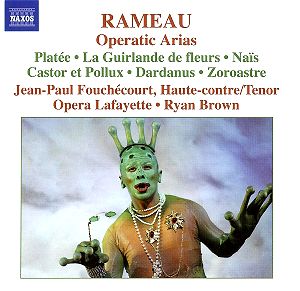
RAMEAU (1683–1764) Operatic Arias Platée (1745):
1. Que ce séjour est agreeable (Act 1, Scene 3)
[3:52]
2. Quittez nymphes, quittez (Act 1, Scene 5) [2:26]
3. A l’aspect de ce nuage (Act 2, Scene 1) [7:56]
4. Marche pour la danse – Dans cette fête: Mouvement
de menuet – Marche pour la danse (Act 3, Scene 3) [3:45] La Guirlande de Fleurs (1751):
5. Peut-on être à la fois si tendre … Raminez vous – Musette:
Allegro [7:57]
Castor et Pollux (1754 version):
6. Séjour de l’éternelle paix (Act 4, Scene 5) [4:48] Naïs (1749):
7. Prélude: La jeune nymphe que j’adore … Que l’univers
entire … Amour, tu termines nos maux … Je vole où m’appelle
ton choix (Act 3, Scene 1) [7:34] Les Festes de l’Hymen et de l’Amour (1747):
8. Gigue – Que vous connaissez mal … Qu’à la voix d’Osiris – Mouvement
de sarabande et de loure (Act 1, Scene 1) [6:43] Dardanus (1744 version):
9. Lieux funestes (Act 4, Scene 1) [4:59] Zoroastre (1749):
10. A mes tristes regards (Act 2, Scene 1) [3:45] Zaïs (1748):
11. Prélude: Charmes des coeurs ambitieux … Ritournelle – A
mes desires (Act 2, Scene 1) [4:46] Naïs: 12. Cessez de ravager la terre (Act
3, Scene 5) [2:54] Platée:
13. Charmant Bacchus (Prologue) [2:39] Jean-Paul
Fouchécourt (haute-contre/tenor)
Opera Lafayette/Ryan Brown
rec. Clarice Smith Performing Arts Center, University of
Maryland, USA, 10-13 February 2006
texts and translations included NAXOS 8.557993 [64:04]
Fouchécourt may have
lost something in tonal quality but this is more than compensated
for by his deep insight.
This disc should be of interest to anyone the least interested
in baroque opera.
Jean-Philippe Rameau
was granted a long life: he was born two years before Bach and
Handel and survived them both, Handel by
five years. He spent his early career as organist and his
compositions were mostly for keyboard instruments, primarily
harpsichord. Not until he was fifty did he start writing
operas, his first success being Hippolyte et Aricie in
1733. The works he wrote during the next twenty years are
regarded as the cream of French Baroque opera, Castor
et Pollux (1737, revised 1754) possibly his masterwork.
His music became unfashionable towards the end of his life
but in our time, from the 1960s, many of them have been revived
and recorded. I remember hearing a performance of Castor
et Pollux on Swedish Radio in the early 1970s, conducted
by Harnoncourt, who later recorded the work with the same
forces in Stockholm with Gerard Souzay as Pollux. That recording
that still ranks high in the Rameau stakes.
On this disc the renowned French haute-contre Jean-Paul Fouchécourt
sings a number of arias from eight of Rameau’s stage-works,
which can be divided in tragedies lyriques, comedies lyriques and comedies-ballets.
The term ‘haute-contre’ should not be confused with ‘counter-tenor’.
The latter is a man who sings falsetto in the contralto range
while the haute-contre is a high tenor who sings in his natural
voice from e to c’’.
The arias on this disc have been chosen to represent Fouchécourt’s
great predecessor Pierre de Jélyotte (1713–1797) who sang
at the Paris Opéra from 1733 to his retirement in 1755, where
he performed 46 characters in 41 works. One of his first
assignments was two characters at the premiere of Rameau’s
first opera Hippolyte et Aricie and he was given roles
in thirteen of the sixteen stage works that Rameau mounted
during this period. Nobody knows what he sounded like but
contemporary reports say that it was a powerful and supple
voice with a wide range. What did ‘powerful’ mean in those
days? Certainly not the same thing as today, where powerful
means a voice that can ride a Wagnerian orchestra or challenge
Verdi’s Aida trumpets. Knowing the music Rameau wrote for
him and the orchestral forces he had to compete with one
can probably conclude that in today’s terminology it was
a lyric voice and that Jean-Paul Fouchécourt is a worthy
stand-in for him. Beauty, flexibility and virtuosity were
more important components in a singer’s armoury during the
18th century than sheer force.
Hearing Fouchécourt almost twenty years ago I remember him as a very
light voiced singer, agile and with beautiful tone. When
he recorded Gluck’s Orphée et Euridice in the 1774
Paris version for Naxos five years ago with the same orchestra
and conductor (see review)
his was still a marvellously handsome voice, in my view an
ideal instrument for the part. Four years later, when this
disc was recorded, his technical accomplishment is still
without reproach, his runs are exemplary and grace notes
are applied with the utmost elegance. His soft singing is
also very attractive but it seems that he has lost something
of the suppleness of tone. It has hardened and he has to
work harder than before with a slight widening of vibrato
on sustained notes at forte. Today he sounds more like a
character tenor, which isn’t as negative as it might seem.
This is namely one of the most expressive baroque recitals
I have come across. He makes the words tell and he colours
the voice accordingly to good theatrical effect. Conveying
a character or a situation with vocal means alone is a hard
task for any singer or actor but Fouchécourt’s singing has ‘face’.
Ryan Brown and his Opera Lafayette also contribute to make
this a highly desirable disc. Besides the aforementioned Orphée he
also made a successful recording of Sacchini’s Oedipe some
time ago (see review)
and since several of the works here are ballets he has rich
opportunities to let the orchestra shine – which it does
with rhythmic flair, precision and elegance and also in the
elegiac numbers he keeps the music alive. There are some
spectacular sound effects in Platée (tr. 3, near the
end) where the stage instruction says: “… suddenly a great
clap of thunder is heard. A shower of fire falls from heaven.
Platée runs about the stage in great fright.” If you happen
to nod during this long scene – which to be sure seems improbable – you
will certainly be woken up!
Musically this is a string of pearls of wonderful scenes
with dances and arias, joyful, dramatic, elegiac, beautiful.
For a taster
of Fouchécourt’s accomplishment try the little arietta from Platée – Quittez
nymphes, quittez (tr. 2), where his expertise in coloratura
as well as his expressive colouring of the voice are to the
fore. Also lend an ear to the elegiac aria from Castor
et Pollux (tr. 6) and Neptune’s beautiful aria from Naïs (tr.
12): Cessez de ravager la terre, which has less to
do with topical problems like global heating and devastation
of the rain-forests than the eternal plague of war.
Ideally one could have wished that this disc had been recorded
a couple of years earlier when Fouchécourt’s voice was in
even better shape but his deep insight compensates for what
loss of tonal
quality there is.
Full marks to Naxos for providing not only full texts and
translations but also an introduction to each scene with
some historical
notes and then placing the aria in context.
This disc should be of interest to anyone the least interested
in baroque opera.
Göran Forsling
Please support our advertisers below by clicking on the logos for further information.

























 Jean-Paul
Fouchécourt (haute-contre/tenor)
Jean-Paul
Fouchécourt (haute-contre/tenor) 