The opening of Vaughan
Williams’ Fantasia on a Theme by Thomas Tallis here has
stillness, sheen and already the expansive measure which characterizes
the performance when all the string groups are playing. The sudden
fp (tr. 1 1:08) alerts you to the evocative soft tremolo
of the first violins ushering in a richly projected presentation
of the Tallis theme, vividly scaled down to pp at the end
(2:21) before a repeat which really is appassionato as
marked, with playing of great fervour. The muted, smaller second
orchestra which often gives out a swaying motif as a kind of refrain
is clearly differentiated from the first though perhaps not quite
as soft and mysterious as it might be. The central section which
brings first solo viola, then violin and string quartet of soloists
to the fore is presented in confident folksy manner. It’s forward,
glowing and fluent. In contrast, when eventually these soloists
and both orchestras join together and the texture becomes more
elaborate and dense Previn’s approach is one of savoured lyricism,
the poco a poco animando marking (10:52) only a fractional
limbering up to the broader climax (11:28) and not the spontaneous
combustion realized by the Sinfonia of London/John Barbirolli
(EMI 5672642), for me this work’s finest interpretation. After
the climax Previn’s second orchestra echoes do become chillingly
ghostly and the consistently fluent duet between solo violin and
viola is full of feeling and eloquence.
I compared Previn’s
1988 recording with the Royal Philharmonic Orchestra (Telarc
CD 80158). Its opening has more finesse but is also more self-conscious.
The theme has a more sober dignity but its repeat is less passionate
as it presses forward more. The second orchestra echoes are
more eerie yet the solos in the central section are rather lugubrious
in their expressiveness. But more animando before the
climax here makes it more effective and the closing duet soulfully
honours the melody.
Previn’s Curtis
Institute account of Vaughan Williams’ Fifth symphony opens
serenely with a lustrous string sound and steady focus, yet
it also has a purpose and growth to its outpouring. The second
theme (tr. 2 3:39) is balmy, the development (5:34) suddenly
of a feathery insubstantiality in the strings and shadows of
foreboding in the falling motif in the wind. The ensuing build
up isn’t especially noteworthy but the strings’ climax is steely
enough, after which the recapitulation is welcomed with relief
and the second theme climax shines forth.
I compared all three
Previn recordings. Here are the timings:
|
Timings
|
I
|
II
|
III
|
IV
|
Total
|
| Previn 1995
|
12:43
|
5:24
|
12:08
|
10:21
|
40:36
|
|
Previn 1988
|
12:30
|
5:14
|
12:57
|
9:55
|
40:36
|
|
Previn 1971
|
12:53
|
5:17
|
12:19
|
11:18
|
41:47
|
Previn first recorded
this symphony with the London Symphony Orchestra in 1971 (RCA
8287655 7082). The first movement is notable for the gentle
insistence of its unfolding, the clarity and distinctness of
texture, feel of all contributing and conviction of statement.
The second theme is introduced and progresses with regal calm.
The development contrasts glinting strings as if in the half
light and ominous, energetic woodwind who whip the strings into
a stormy outburst. In the recapitulation pristine calm is restored
as the natural order, with a strong build up to a second theme
climax of fiery avowal. The close is quizzical with the positive
strings and negative woodwind elements side by side.
Previn’s second
recording was with the Royal Philharmonic Orchestra in 1988
(Telarc CD 80158). The recording has greater density and this
brings a vivid sense of a distinctive and mysterious environment,
but the sense of progression is less strong and the observation
seems more objective, from a distance. The second theme is rather
dreamily treated, its climax more formal.
The 1995 Curtis
recording under review isn’t as assured or organic in feel as
Previn’s 1971 yet has a sense of a journey of discovery which
makes it more engaging than Previn’s 1988 recording. The more
shadowy nature of the opening of the development is a greater
contrast than the other recordings, its build up more gradual
and climax less expected but thrilling all the same. The recapitulation
is more relaxed at first, but with a powerful build up to a
formally presented second theme climax. The two elements of
the close are smoothly blended.
Previn’s Curtis
Scherzo is characterized by lightness of touch in the strings
and jaunty humour in the wind. The first Trio (tr. 3 2:00) is
full bodied jollity in the wind against teeming strings. The
second Trio (3:43) has more bite but is still jocular. Towards
the close when the fast opening and recurring material is presented
becalmed the strings could relax more but at the very end they
are sensitively shimmering. The 1971 Previn Scherzo is similar
in tone but somewhat sharper in focus. The first Trio is firmer
with strings, woodwind and brass more distinctly differentiated
in their neat balance, the second Trio is spikier yet still
dapper, while the strings relax more expressively towards the
close.
To open the Curtis
Romanza Previn creates a rapt strings’ expanse as a backcloth
for a rich toned cor anglais solo and you appreciate the soft
but dense, emotive response of the strings and its later flowering
forth after their rich reprise of the solo. Curiously the development
(tr. 4 5:58), though marked animato, seems a touch slower.
It does, however, have striking dramatic focus, not least in
the tingling tremolo on violins and violas shepherding the graphic
horn and trumpet versions of the solo which are more clearly
focussed than the 1971 solos. Here too the recapitulation comes
as a relief, is a little faster as marked and with that freedom
also comes a sense of fulfilment. The 1971 account isn’t as
rich in tone but is more elegiac in manner. It’s less cultivated
but seems more spontaneous than the Curtis, in particular owing
to the seamless way one strand leads to another and the climax
has a more blazing intensity.
Previn’s Curtis
Passacaglia finale has a smooth flow in both the opening ground
bass and violins’ counter melody (tr. 5 0:12) yet also a strong
element of eagerness and joyous celebration. It’s really rather
fast for the moderato marking of the opening and strains,
via relished syncopation from 1:15, towards the eruption of
the allegro second section (1:58) with brass turned full
on and strings’ rhythms skipping. The third section (3:49) begins
with a very reflective clarinet solo, the first of a number
in the woodwind, scrupulously distinctive in VW’s somewhat gawky
phrasing. The coda (6:29) brings back the symphony’s opening
theme, welcomed with some breadth, before the strings reflect
in relaxed, tender and hymn like fashion on the finale’s counter
melody. Interestingly the quite fast closing counter melody
works better than at the opening. The 1971 slower Passacaglia
has a more natural flow from the outset, a kind of inevitability
about it, contrasted by a stimulatingly brisk allegro
and more measured third section before a more heroic return
of the opening theme and closing serene counter melody. The
trombones and bass trombone vivid capping of the horns and trumpets’
ff chord at the end of the second section and the bass
trombone solo in the third section are more emphatically realized
in 1971 than 1995.
The final work on
this Previn Curtis CD features Previn as composer as well as
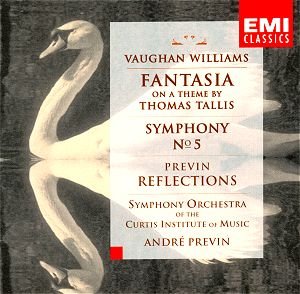
conductor. The cover illustration may lead you to think Reflections
(tr. 6) is going to be like The Swan of Tuonela but it’s
neither as romantic nor as bleak. It’s a modern fantasia in
that the initial melodic idea is constantly modified and extended.
It begins with cor anglais alone in an angular yet soaring melody,
shortly joined by a reflecting cello, which is to say its melody
is as firm and clear as the original yet with a surprising intensity
at the close, before other wind instruments get involved and
the strings provide a backdrop and occasional comment, also
sometimes of unexpected intensity. The work aspires to the rhapsodic
but in an astringent environment. You could term this ‘the modern
idiom’ and it includes some Brittenesque fanfare writing for
trumpet at 3:51 which itself is a reflection of the cello solo.
At 5:04 a livelier, jazzier, scherzo like section is started
by side drum and cello which the cor anglais becalms with something
more melodic and alluring, akin to a folksong outpouring. This
the cello at first restlessly brushes aside but from 8:11 the
two ideas are combined then interwoven. At 8:52, when the cor
anglais introduces a new, more pleading idea the cello now reflects
this. At 9:35 the strings find a passionate hinterland to the
original melody and from 10:13 the cello an eloquent, wistful
commentary which leads to a brief and moving unique playing
in strict accord by cello and cor anglais from 10:28. The work
ends with just the start of the cor anglais solo opening, like
posing a question, but reminding you of the source of all the
subsequent ideas. It sustains the listener’s interest as an
examination of melodic motifs and moods, thoughtful and thought
provoking and not otherwise currently available on CD in the
UK than in this committed performance.
To sum up, these
accounts, never released in the UK by EMI and only now available
on Arkiv CD, are spirited and often attractive with a fine sense
of direction. Even if the Fifth symphony doesn’t quite have
the sheer conviction of Previn’s 1971 recording, the Curtis
players show themselves to be a student orchestra of prolific
talent. Their strings sound more like the Philadelphia than
any other orchestra I’ve heard, unsurprisingly given that nearly
half the Philadelphia’s players are Curtis Institute graduates.
Michael Greenhalgh

























 1Elita
Kang, Nurit Bar-Josef (violins), Hui Liu (viola), 1,3Sophie
Shao (cello), 3Lelie Ann Resnick (English Horn), 1-3Symphony
Orchestra of the Curtis Institute of Music, Philadelphia/André Previn
1Elita
Kang, Nurit Bar-Josef (violins), Hui Liu (viola), 1,3Sophie
Shao (cello), 3Lelie Ann Resnick (English Horn), 1-3Symphony
Orchestra of the Curtis Institute of Music, Philadelphia/André Previn
 [69:18]