None
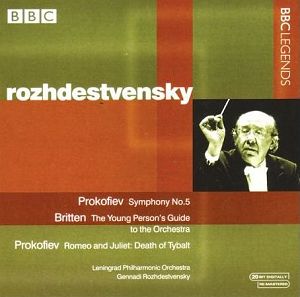
of these performances equals or bests their recorded predecessors,
so if you're shopping for single versions of each, continue
elsewhere. But the Prokofiev Fifth captures one of those moments
when an insightful but workaday performance, out of nowhere,
suddenly becomes exalted - what athletes refer to as "getting
in the Zone." It may be difficult, especially for infrequent
concertgoers, to understand how this can happen (or, conversely,
why it isn't an everyday occurrence!). But veteran performers
can attest to those experiences that transcend the routines
and limits of quotidian music-making - it's happened to me on
the podium exactly twice.
The
first movement's forthright address, with the tempo edging faster
as early as 1:36, may represent, not a broadly "Russian"
tradition, but one peculiar to Leningrad/St. Petersburg: Jansons's
St. Petersburg concert recording (Chandos) is similarly brisk
and taut, but Oistrakh and Simonov's Moscow-based recordings
play the music more broadly, in the customary Western style.
Listeners accustomed to more weight and deliberation, to a more
searching manner, may take issue with such a no-nonsense approach.
But it has its benefits, disposing of the perpetual question
of whether or not to speed up at Prokofiev's animato
marking - the pace having become sufficiently "animated"
as to require no further adjustment - and realizing a certain
epic sweep in the development, as the brasses call across the
orchestra with their long-breathed motifs. Since the playing
is good but not great - the violin tone tends to harden under
pressure, or to go glassy at the top, and the trumpets' heavy
vibrato is distracting - this plausible and musical rendition
hardly seems one for the ages.
At
the scherzo's start, Rozhdestvensky takes pains to give the
chugging accompaniment an undulating shape that brings out the
music's long line; but the figures settle into a more routine
motor impulse as the movement progresses. The conductor's markedly
slower pace for the "B" section, however - Ormandy
(Sony, RCA), among others, used to take it this way - underlines
its gentle piquancy and its lyricism at once.
The
first statement of the Adagio theme is tentative, but
the strings' immediate repeat is more confident and full-throated.
The second theme, at 3:31, pushes forward impulsively in the
manner of the opening movement, and the subsequent series of
contrasting episodes, flowing rather than starkly dramatic,
goes well enough. But, at 7:35, after the big outburst, the
magic happens: the violins intone the return of the opening
theme with a breathtaking hush, and over the next four minutes
the movement spins to a close with unerring concentration.
The
musicians stay "in the Zone" for the Finale. The strings
at 0:24 vibrantly recall the first movement's principal theme.
The horns' light, crisp accenting of their ostinato lends
the movement an easy propulsion, over which the clarinet and
then the violins project their running theme with relish. The
'cellos make deep, rich sounds in their brief moment in the
sun at 6:09, and the violins' numerous "upbeat" runs
(the first is at 7:10) sound warm and assured, without smearing
or blurring. All in all, it's a fulfilling end to a performance
whose beginning seemed to promise less.
The
companion pieces, dating from eleven years earlier and recorded
monaurally, find conductor and orchestra at a less assured stage
of their collaboration - and in the Britten, dealing, I suspect,
with relatively unfamiliar territory as well. The statement
of the Purcell theme is suitably ceremonial, marred by moments
of slurry violin playing. Among the individual variations, the
best are those that allow for a measure of virtuoso panache:
those featuring the dazzling passagework of the duetting flutes,
for example, or the galloping trumpets and snare drum. Other
episodes, such as the clarinets', even when musically sympathetic,
feel somehow less idiomatic. The closing fugue, taken at a breakneck
pace, suffers a few brief ensemble lapses, though, judging by
the applause, it made a thrilling impression in the hall. The
encore performance of The Death of Tybalt is no better
or worse than numerous other renditions.
If
nothing else, the symphony reminds us record mavens of an important
difference between a concert performance and a studio recording:
in concert, wonderful things can happen, sometimes when everyone
- including the performers - least expects it.
Stephen Francis Vasta