The earliest work
here, the somewhat hybrid Le Légendaire for violin,
chorus and orchestra, was completed in 1984. The chorus sings
words in Esperanto, all “touching upon the idea of legend” (the
composer’s words), although these words do not form a text as
such. (Incidentally an alphabetical glossary of the words is
printed in the insert notes, but it is not always easy to hear
which words the chorus is singing, so that I would be tempted
to think that they are mostly used as pegs to hang the music
on.) The work is in one single movement unfolding through a
variety of moods, “from confrontation to communion”, as the
composer has it. It opens with hieratic brass fanfares giving
way to more reflective, melodic solo lines. The first entry
of the chorus is followed by an animated, almost angry section
with angular solo lines and sombre brass with percussion, leading
into a rather desolate section. This in turn is followed by
a dramatic episode alternating strongly contrasted, almost conflicting
moods that are eventually reconciled in the glowing, appeased
and assertive coda. According to the composer, the piece is
about “the one coming from somewhere else, whether he be Peter
Pan, E.T. or Buddha. It is the story of a visit.” In fact, the
composer leaves much to the listener’s imagination; but what
comes clearly through anyway is some warmly lyrical and generous
music of great communicative strength.
Petitgirard’s Cello
Concerto, completed in 1994 and dedicated to Marcel
Landowski, does not bear any literary or poetic title. “Its
only subject is the exaltation of this marvellous instrument”.
It is laid-out in three movements of roughly equal length :
a moderately fast first movement with several contrasting episodes
that ends quietly, preparing for the mostly reflective slow
movement that concludes with an unresolved crescendo. In spite
of some rhythmically alert episodes, the final movement does
not entirely dispels the elegiac mood that prevailed during
the preceding movements, neither does the angrily dismissive
final gesture. Petitgirard’s Cello Concerto is a rather tense
and intense work, partly inspired by the sudden death of one
of the composer’s friends. This often gripping and moving work
is undoubtedly a strongly personal utterance on the composer’s
part.
Dialogue for
Viola and Orchestra is the most recent work here. It
was completed in 2002 and dedicated to Jesse Levine who was
the soloist for the first performance in 2003. The title rather
aptly suggests a discussion, in which partners constantly confront
each other, disagree and – at times – agree, rather than a real
concerto, in which the soloist battles against larger forces.
The tone is in turn light, angry, sorrowful and impassioned;
and the music reaches some forceful climaxes. The work, however,
ends with a beautiful, appeased coda. Neither the Cello Concerto
nor Dialogue are programmatic works. Rather they
are abstract pieces of music, in which emotion and communication
are paramount.
Laurent Petitgirard’s
music may not be strikingly original but it is eminently personal.
It is characterised by a formidable orchestral and instrumental
mastery as well as a remarkable stylistic consistency; for Dialogue
or Les Douze Gardiens du Temple (on Naxos 8.570138
that I reviewed here some time ago) are obviously from the same
pen as the score for the Maigret TV series.
These performances
played by top-rank soloists, who obviously relish the composer’s
generous music, and conducted by the composer are really very
fine. These recorded performances of the Cello Concerto and Le
Légendaire were released some time ago, but still sound
remarkably well. Anyone who has heard and enjoyed Petitgirard’s
opera Joseph Merrick, the Elephant Man
or the orchestral works recently released by Naxos will need no
further recommendation to get this most appealing release, whereas
anyone enjoying accessible contemporary music will find much to
enjoy here.
Hubert Culot
























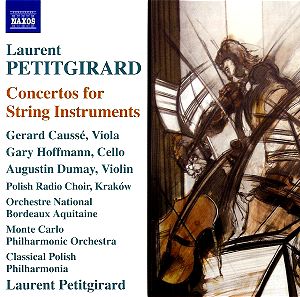

 Gérard Caussé
(viola)a; Gary Hoffmann (cello)b; Augustin Dumay
(violin)c
Gérard Caussé
(viola)a; Gary Hoffmann (cello)b; Augustin Dumay
(violin)c