MusicWeb is not a subscription site and it is these advertisers that pay for it. Please visit their sites regularly to see if anything might interest you. Purchasing from them keeps MusicWeb free.

Classical Editor: Rob Barnett                               Founder Len Mullenger


CD REVIEW


Online Count. There are currently : visitors. What this means.
Site Map

More Reviews

How to find a review

Classical CD Review Archive

Book Reviews

Film Music Reviews

Jazz CD Reviews

Nostalgia

Comment

Norman Lebrecht Weekly

Arthur Butterworth Writes

Phil Scowcroft's Garlands

Classical blogs

Reviewers Logs

Announcements

Don't Go Here!

Community

Bulletin Board

Web Ring

Reviewers

Helpers invited!

Resources

Quiz

British Composers

British Light Music Composers

Other composers

Indexes
   Label
   Masterwork

Discographies

On-line Music
[Download sites]

Themed Review pages

Our Classic Classics

Online books
MWI Classical
     Encyclopaedia

Gilder Dictionary of
     Composers

MWI Pop
     Encyclopedia

Other Complete Books

Programme Notes


British Music Society
Performers
The BBC Proms
Musical WWW pages
Classical Music Online

Recording Companies and Retailers
Agents and Marketing
Publishers
Non-Classical Web pages
Orchestra Web Sites
Newsgroups
Web News sites etc


Editorial Board
Classical Editor
   
Rob Barnett
Seen & Heard
Editor and Webmaster
   Bill Kenny
MusicWeb Webmaster
   Len Mullenger
Assistant Webmasters
   Patrick Waller
   David Barker

PotPourri
A pot-pourri of articles

MW Listening Room
MW Office
Helping MusicWeb
Advice to Windows Vista users  
Questionnaire    
Site History  
What they say about us
What we say about us!
Where to get help on the Internet
CD orders By Special Request
Graphics archive
Currency Converter
Dictionary
Magazines
Newsfeed  
Web Ring
Translation Service

Rules for potential reviewers :-)
Do Not Go Here!
April Fools

Would you like a hyperlinked weekly summary of the CDs we have reviewed?
Click for further details

Sample: See what you will get

alternatively Crotchet


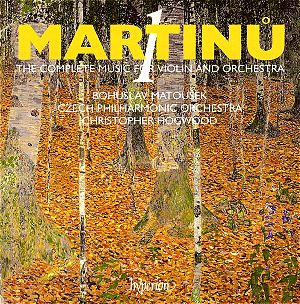
Bohuslav MARTINŮ (1890-1959)
Concerto for flute, violin and orchestra H252 (1936) [18:41] ¹
Duo concertante for two violins and orchestra H264 (1937) [17:44] ²
Concerto in D major for two violins and orchestra H329 (1950) [18:37] ³
Bohuslav Matoušek (violin)
Janne Thomsen (flute) ¹
Régis Pasquier (violin) ²
Jennifer Koh (violin) ³
Czech Philharmonic Orchestra/Christopher Hogwood
rec. Dvořák Hall, Rudolfinum, Prague June 2004 (Duo concertante) and December 2005 (remainder)
HYPERION CDA 67671 [55:06]


It was something of a shock to see these performances on Hyperion. I’m not privy to the matter but Matoušek and Hogwood have already made excellent recordings of the First Violin Concerto and Suite Concertante (premiere recording) for Supraphon [SU36532]. What intensifies the matter is that these new recordings, issued as volume one in a set of the complete music for violin and orchestra, are not exactly hot off the press. Has Supraphon declined to take on further volumes – and will the earlier disc reappear in this new Hyperion series?

While we ponder those questions we can reflect on the fact that Hyperion Volume One has started with works that even seasoned admirers of the composer may not have encountered. The Concerto for flute, violin and orchestra for instance was written in 1936, commissioned by Marcel Moyse for himself and his daughter-in-law Blanche Honegger Moyse to play.  It’s written in his best neo-classical style, richly textured, with a piano to add variety. The flute’s writing is energetic and virile but almost immediately the violin introduces a second subject of ravishing beauty. The piano’s slightly off-kilter contribution is most audible in the central movement but what most impresses is the level of expressive continuity generated throughout – and also the gutty violin cadenza – and those moments when the two instruments entwine longingly; he composed it at around the time he wrote Julietta. Francophile dreamscapes fleck the finale, which alternates between perky drama and reflective stillness.

The following year Martinů wrote his Duo concertante and it was premiered in 1938 by the Desarzens brothers with the Suisse Romande and Ansermet. Readers will know that Victor Desarzens later became a conductor. This is a concerto grosso, strongly predicated on the alternation of soli and tutti and once again there’s a strong colouristic and rhythmic profile for the piano. The focus is the slow movement which rises to a considerable pitch of feeling led by the brass before the solo violins embrace gracious pirouetting and anticipate the cadential passage. The finale rather reprises the opening’s slightly pawky profile but Martinů constantly builds up and releases the tension with characteristic assurance. It’s a less distinctive work than the earlier concerto but fully characteristic.

In 1950 he wrote the Concerto in D major for two violins and orchestra. Once again he found violinistic brothers to play it – Gerald and Wilfred Beal, in Dallas in January 1951. But this is a work apart. The pre-war works cleaved to neo-classicism but this one embraces romanticism. The writing is verdant and vibrant but never becomes cloying. The “Juliette theme” reappears in the slow movement – always a good sign with Martinů -  and this central movement courses with dance rhythms and youthful fire, as does the finale.

This is a propitious start in what looks like being a must-have series for the Martinů adherent. The engineering has placed the soloists – all highly, indeed admirably characterful – in close-up which means that some orchestral detail is occasionally obscured. I happen to like this immediacy of sound, feeling it suits the nature of the works, but I suspect that others will find it overdone.

Jonathan Woolf



Advertising Rates
Visitor stats
MusicWeb International
has over 21,000 Classical CD reviews on offer


Gerard Hoffnung Concerts &
The Bricklayer Story

Naxos Classical 

Australian Eloquence CDs on Buywell.com


New Releases

Hyperion
New Releases


Guild Music


23rd-27th May


MusicWeb sells the Polish
catalogue CDAccord
£10.50 post free W-W


MusicWeb sells the
Arcodiva catalogue
£12.00 post free W-W


Price Reduction: £11.75
post-free


Bull Horn
Price comparison Website


MusicWeb can now offer you discs from the following catalogues:
Prices include postage

[Acte Préalable £13.50]
[Arcodiva £12.00]
[Ashgate Music Books]
[Avie from £6.25]
[British Music Society £13.49]
[CDACCORD from £10.50 ]
[Hortus £14.99 ]
[Lyrita ONLY £11.75 ]
[Onyx £12.00
]
[REDCLIFFE £11 ]
[Tactus £11.50 ]
[Talent from £12.00 ]
[Toccata Classics £12.50 ]

MusicWeb Recommended Recordings 2007

DISCS OF THE YEAR 2007


Return to Review Index


Reviews from previous months
Join the mailing list and receive a hyperlinked weekly update on the discs reviewed. details
We welcome feedback on our reviews. Please use the Bulletin Board.  Please paste in the first line of your comments the URL of the review to which you refer..


You can purchase CDs and Save around 22% with these retailers: