Kancheli’s Styx
for viola, choir and orchestra was composed
at the request of Yuri Bashmet who had
already championed Kancheli’s earlier
Liturgy for Viola and Orchestra.
In Greek mythology, the River Styx must
be crossed by dead souls when on their
way to Hades, the world of the dead.
The viola incarnates the ferryman Charon
who mediates between past and present,
life and death, light and darkness.
So, to a certain extent, Styx
may be considered as another "liturgy"
of some sort, in which the composer
also evokes Georgia and his recently
deceased friends Alfred Schnittke (1934-1998)
and Avet Terterian (1929-1994). He does
so, too, through the text that he devised
using a number of allusions to Georgia,
its landscapes, its churches, its folklore
and the like. The music is thus lyrical,
elegiac, dance-like, angry, joyful and
consolatory. Although Kancheli’s main
fingerprints are present throughout
this substantial score, some greater
emphasis is laid on long melodic lines
(this was a request of Bashmet). The
score is in seven contrasted sections,
the concluding one setting a text in
English. The whole amounts to what may
be one of Kancheli’s most personal achievements,
and one of his most deeply moving works.
I must confess that I am still nourishing
doubts concerning some of Kancheli’s
recent works, in which I find the material
a bit too thin and not particularly
attractive and in which the deliberate
shocking contrast between loud and soft,
nearly inaudible sections sounds rather
single-minded. Not so indeed in Styx,
I am glad to say.
It is interesting to
compare Rysanov’s reading with Bashmet’s.
Bashmet’s recording with Gergiev and
his Russian forces (St. Petersburg Chamber
Choir and Orchestra of the Mariinsky
Theatre – DG 471 494-2) is of course
technically superb, and everyone concerned
plays immaculately throughout; but,
when compared to the version under review,
it slightly lacks in warmth. Rysanov’s
recording was made with a provincial
Latvian orchestra and a Latvian chorus
for whom the work - maybe because of
the text - obviously means much, and
they give a formidably committed reading.
The recorded sound, too, benefits from
the rather reverberating acoustics of
the Dome Cathedral in Riga, that lend
some considerable presence and immediacy
of sound, somewhat absent in the Russian
recording.
John Tavener’s The
Myrrh-Bearer, too, was written
for Yuri Bashmet who gave the first
performance in London in October 1994.
This fairly substantial work is scored
for viola, percussion (one player),
semi-chorus of male voices and mixed
chorus. The piece is inspired by Cassiane’s
Troparion, an early text conceived
as a confession by Mary Magdalene as
she pours myrrh over Christ’s head before
the Passion. This text, however, is
not set, but rather is laid over the
solo part, whereas the male semi-chorus
sings a drone to the words of Kyrie
eleison throughout the entire work
and the mixed chorus a text, apparently
by the composer, representing "the
inane and mindless cries of ugliness
and violence which represent the world"
(the composer’s words). Nevertheless,
what comes strongly through is the sheer
beauty of the music, even in episodes
evoking "the inane and mindless
cries of ugliness" - Tavener is
actually incapable of any musical ugliness
- although these "cries" may
be briefly justified by some dissonance.
The music thus unfolds continuously
on three different levels, with the
viola embodying Mary Magdalene’s complex
personality, in turn warmly sensual
or repentant. Tavener’s The Myrrh-Bearer
is a quite beautiful and often moving
piece of music, although I suspect that
some might find it a tad too long; but,
now, this is music that needs to unfold
at its own pace to emphasise the predominantly
meditative nature of the work. The music,
however, has enough variety to sustain
its long time span.
Both pieces are magnificently
performed by all concerned. Rysanov
is a beautifully equipped musician with
both impeccable technique and subtle
musicality that these often exacting
works call for. The Latvian choruses
and orchestra commit themselves wholeheartedly
in these demanding but strongly expressive
scores. The present recording of Tavener’s
work is a first, whereas Rysanov’s competes
with Bashmet’s. Both are marvellous
musicians; but, as I mentioned earlier
in this review, Rysanov’s and the Latvian’s
reading of Styx is gripping
and strongly moving. Theirs is, I think,
the recording to have, if Styx
is the work you are interested in. The
coupling might be the deciding factor.
I would not be without Gubaidulina’s
beautiful Viola Concerto either.
Hubert Culot
ONYX
Catalogue
























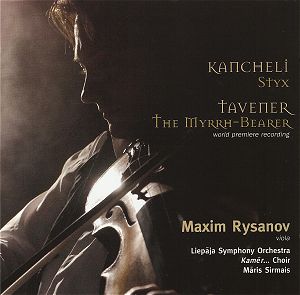
 Maxim Rysanov (viola); Rihards Zaļupe
(percussion)b; Kamēr...
Choirab; Men of the State Choir
Latvijab;
Liepāja Symphony Orchestraa;
Māris Sirmais
Maxim Rysanov (viola); Rihards Zaļupe
(percussion)b; Kamēr...
Choirab; Men of the State Choir
Latvijab;
Liepāja Symphony Orchestraa;
Māris Sirmais  Sound
Sample
Sound
Sample