Editorial Board
MusicWeb International
Founding Editor Rob Barnett Editor in Chief
John Quinn Contributing Editor Ralph Moore Webmaster
David Barker Postmaster
Jonathan Woolf MusicWeb Founder Len Mullenger
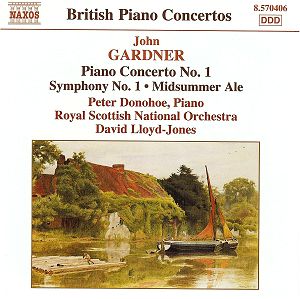
John GARDNER (b.
1917)
Overture: Midsummer Ale Op.73 (1965) [5:28]
Piano Concerto No.1 in B flat major Op.34 (1956) [25:39]
Symphony No.1 in D minor Op.2 (1947) [40:47] Peter Donohoe
(piano)
Royal Scottish National Orchestra./David Lloyd-Jones
rec. Henry Wood Hall, Glasgow, 28-30 November 2006 NAXOS 8.570406 [71:54]
John Gardner was still
teaching at the Royal Academy of Music when I was there in
the 1980s, and I received some valuable lessons at orchestration
classes where he unfortunately had to put up with singers
and the like who, obliged to complete the subject for their
course work, had no interest in the subject whatever. I enjoyed
his gruff directness and avuncular style, and remember him
inviting me to throw in everything to my work: “nobody’s
going to play the thing, so why not?” and so I would be allowed
go off and play with impractical but satisfying Sibelian
effects like huge trombone sections and colourful percussion.
One other golden tip was always to make sure you have more
staves on your manuscript paper than you think you will need
when you start. “You’ll always find yourself needing more – you
can never have too many”, and it’s a truth which has kept
me in good stead for the last twenty years.
I also remember many amiable hours in the Academy bar spent
over many gin and tonics – John was always ready with an
entertaining anecdote and was a very good friend even to
shy and retiring types like I was all those years ago.
MusicWeb International has some very useful resources on
John Gardner, with articles on his life and work and
the symphonies in
particular. As the booklet notes for this excellent release
begin, “The neglect suffered by John Gardner’s considerable
output is both surprising and hard to understand.” Indeed,
and on the evidence presented by this CD his work is long
overdue for a big renaissance. The Overture: Midsummer
Ale is great fun, packing Bernstein’s swagger into an
Arnoldesque romp written for the Morley College Orchestra
and that institute’s 75th Birthday celebrations.
Gardner the storyteller comes through loud and clear in the
booklet: “Debussy and Joan Last must be the only composers
who never found the naming of pieces a hell of a chore. I
spent longer searching for the title of this piece than in
writing down its notes on a five line stave…”
The overture is fun, but the invention and searching seriousness
of the Piano Concerto No.1 is in a different league.
Given its première by Sir John Barbirolli at the Cheltenham
Festival in 1957, the performance with as soloist Cyril Preedy
failed to launch the piece as a staple of the repertoire,
and other than a brief revival by Malcolm Binns in 1965 the
work has lain dormant until the present recording. As one
might expect, Peter Donohoe is entirely convincing, indeed
brilliant as soloist, and the orchestra pulls no punches
in the energetic opening Allegro con brio, the balance
of the recording realistic in the way that the piano is pitted
directly against the orchestra in a grim battle for supremacy.
An atmospheric final section concludes the first movement,
and wind solos and climbing figures from the piano wind through
a bed of restless chords in the strings. This chorale-like
harmonic movement is taken up by the soloist in the second
movement, whose Tema con Variazioni moves darkly though
a nocturne of cinematic gorgeousness. The more lively development
recalls Bartók in places, and the whole movement has a rich
strangeness which is entirely fascinating. This moves directly
into a Finale: Rondo which introduces a kind of fugal
resolution, using material from the other movements. Something
about the intervals Gardner uses bring my ear back to Bartók,
but his idiom is of course entirely different, if hard to
categorise. Perhaps this has been a problem in ‘selling’ Gardner’s
music – if it lacks an immediate sense of Englishness than
how to categorise it? To European ears it would probably
be more immediately associated with a British tradition than
anything else, but one can sense the work seeking out worlds
beyond that island’s shores.
This is also true of the Symphony No.1, which has
however fared a little better than the concerto, receiving
a number of performances since its première, again under
the baton of John Barbirolli, this time at the Cheltenham
Festival of 1951. The work’s success brought recognition
to Gardner, and a string of subsequent commissions allowed
him to become established as a composer. The low opus number
of the work comes as a result of the “new start” Gardner
made after the war, having withdrawn his pre-war works, but
in fact drawing on some of the old material in the composition
of the first symphony. As Chris Gardner – the composer’s
son if I’m not mistaken – writes in the booklet notes, “to
listen to the symphony is to go on a journey, but the themes
are tightly integrated and in a constant state of development
and transition, and this is what gives the work its cohesion
and drives it towards its triumphant final D major chord.” There
are many fascinating moments along this journey, and with
a scoring which allows for a huge variety of tonal colour,
with harp, triple winds and cleverly subtle use of percussion
Gardner allows himself plenty of room for all kinds of expression
within this wide palette. Moments of lilting melody and passages
of chamber-music like ensemble writing vary the potential
power of the orchestra in full cry, and one can immediately
sense the appeal this work would have on any audience. It
is approachable but complex at the same time, at times relaxed
and/or ebullient without being vapid or superficial. There
are tunes which have an air of folk-like familiarity, but
like those of Malcolm Arnold they are elusive – conjuring
nostalgia, but quite from where or why one knows not. Unlike
Arnold, Gardner’s seriousness of purpose prevents him from
straying from the idiomatic path he has set himself, and
while the work is in no way dour there is no sense of sardonic
cynicism in his elegant whiffs of contact with the more commonplace.
Other than some small scale works heard while a student at
the R.A.M., I have, shamefacedly, to admit an entire lack
of knowledge of my old teacher’s music. Now I’ve heard some,
and performed superbly by the Royal Scottish National Orchestra,
I can honestly say I am deeply impressed, and now understand
just a little more of the personality which had such a positive
influence on us rebelliously ignorant youths of ’85-’86.
Gardner’s music has a grit and no-nonsense character which
is reflected in the composer’s character – equally, it has
a sparkle and warmth which could come from no-one else. “Gin & tonic
please, Brian….”
























 Peter Donohoe
(piano)
Peter Donohoe
(piano)