Editorial Board
MusicWeb International
Founding Editor Rob Barnett Editor in Chief
John Quinn Contributing Editor Ralph Moore Webmaster
David Barker Postmaster
Jonathan Woolf MusicWeb Founder Len Mullenger
Buy
through MusicWeb
for £11.00 postage
paid World Wide. Try
it on Sale or Return You
may prefer to pay by Sterling cheque or
Euro notes to avoid PayPal. Contact
for details
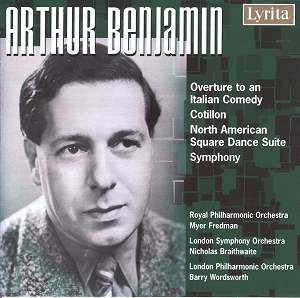
Arthur BENJAMIN(1893-1960)
Overture to an Italian Comedy(1937)
[6:21] Cotillon, A Suite of Dance Tunes
(1938) [12:12]
North American Square Dance Suite(1951)
[13:48]
Symphony (1945) [44:22]
Royal Philharmonic Orchestra/Myer Fredman
(overture); London Symphony Orchestra/Nicholas
Braithwaite (Cotillon); London Philharmonic
Orchestra/Barry Wordsworth (Dance Suite;
Symphony)
rec. 1971, 1982. ADD/DDD
LYRITASRCD.314 [76:50]
It’s good to see that this Benjamin
selection traverses the gorge from light
to dark. The first three works are in
fact lighter fare but the Symphony is
hewn from different rock altogether.
First though we meet the pre-War Overture
to an Italian Comedy. A cocksure
tarantella fizzing with flair and similarly
orchestrated. Cotillon, A Suite of
Dance Tunes comes from the following
year and takes tunes used in the 1719
Dancing Master, furnishing them
with great warmth and lithe embellishment.
Noteworthy in this performance is
the tremendous string warmth in Daphne’s
Delight and the natty percussion
writing in Marlborough’s Victory.
So too is the beautiful string layering
of Love’s Triumph which is a
ravishingly vital example of Benjamin’s
control of, and eloquence in, expressive
romantic tunes. Jigg it a foot
has sinuous charm and there’s a classical
refinement and chaste warmth in Nymph
Divine. These are a cut above the
run-of-the-mill visitations by some
British composers to the world of the
antiquaries. Perceptive and ear catching
particularity is what does the trick.
The North American Square Dance Suite
is a considerably later work, dating
from 1951. These are not so successful
because there’s less Benjamin here than
in Cotillon. One feels he’s meeting
the dances more than halfway over the
“wrong side” and the result is often
delightful but seldom if ever personal.
That said the bluff-relaxed reel (Miller’s
Reel) has a lot going for it and
he does unleash some Lat-Am percussion
in The Old Punk and there’s some
rambunctious chasing going on in Pigeon
on the Pier – though Zez Confrey
fans needn’t get too excited, this isn’t
a Kitten on the Keys salute.
The meat of the programme however is
the 1945 Symphony, an imposing three
quarters of an hour, four-movement work
of very considerable stature. It was
dedicated to Vaughan Williams, who was
himself an influence on Benjamin every
bit as much as Sibelius. One doesn’t
want to overdo these DNA traces in Benjamin’s
symphony, otherwise we can reduce it,
not unlike Moeran’s, in a reductive
spirit. It has powerful strengths of
its own, portentous, dark and glowering
in the opening movement, with sardonic
percussive tattoos as well. The VW string
choir leavening serves as brief respite
– back come powerful brass calls and
martial percussion, increasingly brutal.
There’s no real let up in the Scherzo
except for questions of density of sound.
Fragmented military calls to arms follow
the opening mists before things become
enshrouded once again in shadows. Sustained
with great concentration the slow movement’s
melancholy is indivisible from a more
tensile urgency, dramatically, even
convulsively expressed. And this spirit
of red-hot engagement surges into the
finale, initially gimlet-aggressive,
but one that becomes increasingly engulfing,
and that posits the imminence of celebration
through a tumult of voicings and the
return of material from the opening
movement.
Having not heard any rival versions
I can only urge you to hear this symphony
in whichever version you can find it.
It does everything a good symphony should,
and more besides. There are three orchestras
and three conductors involved in this
Lyrita retrieval. Needless to say the
recording operates at the level once
referred to as “demonstration quality.”
Jonathan Woolf
























 for details
 Royal Philharmonic Orchestra/Myer Fredman
(overture); London Symphony Orchestra/Nicholas
Braithwaite (Cotillon); London Philharmonic
Orchestra/Barry Wordsworth (Dance Suite;
Symphony)
Royal Philharmonic Orchestra/Myer Fredman
(overture); London Symphony Orchestra/Nicholas
Braithwaite (Cotillon); London Philharmonic
Orchestra/Barry Wordsworth (Dance Suite;
Symphony)