Editorial Board
MusicWeb International
Founding Editor Rob Barnett Editor in Chief
John Quinn Contributing Editor Ralph Moore Webmaster
David Barker Postmaster
Jonathan Woolf MusicWeb Founder Len Mullenger
Ludwig van
BEETHOVEN (1770-1827)
Symphony no. 4 in B flat major op. 60 [37:05]
Symphony no. 5 in c minor op. 67 [35:50] Munich Philharmonic
Orchestra/Sergiu Celibidache
rec. live 19 March 1995 (no. 4), 28, 31 May 1992 (no. 5),
Philharmonie am Gasteig, Munich EMI CLASSICS
56521 [77:57]
Eyebrows may be raised initially at the timing for the second
movement of the Fourth Symphony. At 13:19 it is considerably
longer
than the next longest in my collection: Furtwängler (Berlin
1943), which lasts 11:41. Most conductors, including Klemperer,
are around the ten-minute mark.
And yet it does not seem so slow at first. Celibidache manages
to give the idea of a serene 3-in-a-bar, not a plodding 6.
However,
other conductors who begin slowly find they have to speed
up at various points. Celibidache holds his tempo steadily
but, for all the beautiful playing, some passages really
crawl past because there just aren’t enough notes to fill
them at such a tempo.
The first movement begins with an impressive air of mystery
but the “Allegro
vivace” has little more than a sort of stately grandeur to
recommend it. The same goes for the Scherzo. Again Beethoven
has asked for “Allegro vivace” but there’s nothing vivacious
here. The marking for the finale is “Allegro ma non troppo” and
no one could say Celibidache is too lively. The question
is whether this amiable stroll is lively at all.
Slow tempi suggest a comparison with Klemperer, but the latter’s
Philharmonia recording has a drama and tension that are lacking
here.
We know that Klemperer in his younger days was something
of a firebrand. He may have slowed down in later years but
he did not, at least in his best recordings, lose all contact
with his earlier self. It would be interesting to hear an
earlier Celibidache reading to see if the child was father
to the man.
For the Fifth, I have been able to compare the present reading with
one he gave in Milan on 8th January 1960. Consider
these timings:
I
II
III
IV
Toscanini 1939
7:11*
9:31
5:06
8:56
E. Kleiber 1953 (Amsterdam, studio)
7:18*
9:15
5:20
9:25
E. Kleiber 1955 (Cologne, live)
7:30*
9:32
5:08
9:23
Celibidache 1960 (Milan, live)
7:35*
10:47
5:30
8:49
Celibidache 1992 (Munich, live)
7:09
11:43
6:17
10:41
* = repeat taken.
Apart from a somewhat more expansive slow movement, Celibidache 1960
is in the Toscanini/Kleiber zone: a tense, fiery performance
with a terrific sense of line. The articulation he gets from
the Milan strings is extraordinarily vivid. Only a couple
of horn bloopers, in places where they are guaranteed to
cause maximum irritation, would stand in the way of a very
high recommendation if this were issued. It is in any case
clear that Celibidache was at that time one of the supreme
interpreters of this symphony.
At first sight the Munich first movement seems a case where
Celibidache has actually speeded up a fraction, but in reality
he omits
the repeat and takes nearly as long even so. It’s a majestic
reading up to a point but I don’t think I’ve ever heard a
performance, even some quite bad ones, lose tension in the
last pages of the movement the way this does.
The slow movement seems just about tenable at the beginning
but, as in that of the Fourth, there are some passages which,
however
beautifully played, are scarcely coherent at such a crawl.
The scherzo is dignified with a pedantic trio. Basically
the movement has been slowed down to a waltz tempo and the
spooky “Valse triste” Celibidache creates at the pizzicato
return has a certain fascination, though I fail to see what
it has to do with the job in hand. The finale opens like
a grand coronation scene. Shorn of drive, certain passages
later on reduce Beethoven to the level of an outgoing organ
voluntary by some Victorian worthy.
More than anything, I find this infinitely sad. The great
interpretation of the 1960s has not just slowed down, it
has lost all its
fire and tension. There are those who feel this about Klemperer’s
stereo remake. Personally I find its sheer conviction makes
for a greater experience than before, so I’m not a priori opposed
to slow tempi. It’s useless to put timings when Klemperer
gives both outer movement repeats and Celibidache doesn’t,
but the latter’s tempi are slower in every case. Put on Klemperer
after this and you can only be struck at the lithe drama
of his reading.
I don’t know whether these plump, half-hearted traversals show that
Celibidache’s fires had all but burnt out in old age, at
least as far as these two works are concerned. Or whether
they bear out the truth of his own conviction that a performance
was a sort of mystic communion between performers and public
and as such impossible to capture on disc. Personally, I
find it hard to believe that anything SO wonderful in the
hall could be SO apathetic on record. At least something
of the experience would have to remain. Either way, his reputation
was hardly served by putting out these performances and only
reinforces my conviction that Celibidache reached his peak
in his Italian period. Whatever the technical and orchestral
shortcomings of the recordings from this period, the decision
to issue exclusively recordings from his last years was an
easy option and in these two works it hasn’t paid off.
Christopher Howell
Please support our advertisers below by clicking on the logos for further information.
























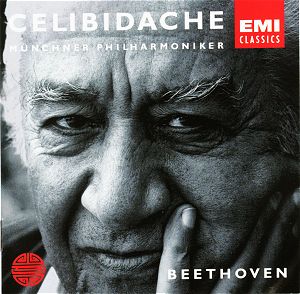

 Munich Philharmonic
Orchestra/Sergiu Celibidache
Munich Philharmonic
Orchestra/Sergiu Celibidache [77:57]