Editorial Board
MusicWeb International
Founding Editor Rob Barnett Editor in Chief
John Quinn Contributing Editor Ralph Moore Webmaster
David Barker Postmaster
Jonathan Woolf MusicWeb Founder Len Mullenger
Pyotr Ilyich
TCHAIKOVSKY (1840-1893)
Piano Concerto no.1 in B flat minor op.23 (1874-75, rev.
1889) [33:29] Nikolai Karlovich MEDTNER (1880-1951)
Piano Concerto no.1 in C minor op.33 (1914-1918) [34:42] Liebliches Kind!, from Nine Goethe Songs op.6
(1904-1905), transcribed for solo piano by Yevgeny Sudbin
[01:46] Yevgeny Sudbin
(piano)
Sāo Paulo Symphony Orchestra/John Neschling
rec. February 2006, Sala Sāo Paulo, Brazil BIS SACD-1588 [71:16]
This is my first encounter with a major work by Medtner. This
may not make me a very authoritative critic from one point of
view. From another, I can put myself in the shoes of somebody
wondering if Medtner is likely to interest him.
Quite definitely, I should say, if you want to hear a composer
of originality, with a sound-world all his own, of his times
but possibly out of joint with them. Forget anything you’ve
heard about a “Russian Brahms”. Nothing here sounds remotely
like Brahms to me. Forget, too, any idea of “Rachmaninov
without the tunes”. Yes, there are references to the big-scale
Russian romantic piano concerto but no, you couldn’t call
the bold opening tuneless. Probably the one category of listener
who should be wary is that which seeks a straightforward,
unproblematic post-Rachmaninov piece of virtuoso barnstorming.
Fantastic virtuosity is certainly required – and is provided
here – but this is a work where nothing is quite what it
seems.
The Rachmaninov concerto it most nearly resembles is the
Fourth, especially in its more extensive first version – which nevertheless
post-dates the Medtner First Concerto and might have taken
its cue from it. Rachmaninov had the greatest admiration
for Medtner as a composer. More than a romantic piano concerto,
it is a concerto about the problems of composing a romantic
piano concerto in a post-romantic world. The opening promises
the full works, and on many occasions the orchestra seems
to be preparing for a big gushing piano entry. Then when
the piano comes in, its treatment of the theme is sardonically – or
whimsically – different from what one might expect. At other
times, the piano makes a big “romantic concerto” entrance
when you’re not expecting it to. Round about half-way through
the finale it sounds as if we’re hotting up for a typical
Rachmaninov 2 conclusion, with soaring strings and feverish
work from the pianist. But the moment dissolves. I won’t
risk a spoiler by telling you what happens at the end, but
it’s quite extraordinary.
I may have given you the idea of something weird and shapeless,
yet it doesn’t actually sound like that. It sounds improvised,
but improvised to a preordained scheme, as it were. Improvisation
to a preordained scheme is a characteristic of Indian music,
of course. Perhaps that is why the Maharajah of Mysore was
sufficiently fascinated by Medtner to finance the first recordings
of his works. For myself, it is a long time since I heard
a work by a composer hitherto only a name to me, which has
impressed me so much.
I’m also mightily impressed by the performance. If I don’t
find here the complicated textures some people complain of
in Medtner,
this is no doubt because Sudbin makes everything crystal
clear. He seems to know exactly which of the several strands
our ears should be directed to. The melodies always have
convincing shape and he lets us understand where each phrase
is going.
The same may be said of John Neschling’s conducting. The Sāo
Paulo Symphony Orchestra proves a fine band, with some excellent
woodwind soloists and warm-sounding strings. The interplay
between soloist and orchestra is beautifully clear.
I cannot imagine a better performance, but the downside of
my newly-kindled enthusiasm is that I cannot tell you whether
you will find
at least its equal in the discs by Scherbakov (Naxos), Alexeev
(Hyperion), Tozer (Chandos, deleted) or Zhukov (a recording
from the Russian archives, I don’t know if it’s available
now). All these except Zhukov come with more Medtner. I can
only leave the reader to sort out whether the couplings here
are helpful or not.
The tiny song-transcription did little for me, but I wouldn’t
discourage Sudbin from making others. Perhaps a group of
five or six
would leave a more lasting impression.
Don’t make the mistake I made and listen to the Tchaikovsky immediately
after the Medtner. After the latter’s complex world, Tchaikovsky’s
language seemed simple and straightforward to a fault. I
think the impression was also partly due to a delightful
but swift, rather lightweight performance. Sudbin seems to
take the view that Tchaikovsky was a sort of Russian Saint-Saëns.
It’s certainly refreshing to hear the work shorn of bombast,
without tearing passions to tatters. The slow movement, for
example, has a grave charm as opposed to overpowering melancholy
and the finale concludes with jubilation rather than rhetoric.
I think my own preference would be for a larger-scale reading,
but from its own point of view this is carried off perfectly,
by the orchestra and conductor as well as the pianist.
One query. At the beginning of the slow movement the third note of
the flute melody is altered so that it corresponds to the
melody as played immediately afterwards by the piano. I have
occasionally read about performances that do this, though
no CD in my collection does so.
Sudbin’s love for these works extends to his writing extensive, readable
and – especially for the Medtner – really helpful notes,
printed in English, German and French. BIS, for their part,
provide an excellent recording, which I heard as a normal
CD.
Christopher Howell
Please support our advertisers below by clicking on the logos for further information.
























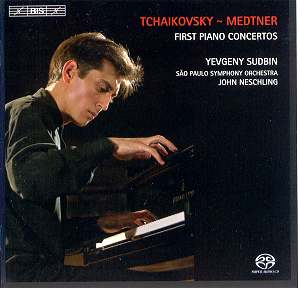

 Yevgeny Sudbin
(piano)
Yevgeny Sudbin
(piano)  [71:16]