Editorial Board
MusicWeb International
Founding Editor Rob Barnett Editor in Chief
John Quinn Contributing Editor Ralph Moore Webmaster
David Barker Postmaster
Jonathan Woolf MusicWeb Founder Len Mullenger
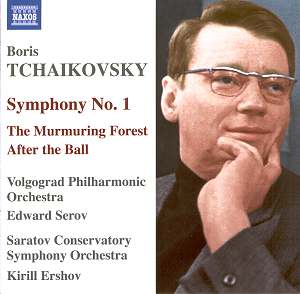
Boris TCHAIKOVSKY (1925–1996)
Symphony No.1 (1947)a [32:17]
Suite The Murmuring Forest (1953)b [13:26]
Suite After the Ball (1952)b [16:54] Volgograd
Philharmonic Orchestra/Edward Serova;
Saratov Conservatory Symphony Orchestra/Kirill Ershovb
rec. Volgograd Central Concert Hall, June 2006 (Symphony
No.1); Great Hall, Saratov Conservatory, June 2006 (Suites) NAXOS 8.570195 [62:38]
Boris Tchaikovsky composed
his First Symphony in 1947, at about the time of his graduation
from the Moscow Conservatory, where Shostakovich was one
of his teachers. Shostakovich was impressed by the symphony
and recommended it to Mravinsky, who agreed to give the first
performance. These were the dark Zhdanov years, which had
ostracised Shostakovich as well as many other Russian composers.
Anyone belonging to Shostakovich’s circle was also regarded
with much suspicion. As a result, the first performance of
the symphony took place in 1962 conducted by Kondrashin.
The
First Symphony is traditionally laid-out, in four movements
with the Scherzo placed second. The first movement, roughly
in modified sonata-form, opens with a pensive tune played
by the strings, that progressively expands generating new
themes and variants. Some fragments will keep re-appearing,
which helps keep the overall formal and thematic coherence
of the whole. The first movement ends calmly and the animated
Scherzo cuts-in in full contrast with the preceding music.
This is lively and slightly ironic. A whimsical tune played
by the clarinet is not unlike some material heard in the
later Clarinet
Concerto (1957). The third movement is a deeply-felt
Largo unfolding without undue pathos. The final movement,
actually a set of variations, which some may find inconclusive,
is a typical Tchaikovsky product, in that the composer liked
to end a work in a deceptively simple way. Some may understandably
expect some sub-Shostakovich stuff; but even a cursory hearing
will reveal a number of striking differences and many elements
that will be regarded as typical Tchaikovsky fingerprints:
clarity of thought, clarity and lightness of the scoring
and – in the final movement – some childlike, though definitely
not childish, innocence. The latter is a recurring feature
in many of Tchaikovsky’s later works: the final section of Signs
of theZodiac (1974), the finale of
the Chamber Symphony (1967) or the concluding
song of the beautiful song cycle The Last Spring (1980).
It is clear, though, that Tchaikovsky never rejected the
Russian symphonic tradition, but that he could breathe fresh
air into it. Similarly, he managed to keep the temptations
of Neo-classicism at bay. Tchaikovsky’s First Symphony clearly
reveals a real though personal symphonist which later works
will only serve to confirm.
After
leaving the Moscow Conservatory he had to find some way to
make a living. He thus worked for the radio and also composed
a number of film scores. Two of them, Aibolit-66 (1966)
and Balzaminov’s Marriage (1964), are available
on Boheme Music
(CDBMR908085). While working for the radio he composed
a number of incidental scores for radio dramas. He had a
particular fondness for his music for Korolenko’s play The
Murmuring Forest (1953), the score of which was considered
lost, much to the composer’s dismay. However, it turned up
in the archives of the Moscow Radio Library and the suite
heard here has been arranged from that material. In 1952
he composed some incidental music for Leo Tolstoy’s play After
the Ball. Writing such music provided him with many opportunities
to enlarge his palette. The music for After the Ball has
its share of affectionate parody and tongue-in-cheek irony,
without ever overlooking the darker moments of the play.
The score consists of a number of dance tunes: a Waltz that
might have been written by his namesake; but also some more
personal music, such as in March [track 15], that has a fife-and-drum
tune redolent of the opening of Prokofiev’s Lieutenant
Kijé. Tchaikovsky, however, counterpoints it with
an ominous modal melody, with strongly expressive results. The
Murmuring Forest is actually much finer and certainly
more personal. In this Tchaikovsky proves himself a brilliant
illustrator; and the score abounds in felicitous touches:
the atmospheric opening of the first movement [track 5] and
its varied restatement in the final section [track 9].
These
early works of Tchaikovsky are really well served by excellent
performances that make the best of them. The First Symphony
stands out as an accomplished work of substance. This impressive
piece reveals a serious, sincere composer, whose music succeeds
in being personal, without either rejecting tradition or
adopting a more modernistic stance, while overtly eschewing
Socialistic Realism. I hope that this, the second
Naxos disc devoted to Tchaikovsky’s music (concertos on 8.557727), will
soon be followed by many more. I particularly look forward
to
hearing
his
six string quartets.
Hubert Culot
Boris
Tchaikovsky’s symphonies on discs:
Symphony
No.2 and Symphony with Harp (1993) Relief CR991080 Sebastopol
Symphony (1980) Chandos
CHAN 10299H
Please support our advertisers below by clicking on the logos for further information.

























 Volgograd
Philharmonic Orchestra/Edward Serova;
Volgograd
Philharmonic Orchestra/Edward Serova;