Editorial Board
MusicWeb International
Founding Editor Rob Barnett Editor in Chief
John Quinn Contributing Editor Ralph Moore Webmaster
David Barker Postmaster
Jonathan Woolf MusicWeb Founder Len Mullenger
Felix MENDELSSOHN (1809-1847)
Violin Concerto in E Minor, Op. 64 (1844) [26:59] Johannes BRAHMS (1833-1897)
Violin Concerto in D Op.77 (1878) [39:51] Joseph Szigeti(violin)
New York Philharmonic-Symphony Orchestra/Bruno Walter (Mendelssohn), Dmitri Mitropoulos
(Brahms)
rec. February 1941 (Mendelssohn) and October 1948 (Brahms) MUSIC AND
ARTS CD1197 [67:55]
Fortunately Szigeti left
behind a number of performances of the Brahms Concerto, some
commercial and some recorded off-air. According to taste
one can go for the Hallé/Harty, Philadelphia/Ormandy and
the stereo LSO/Menges from the commercial discs, and the
Boston/Munch and this NYPSO/Mitropoulos from the live broadcast
material. All repay the closest scrutiny because despite
the pronouncements of current proponents of binary oppositions
in music making, players such as Kreisler, Huberman and Busch
did not possess hegemony in the Brahms.
The
Brahms finds Szigeti with Mitropoulos, the conductor who
apparently held Szigeti in higher esteem than any of his
contemporaries. Let me say at once that this is a performance
that affords manifold insights into the musicianship of two
great musicians. True, the recording exacerbates the tensile
and razory quality of Szigeti’s tone but this was a constituent
of his playing and the insights revealed by him are legion.
Foremost among them is his considered approach to portamentos
and expressive finger position changes. In the Harty recording
the tension between the pervasive sliding of the Hallé strings
and Szigeti’s more sparing use of the device generated a
fruitful if sometimes incongruous tension. Here many years
later in New York we find that the device is very much less
in evidence in the orchestral ranks. Mitropoulos directs
and sculpts a powerful and incisive orchestral sound world;
he’s slower and steadier than Harty’s more fluid and spontaneously
romanticist approach.
The finale in particular
shows just how commanding this pairing can be. Szigeti’s
playing is masculine but sensitive; downward portamenti are
employed for significant expressive intent. Just once one
senses he might become derailed but he recovers. There is
a little damage to the source material – a few acetate ticks
and from 2:45 the sounds starts to crumble, though Ward Marston
has done his best to mask it. There’s some hum audible as
well so I’d recommend taking down the bass frequencies.
We
know Szigeti best in the Mendelssohn from his 1935 Beecham
recording, multiply reissued over the years. In strictly
temporal terms this one with Walter differs hardly at all
though there are certainly differences in attack and both
conductors take intriguingly personalised views in the finale – Beecham
giving a dramatic kick, Walter bringing out capricious Midsummer
Night’s Dream wind tracery. The recording is rather boxy
and Szigeti is well forward in the balance, which because
of his particular tonal qualities means that this is an occasionally
abrasive ride. The brief audience coughs and chuffing on
the original acetates are not intrusive though they’re both
audible. Szigeti’s bowing at the start of both the opening
movement and the finale is not beyond reproach but otherwise
this is an impressive reading, and one interpretatively consistent
with that which he gave with Beecham a few years earlier.
Ward
Marston’s transfers do well with the source material. The
Brahms was once on AS disc 518 where it was coupled with
the Szigeti/Mitropoulos Mozart K216 Concerto – an enviable
all-Mitropoulos conducted disc. The Marston sound is not
radically different – in fact the differences are small,
though his small restoration of the finale crumble in the
Brahms is good.
Talking
of good there’s a long and admiring note from Abram Chipman.
And of course Szigeti admirers should not hesitate to add
this disc to their collection.
Jonathan Woolf
Please support our advertisers below by clicking on the logos for further information.
























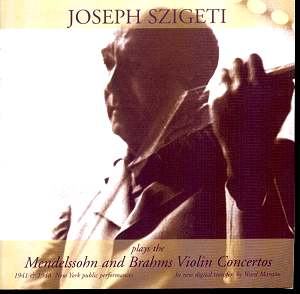

 Joseph Szigeti (violin)