Editorial Board
MusicWeb International
Founding Editor Rob Barnett Editor in Chief
John Quinn Contributing Editor Ralph Moore Webmaster
David Barker Postmaster
Jonathan Woolf MusicWeb Founder Len Mullenger
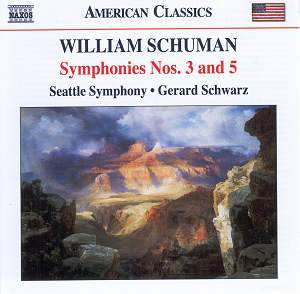
William SCHUMAN (1910-1992)
Symphony No. 3 (1941) [27:28]
Symphony No. 5 Symphony for Strings (1943) [17:54] Judith (1949) [22:22] Seattle Symphony Orchestra/Gerard
Schwarz
rec. S. Mark Taper Foundation Auditorium, Benaroya Hall, Seattle, WA, September
2005 (3); Seattle Center Opera House, 20 January 1991 (5); 5, 7 January 1992
(Judith). DDD NAXOS 8.559317 [67:44]
Two
of the items included here were originally part of the series
of recordings of American orchestral music that Gerard Schwarz
made for the Delos label in the 1990s. The Fifth Symphony
and Judith were issued, together with other Schuman
pieces, on DE 3115. I’m delighted to see them restored to
circulation. The recording of the Third Symphony, however,
is brand new – and just as welcome.
It’s
worth noting, I think, that Schuman himself approved at least
some of the recordings that were on that original disc. A
note in the Delos booklet records that he heard an advance
copy of part of it in January 1992, just a month before his
death, and he wrote to the producer “The performance has
so many superlative elements …. It is rare indeed to have
the combination of intellectual depth, technical superiority
and emotional involvement to the degree that any composer
would hope for. Gerry [Schwarz] achieves those desiderata
in a seemingly effortless way. What he has accomplished with
that orchestra is outstanding.”
The
Fifth Symphony comes from that Delos disc. It’s cast in three
movements. The first is vigorous and strongly rhythmical.
It’s a movement of sustained energy. The central slow movement
lasts for 8:25, nearly half the length of the entire piece.
There’s a somewhat febrile central section but the outer
paragraphs are calmer, especially the closing pages when
the music dies away virtually to nothing. The finale is,
once again, energetic; the music scurries along. Both the
annotator for this release and his colleague who wrote of
the Delos disc rightly point out the parallel between some
pizzicato passages here and the third movement of the Tchaikovsky
Fourth. This is an exuberant movement. Schuman’s music very
often has a serious countenance but this time the music smiles.
The ending sounds positive but not as emphatic as you might
expect.
It
was at that point that I made some comparisons with Leonard
Bernstein’s 1966 New York Philharmonic reading - Sony Classical
SMK 63163; I’m unsure if this is still available. In Bernstein’s
hands the music sounds quite different. In part this may
be due to the closer recording. The extra weight of the NYPO
strings no doubt contributes also. But I have to report that
Bernstein seems to me to impart more passion to the music,
to dig deeper. Good though Schwarz is, Bernstein, as so often,
adds a different dimension.
Judith was also originally issued by Delos.
This score dates from 1949 and represented Schuman’s second collaboration with Martha Graham – they’d
previously worked together in 1947. The tale, from the Biblical
Apocrypha, is a gory one. Judith, an Israelite widow – the
role was created by and for Martha Graham – decides to take
action to rescue her people from the oppression of the Assyrians
and their leader, Holofernes. She infiltrates the Assyrian
camp, seduces Holofernes and then slays him in his own tent,
decapitating him and carrying the head back as a trophy to
her people. Schuman illustrates this story with vivid, sometimes
graphic music. Schwarz and his orchestra play it strongly
and, it seems, with a good sense of drama. The Naxos notes
are quite helpful in describing the action – though the Delos
essay has a slight edge – but it would have been helpful
if some cuing points had been provided and linked in to the
notes.
The
brand new release is that of the Third Symphony. This dates
from 1941 and it was first performed – as was the Fifth – by
Koussevitzky and the Boston Symphony. As befits a wartime
work it’s a powerful piece, cast in two movement though each
of these is further subdivided into two. The scoring reflects
Schuman’s frequent predilection for brass and percussion.
The first movement is entitled ‘Passacaglia and Fugue’. In
the Passacaglia the strings and brass predominate. It’s strong,
sinewy music of great purpose. The fugue, when it comes (6:09),
is launched by the horns and the material is quite jagged.
It’s only at 7:40, when the music enters a quieter episode,
that we really find the wind coming into their own for the
first time but when Schuman does bring them into the picture
he does so by means of some effective, twining writing. Eventually
the timpani launch more propulsive music which, over the
next three minutes or so, brings the movement to a bracing,
exciting end.
The
second movement is called ‘Chorale and Toccata’. As Steven
Lowe observes in his note, the Chorale is “a haven of comparative
serenity.” The music is gravely beautiful and a haunting
trumpet solo, supported by hushed strings (1:21) really catches
the ear. Is this, I wondered, music of the Great Outdoors
or of the City? However, at the risk of being pedantic I
must point out one small but very important slip in the notes.
Schuman is quoted as saying that the Chorale “really represents
the spirit of composition.” That statement does make sense.
However Michael Steinberg has the same quote in his essay
on the work (The Symphony, A Listener’s Guide. (1995),
p. 498) and he gives it with the insertion of the definite
article before the word “composition”. This seems to me to
make even greater sense and it’s quite an important distinction.
The Toccata begins at 7:47 with a low, quiet note on contrabassoon
over which a very quiet side-drum tattoo is played. This
is a moment of very effective tension. From these quiet beginnings
the woodwinds whisk us away into an energetic display piece,
punctuated at one point by a slower interlude for the strings.
The ending is explosive and jubilant, led by Schuman’s favourite
brass and percussion sections.
Schwartz
conducts a very good performance of this work, I think. Once
again, however, he faces competition from Leonard Bernstein and
the NYPO. Bernstein’s first traversal is on the aforementioned
Sony disc and dates from 1960. He’s broader and weightier
than Schwarz, taking 30:56, more than three minutes longer.
By the time he set the piece down again, live
in 1985 for DG,
his interpretation had lengthened further, coming in at 32:20.
Despite the more modern sound this, I
think, is a bit too much of a good thing and I prefer Bernstein’s
first thoughts. As in the Fifth I think Bernstein finds a
bit more than Schwarz in terms of drama and thrust. But perhaps
it would be fairer to say that he finds different emphases
in the music.
This
is a very valuable disc and a worthy follow up to Schwarz’s
previous discs of Schuman symphonies. Anyone who has the
original Delos disc may baulk at the duplication but it would
be a pity to miss out on the new performance of the Third.
I couldn’t detect any significant differences between the
sound on the two discs. Both are very good. I can recommend
this disc with confidence, especially to those collecting
the series, for William Schuman is a considerable symphonist
and it’s good to find his works becoming widely available
and in such good performances. However, I’d also urge collectors
to hear Bernstein for his insights into these fine symphonies.
I look forward to the completion of this Naxos cycle with
some impatience.
John
Quinn

























 Seattle Symphony Orchestra/Gerard
Schwarz
Seattle Symphony Orchestra/Gerard
Schwarz