This excellent CD
offers us a chance to hear some of Scheidt’s less well-known compositions
performed with elegance and passion under the rubric of sacred
‘concerto’s in that word’s seventeenth century meaning. Apart
from a period of study with Sweelinck between 1607 and 1609, Samuel
Scheidt lived his entire life in Halle on the Saale, where he
was court organist and had the opportunity to work with such leading
composers of the day as Praetorius and Schütz. His elevation to
Hofkapellmeister in 1619 ushered in a brief period of productivity
for Scheidt, both in composition and publication. But the bloodshed,
disruption and destruction of the Thirty Years War adversely affected
that opportunity… particularly in terms of the curtailed forces
for which Scheidt’s sacred music was composed.
Wies Gott gefällt,
for instance, has been arranged (reconstructed, really) here
with more performers than called for in the original score and
the inclusion of a couple of sinfonias from the 70 contained
in the composer’s 1644 collection. You need not be wary of this,
Scheidt wrote that the pieces were to be used… ‘for any concerto
or motet at the beginning, in the middle or wherever you want.’
This is the longest of the nine works on this excellent CD and
has some beautiful and memorable themes and sound painting.
A similar conclusion
is easily reached for Kommt her, ihr gesegneten; in particular
the addition of a trombone trio and a coro di luti for
the forces of evil and good respectively point up that contrast
as the latter employs heavenly figures and the former chromatic
descents into… the other place. Lovely.
Contrapuntal sections
from the original hymns and triple time homophonic material alternate
in both Nun lob mein Seel and Freu dich in ways
(particularly the very effective use of a double choir) redolent
of Schütz. In fact the latter was written in 1628 to celebrate
the wedding of a Halle couple who were to buy a house from Schütz!
Warum betrübst
du is an animated piece celebrating – at such sorrowful
times – the resilience of the spirit… choirs and soloists exchanging,
almost dancing on, expressive text and uplifting music testifying
to the God who ‘aller Ding erschaffen hat.’ Starting sombrely,
it builds its confidence through a kind of static and understated
certainty to which the performers here more than do justice.
It’s in contrast to the more conservative (and probably earlier)
Ist nicht Ephraim while Christo, dem Osterlämmlein
and Ich bin die Auferstehung are two of more than a hundred
‘sacred songs for five voices in the madrigal style’ offered
by Scheidt to the Duke of Braunschweig in 1642. Exemplary in
the arrangements of these pieces is the restrained addition
of instruments specifically to emphasise key moments in the
text and to underline the return of the unadorned main melodies.
Earlier still (1638?)
is the joyous polychoral Nun danket alle Gott; it was
written at a time of some loss for Scheidt – although he kept
his Hofkapellmeister position, he lost his position at court
and had to rely on teaching and occasional composition for his
survival. Scheidt died in poverty.
Musica Fiata and la
Capella Ducale have all the right sensitivity towards the nuances,
strengths and emotions of this music without undue indulgence.
The instrumental playing is individually clear and wholesome.
The singing is beautiful and transparent. The one quality that
stands out through the many shades and turns these performers
make in exploring some of Scheidt’s most persuasive music is their
‘genuineness’. The tempi are regular, the singing down to earth
yet inspired. Behind the always-resisted temptation to over glamorise
the more brilliant moments (e.g. the end of Nun danket)
can be perceived a very real conviction to communicate what Scheidt
wrote in its musical context and with sophistication and enthusiasm.
Exemplary.
Despite the odd typo
in the English translation of the text, the booklet is useful
and comprehensive with full texts in German and English. It’s
an atmospheric recording with much to commend it. None of the
works here is available elsewhere and they all have special and
lasting appeal.
Mark Sealey
























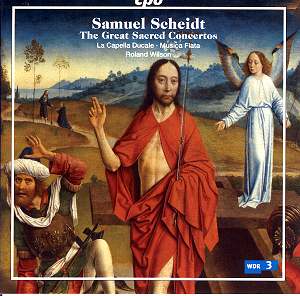

 La Capella
Ducale: Monika Mauch (soprano); Constanza Backes (soprano); Ralph
Popken (alto); Werner Buchin (alto); Wilfried Jochens (tenor); Markus
Brutscher (tenor); Harry van der Kamp (bass); Wolf Matthias Friedrich
(bass)
La Capella
Ducale: Monika Mauch (soprano); Constanza Backes (soprano); Ralph
Popken (alto); Werner Buchin (alto); Wilfried Jochens (tenor); Markus
Brutscher (tenor); Harry van der Kamp (bass); Wolf Matthias Friedrich
(bass)