Editorial Board
MusicWeb International
Founding Editor Rob Barnett Editor in Chief
John Quinn Contributing Editor Ralph Moore Webmaster
David Barker Postmaster
Jonathan Woolf MusicWeb Founder Len Mullenger
Claudio MONTEVERDI (1567-1643) Madrigali guerrieri et amorosi: libro ottavo (1638)
1. Combattimento di Tancredi e Clorinda [22:03]
2. Il Ballo delle ingrate [36:10]
3. Sinfonia a doi violini e una viola di brazzo [0:45]
4. Altri canti d’amor, tenero arciero, a sei voci con quattro
viole e doi violini [9:52]
5. Lamento de la Ninfa [4:43]
6. Vago augelletto, che cantando vai, a sei e sette voci
con doi violini e un contrabasso [5:42] 7. Perchè t’ en fuggi, o fillide? A
tre (alto, tenore e basso) [5:59] 8. Altri canti di marte, a sei voci et doi
violini [8:59]
9. Ogni amante è guerrier [14:18]
10. Hor che ’l ciel e la terra e ’l vento tace, a sei voci
con doi violini [10:46]
11. Gira il nemico, insidioso amore [5:43]
12. Dolcissimo uscignolo, a cinque voci, cantato a voce piena,
alla francese [3:42]
13. Ardo, ardo, avvampo, mi struggo, a otto voci con doi
violini [4:16]
14. Introduzione e ballo [9:40]
15. Se vittoria sì belle, a doi tenori [2:39]
16. Su, su, su, pastorelli vezzosi, a tre, doi canti e alto
[2:33]
17. Ardo e scoprir, ahi lasso, io non ardisco, a doi tenori
[3:30]
18. Chi vol aver felice e lieto il core, a cinque voci, cantato
a voce piena, alla francese [2:06]
19. Armato il cor d’adamantina fede, a doi tenore [2:20]
20. Non partir ritrosetta, a tre, doi alti e basso [4:17]
21. O sia tranquillo il mare, a doi tenori [4:20]
22. Mentre vaga angiolwtta, a doi tenori [9:31]
23. Ninfa che, scalza il piede [5:19] Concerto Italiano/Rinasso
Alessandrini
rec. (1-3) January 1998, Centro Giovanni XXIII, Frascati,
Italy; (4-13) February 1997, Salone della Musica, Villa Medici,
Ora
Giulini, Briosco, Italy; (14-23) December 2005, Palazzo Farnese,
Rome, Italy. OPUS
111 OP30435 [3
CDs: 58:24 + 75:11 + 46:22]
Monteverdi’s
eighth book of madrigals was published in Venice in 1638,
under the title of Madrigali guerrieri et amorosi (Madrigals
of Love and War), some nineteen years after the publication
of his seventh book of madrigals (also in Venice). Madrigali
guerrieri et amorosi actually incorporates some work
(such as the ‘Ballo delle ingrate’) actually predated, by
some distance, even that seventh book; some of the works
included belonged to the 1620s; some was written nearer to
the date of publication. Taken as a whole, this was certainly
the most substantial and complex collection published by
Monteverdi and, since it contains some of his very best work,
it follows that this 1638 volume is one of the high points
of European vocal music.
There
is masterpiece after masterpiece in this great collection
and through the skilful use of varied resources which characterises
Monteverdi’s work here, the sheer precision and sensitive
strength of Monteverdi’s writing, the human passions (War
and Love are, essentially, a pair of complementary opposites – antithetical
states of the human soul and of human activity, which turn
out, as experienced, to have more than a little in common)
find glorious and moving expression with remarkable power.
The nature of Monteverdi’s ambitions – and some sense of
how radical they were – is made very clear in the Preface
which he contributed to the volume. In it Monteverdi relates
his musical practice to his belief that the human mind “has
three principal passions or affections: that is, anger, temperance
and supplication (or humility)”, observing that “the intrinsic
nature of our voices falls into high, low and medium registers” and
affirming that musical theory describes three corresponding
styles by the terms “concitato [agitated], … temperato [temperate]
and molle [soft/languid]. All three are to be heard
in the Madrigaliguerrieri et amorosi. AsMonteverdi
himself points out, he had few working models of the ‘agitated’ style
and this was his greatest innovation – not least as it was
employed in some parts of ‘Il Combattimento di Tancredi e
Clorinda’. Overall we might say that the defining feature
of Monteverdi’s work here was to find ways of putting all
the resources of music, instrumental and vocal, at the service
of text, of meaning and mood as enshrined in the verbal text,
without ever robbing music of its own nature or dignity.
The results might, in a sense, be thought of as bringing
about the end of the madrigal by stretching and fulfilling
its conventions and possibilities so absolutely that serious
composers could no longer return to the ‘conventions’ of
the form as they had previously been established. As Rinaldo
Alessandrini puts in his booklet notes – “In the eighth book,
Monteverdi demolishes the form of the classical madrigal,
setting himself the task of reinventing it each time according
to the demands and potential of a poetic text”. And how well
he does it!
What
we have on this three CD set is a thoroughly rewarding interpretation
of Madrigaliguerrieri et amorosi under the
direction of Alessandrini, working with his Concerto Italiano – or,
to be more precise, with two (three?) slightly different
incarnations of the Concerto Italiano. The first two CDs
were recorded in the 1990s and have been issued previously.
The third CD is, I believe issued here for the first time,
and was recorded less than eighteen months ago.
The
two most explicitly dramatic, or at least quasi-dramatic
pieces – and the longest – are both presented on Disc 1.
Both ‘Il Combattimento di Tancredi e Clorinda’and
the ‘Ballo delle ingrate’ were printed with what are effectively
stage directions. The score of the ‘Ballo’ is prefaced by
the following instructions:
“A
set must be constructed showing the mouth of Hades with four
openings on either side, belching forth fire, and from which
the Ingrate Souls emerge two by two with mournful gestures
to the sound of the entrance music which marks the start
of the ballet, and which may be repeated until all have reached
their respective positions in the centre of the stage ready
for the ballet to begin. Pluto stands in the centre, leading
them with slow, solemn steps. The entrata over, he stands
aside for a time; the dance begins, but is interrupted by
Pluto, who addresses the Princess and the other Ladies present
as indicated. The Ingrate Souls should wear ash-grey costumes
adorned with artificial teardrops. The ballet over, they
return to Hades in the same way as they entered, and to the
same mournful music; one of them remains behind on stage
to sing the lament as written before she too returns to Hades”.
With
a text by the significant poet Ottavio Rinuccini, words,
music, movement, costume, scenery – and, no doubt, other
elements too – have taken us well beyond the concept of the ‘madrigal’ as
normally understood. The two pieces on this first disc get
particularly impressive performances. They – perhaps especially
the ‘Combattimento’ – are especially well suited to Alessandrini’s
approach, with his fondness for startling contrasts of tempo
and dynamics, his encouragement of his singers to characterise
in a way that can, at times, come near the boundaries of
caricature. Roberto Abbondanza’s bass voice as the narrator
in the ‘Combattimento’ is a thing of beauty and conviction,
his understanding of the stile concitato everywhere
apparent. As Clorinda, Elisa Franzatti sings with exquisite
tenderness in her dying words to Tancredi, persuasively interpreted
by Gianluca Ferrarini. In the ‘Ballo’ another bass, Daniele
Carnovich is an imperious Pluto, singing with both immense
gravity and considerable grace.. Cupid (Francesca Russo Ermolli)
and Venus (Rosa Dominguez) blend their voices magically.
In
the second and third CDs Alessandrini and his company give
us the shorter pieces, some of them rather closer to our
traditional understanding of the madrigal, though the use
of instrumental accompaniment, used as part of Monteverdi’s
subtle understanding of his chosen texts – texts by poets
such as Marino, Petrarch, Guarini, Rinuccini and Fulvio Testi – makes
for music which is never easily or obviously limited by generic
definitions. There are many minor masterpieces (minor in
length, at least) here. The setting of Petrarch’s sonnet ‘Hor
che’l ciel e terra e ’l vento tace’ is quite stunning, beginning,
in the octave, with a hushed evocation of silence and the
night sky, an evocation musically troubled by the unhappy
speaker’s pains of love even before the text makes them explicit,
and closing, in the setting of the sestet, in music which
evokes the text’s despair while retaining great dignity.
The rhythmic control of this performance, and the perfection
with which voices are blended, are exemplary. Rossana Bertini
is a seductively poignant soloist in the famous ‘Lamento
della Ninfa’ – but it would be pointless to go on listing
the many pleasures of this set. I suspect that I should end
by listing every track.
In
an interview printed in issue 17 of Goldberg, Alessandrini
summed up his view of Monteverdi (and especially his madrigals)
very succinctly:
“ Monteverdi
was the father of a revolution in Western music. He was at
a crossroads between vocal music, instrumental music and
opera, and invented a new, far-reaching style. He made huge
strides, for example, in the Eighth Book of Madrigals, particularly
in Il Combattimento di Tancredi e Clorinda. There
is no word to define this work; it isn’t a madrigal or an
opera”.
That
is the vision that underlies these recordings, and it makes
for powerful, beautiful and moving listening. There are other
complete recordings of Monteverdi’s Eight Book of Madrigals
and – of course – there have been many recordings of individual
items from the book. Here and there – especially on the first
two CDs – there are very slight blemishes of instrumental
intonation in Alessandrini’s performances. But overall this
is a splendid set, a recording which does something like
justice to one of the great vocal collections. These are
very ‘Italian’ performances – full of drama, full of intensity,
not afraid of exaggeration, never hampered by reticence.
Some listeners will, perhaps, find them just a little too
much so. Not me. This is the best complete set I know. Alessandrini
and his company show one just how fully Monteverdi’s work
speaks of the aesthetic world of its time, in a language
that we can hear and understood. Alessandrini finds in the
music (and texts) the equivalent of that theatricality of
gesture and posture which characterises the paintings of
Monteverdi’s contemporaries such as, say, Guido Reni and
Guercino, a theatricality which is thoroughly ‘physical’ and
yet simultaneously registers the movements of the heart and
spirit. So does Monteverdi’s music. Look at Reni’s Angel
Musicians in the frescoes of the Palazzo del Quirinale in
Rome and it’s hard not to feel that they must be playing
and singing Monteverdi! And if we could hear them they would
surely sound something like the music we hear on these three
discs!
Glyn Pursglove
Please support our advertisers below by clicking on the logos for further information.
























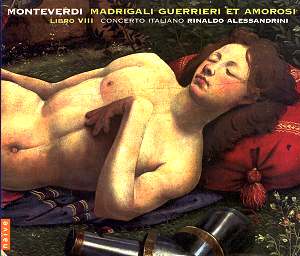

 Concerto Italiano/Rinasso
Alessandrini
Concerto Italiano/Rinasso
Alessandrini