Fresh from my audition
of the Christopher Nupen DVD portrait of Milstein (see review)
comes this concert film of the great man with Adrian Boult in
1972. We also see Boult conducting Vaughan Williams’ Eighth
Symphony at a concert in the Festival Hall later in the year.
A few things before
we begin. Navigation is easy and effective. Individual movements
can be cued in. There is a minimal booklet as this series has
dispensed with text and prefers its documentary information
to be presented as an appendix in the disc. I don’t actually
enjoy wading through texts on screen, even when written by Tully
Potter, but it’s not too onerous here. I’d still prefer to read
a booklet however. The disc cover also features a rather more
elderly looking Milstein than was the case in 1972 and the uniform
black and white “archival” look may not prepare one for what
is actually a colour film.
Such matters aside
this is a fascinating document of a meeting between the two
men with Boult conducting the LPO, then led by the saturnine
and brilliant Rodney Friend. One of the more fascinating things
is that, for all his aristocratic and motionless command, Milstein
shows signs of being uncomfortable. He repeatedly turns his
back on the audience to check his tuning. Signs of unease appear
as early as the orchestral introduction when Milstein plays
along with the first fiddles. I saw Shumsky do this when he
performed the Elgar at the Barbican (one of the greatest performances
of anything I’ve ever heard) and it’s hardly a novelty. But
Milstein does it throughout the Beethoven. Whether it was a
problem with the strings, or the heat (or coldness) of the hall
that February evening it’s hard to say. But his tuning is unusually
suspect from time to time and he spends “off –duty” passages
on more remedial work than one would possibly expect from an
otherwise untroubled performance.
That performance
is nevertheless of an elevated standard. He uses his own cadenzas
and phrases in the Larghetto with his accustomed seraphic serenity.
Despite whatever tuning problems he may have faced, the technique
is strong enough to resist. Boult is an accompanist of tremendous
sagacity and control. To watch his fabled long baton technique
is to be in the presence of a technician of considerable eloquence.
With Boult the tip of the baton was the thing. Here as ever
he generates power through its precise employment. His left
hand is soothing, shushing, never raised above shoulder level.
But a final grouse about some of the camera work. There is a
lengthy shot of the orchestra from a distance that adds nothing.
And someone has decided to cut Milstein’s entries very fine.
We see the orchestra, feel the tension of (say) the opening
broken octave entry and then suddenly cut to Milstein just as
he begins. This happens repeatedly; not especially musical work
from the editing booth.
Boult’s on testy
form at the beginning of the VW. Person or persons unknown in
the audience have irritated him and he turns to the audience
and then to Friend with a querulous look and mutters something
- a question probably. Friend gives him a dazzlingly unsure
smile, looks mildly bewildered and says nothing. The audience
quietens. Boult carries on. Bit of a sticky start.
The keynote here
is the rhythmic vitality Boult is able to generate at the age
of eighty-three. The dynamism is a product of his absolute engagement
with the material and his powerful understanding of it. He conveys
this through careful, clear and incisive right hand baton work
and uses the left hand with sparing incision. The camera work
is good. It picks up the brass and wind passages with equal
clarity – vital in this of all works -and allows us to see Boult’s
meticulous but selective cueing. The camera work here is better
than the Beethoven; editing decisions are more pertinent and
musical. Boult recorded the symphony twice with the LPO and
this is a splendid addition for admirers of the conductor.
I sincerely hope
this disc heralds many more such concert performances from Boult
– a conductor who could really blaze in such circumstances in
the 1970s.
Jonathan Woolf
See also Review
by Ian Lace
























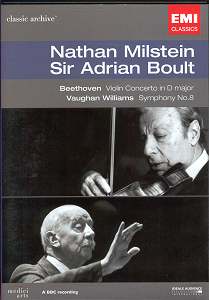

 Nathan Milstein (violin)
 [69:05]