Editorial Board
MusicWeb International
Founding Editor Rob Barnett Editor in Chief
John Quinn Contributing Editor Ralph Moore Webmaster
David Barker Postmaster
Jonathan Woolf MusicWeb Founder Len Mullenger
George
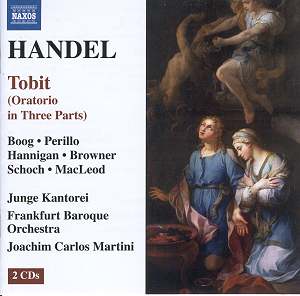
Frideric HANDEL (1685–1759) and John
Christopher SMITH (1712–1795) Tobit(1764) Anna – Maya
Boog (soprano)
Sarah – Linda Perillo (soprano)
Azarias/Raphael – Barbara Hannigan (soprano)
Tobias – Alison Browner (mezzo)
Tobit – Knut Schoch (tenor)
Raguel – Stephan MacLeod (bass)
Junge Kantorei
Frankfurt Baroque Orchestra/Joachm Carlos Martini
Rec. live, Koster Eberbach, Rheingau, Germany, 3 June 2001.
DDD NAXOS 8.570113-14 [76.22
+ 80.00]
Johann
Christoph Schmidt acted as Handel’s principal copyist and
assistant from 1756 until Handel’s death in 1759; he is commonly
known by his English name John Christopher Smith the elder.
On Handel’s death he received a bequest of all of the composer’s
manuscripts. His son, John Christopher Smith the younger
studied composition with Thomas Roseingrave and Pepusch.
In the 1750s he assisted Handel with performances of his
oratorios, effectively taking over after the onset of the
composer’s blindness.
The younger Smith’s reputation was as a music teacher
rather than as a composer and this is borne out by the changes
to Handel’s manuscripts made for performances after Handel
became blind; for the most part Smith’s alterations and adaptations
are cruder than Handel's.
When Smith the elder died, the precious batch of Handel
manuscripts passed to his son and he used these as a source
for material for a group of pasticcio oratorios. The pasticcio
was a popular 18th century form in which pre-existing
music was fitted to a new plot. Handel created a number of
pasticcio operas using his own and other people’s music.
Some of his oratorios, such as Deborah and The
Occasional Oratorio, were effectively self pasticcios
as they re-used so much existing material.
For a number of his pasticcios, Smith turned to Thomas
Morrell who had provided Handel with the librettos of Judas
Macabbeus, Alexander Balus, Theodora and Jeptha.
Morrell had also provided the English text to The Triumph
Truth and Time, the oratorio that Smith and Handel created
out of Handel’s early Italian piece.
Morrell’s librettos are by no means the best that Handel
set. Charles Jennens had a far stronger dramatic sense. But
the composer was able to triumph over the weaknesses in Theodora and Jephta to
create works of genius, despite their librettist. Without
Handel’s dramatic genius though, Morrell’s libretto for the
pasticcio Tobitis a strange thing.
The story concerns Tobit, living in Nineveh under the
Jewish captivity. Tobit is persecuted for his piety in burying
the dead, contrary to local custom. He suffers greatly and
is afflicted by both poverty and blindness. He sends his
son Tobias to Media to call in a loan he has made. Tobias
travels with his friend Azarias and after various adventures,
marries Sarah in Medina and returns home. All ends happily
and Azarias turns out to have been the Angel Raphael.
But Morrell’s libretto plays down the adventures that
Tobias and Azarias have. The rescue from the fish barely
gets a mention and neither does Tobias’s exorcising of Sarah’s
demons. The result is peculiarly discursive without ever
being very dramatic. This has the effect of putting some
spotlight onto Tobit and his persecution, a fact which has
led some commentators to wonder whether Morrell and Smith
deliberately wanted to make a point about contemporary anti-semitism.
Smith took the arias and ensembles from a selection
of Handel’s works, both opera and oratorio. The works quarried
include Esther, Athalia, Deborah, Belshazzar, The
Occasional Oratorio, L’Allegro, Semele, Susanna, Hercules, Theodora, Faramondo, Sosarme, Deidamia, Alessandro and Giulio
Cesare. Quite a number of these were works which had
rather low performance tallies both during Handel’s lifetime
and after. Smith might have been taking care to give the
public novelties which it would not have heard recently.
Smith wrote the recitatives and accompanied them himself.
In this performance from Joachim Carlos Martini and
the Frankfurt Baroque Orchestra, Martini has made some adjustments
to the score; adding a number of sinfonias to delineate scenes
plus some extra arias.
The result is attractive without ever being dramatically
gripping. The best way to enjoy it is frankly to forget about
any pretence to drama and plot. Occasionally there is a mismatch
between the original sense of a piece and the new one. One
of the worst seems to be the duet As steals the morn upon
the night from L’Allegro, which in its new context
receives the words To Steal a Grave ev’n for a Friend.
One of my main complaints about this performance is
that it lacks drama, but given such an unsatisfactory plot
in the first place we can’t really complain too much. Martini
has assembled an excellent polyglot cast who all acquit themselves
well.
Alison Browner makes an attractive, warm-voiced Tobias
with Barbara Hannigan as a fine soprano Raphael. Hannigan
shines in Raphael’s final dramatic accompagnato - written
by Smith - and the aria In Jehova’s awful sight from Deborah.
As Tobit, Knut Schoch has a pleasant light tenor and
a neat way with Handelian fioriture. When Tobit is taxed
severely by life, I could have wished for more heft from
Schoch’s voice, but he is never less than accomplished and
frequently more so. As his wife Anna, Maya Boog is rather
under-used, though her English is strongly accented.
Linda Perillo shines as Tobias’s sweetheart, Sarah,
with a light, bright voice and a shapely way with phrasing.
She copes well with the fioriture in Alleluia from
Esther.
Stephan MacLeod has a warm baritone voice as Sarah’s
father Raguel, a role which seems to be remarkably unnecessary.
But MacLeod sings his arias with a fine, grainy tone and
neat if careful passagework.
The Junge Kantorei address the choruses with lively
enthusiasm, though their diction is rather occluded at times.
The Frankfurt Baroque Orchestra accompany nicely and give
neat accounts of the overture from Tamerlano and the
various sinfonias included in the work.
If you think of this as a recital disc then it is a
nice proposition. Just put it on and enjoy some of Handel’s
finest music in attractive performances.
Robert Hugill
Please support our advertisers below by clicking on the logos for further information.

























 Anna – Maya
Boog (soprano)
Anna – Maya
Boog (soprano)