Editorial Board
MusicWeb International
Founding Editor Rob Barnett Editor in Chief
John Quinn Contributing Editor Ralph Moore Webmaster
David Barker Postmaster
Jonathan Woolf MusicWeb Founder Len Mullenger
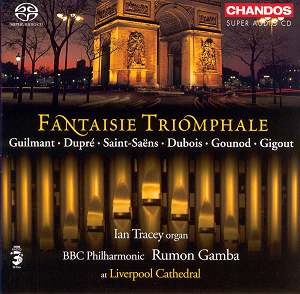
Fantaisie Triomphale Alexandre GUILMANT (1837-1911) Allegro [4:04] Méditation sur le Stabat mater [7:55] Final alla Schumann sur un noel languedocien [3:52] March-fantaisie sur deux chants d’église [8:53] Camille SAINT-SAËNS (1835-1921) Cyprès et lauriers (1919) [16:10] Charles GOUNOD (1818-1893) Fantaisie sur l’hymne national russe [9:10] Eugène GIGOUT (1844-1925) Grand choeur dialogue [5:09]
(transcribed for organ and Orchestra by Ropartz) Marcel DUPRÉ (1886-1971) Cortège et Litanie (1921) [5:22] Theodore DUBOIS (1837-1924) Fantaisie triomphale(1899)[10:22] Ian Tracey
(organ)
BBC Philharmonic/Rumon Gamba
rec. Liverpool Cathedral, 28-29 June 2006 CHANDOS
CHSA5048 [72:02]
“ The
spine-tingling aural sensation of French ‘full organ’ is
akin to an ammunition dump going up”, so comments Joe Riley,
Arts Editor, Liverpool Echo in his notes to this compilation.
He goes on to comment: “Through the 19th century,
the organ, supplemented by ever increasing ranks of pipes
and reeds and higher and higher wind pressures, became the
single most mighty voice on earth … and it wasn’t long before
composers were attracted to the idea of combining organ and
orchestra in a new and glorious panoply of sound.”
French
composers recognised the opportunities for creating sonic-splendour
using the full capabilities of these ‘magnificent beasts’ in
such imposing surroundings as the Madeleine in Paris where
Saint-Saëns was organist from 1858 to 1877. Ian Tracey, on
this new Chandos release, performing on the great Henry Willis
III organ, with its five manual divisions, 146 speaking stops
(35 of them on the pedal organ alone), in the resplendent
ambience Liverpool Cathedral, replicates this authentic French
experience.
The
highlight of this new release is a set of four shorter works
for organ and orchestra by Alexandre Guilmant. The ‘Allegro’ is
a joyful piece, rather Baroque in style, and one of the most
tuneful of the original works on this album. Guilmant’s Méditation is
an austerely beautiful, consolatory work depicting Mary,
mother of Jesus, at the foot of the cross. The little three-minute
tribute to Schumann is a clever pastiche, the usual Schumann
mannerisms are clearly recognisable; its Christmas tune declaimed
grandly and cheerily. The concluding Marche-fantaisie employs
two harps, their voices interweaving with two chorale-like
themes leading into an imposing fugato and developing up
to a commanding climax.
[Ian
Tracey had already recorded, for Chandos, in 1993, Guilmant’s
exciting Symphony No. 1 for Organ and Orchestra (together
with the Widor Symphony No. 5 for organ and the Poulenc Organ
Concerto (Chandos CHAN 9721). Chandos later recorded Tracey
performing Guilmant’s Symphony No. 2 for Organ and Orchestra
with Widor’s Symphony No.3 for organ and Franck’s Organ Chorale
No. 2 on Chandos 9785.]
The
most substantial work in the programme is Saint-Saëns’ Cyprès
et lauriers. The booklet information is slim, you have
to turn for more to the booklet of a rival 1997 recording – Michel
Plasson conducting the Orchestre du Capitole Toulouse with
Matthias Eisenberg as the organist in this work and probably
the most famous piece of this period for organ and orchestra
Saint-Saëns Organ Symphony No. 3 (1887) on EMI 7243 56362
2 5. Written in 1919, and dedicated to the president of
the Republic, Raymond Poincaré, Cyprès et lauriers (‘Cypresses
and Laurels’) was given its first performance at the Casino
in Ostend in that year and first heard in Paris on the Cavaillé-Coll
organ of the Trocadéro in celebration of the end of the 1914-18
war and the liberation of France. Its extravagant scoring
includes multiple brass and two harps. Cyprès, for solo
organ, opens with imposing swells before the music alternates
between quiet reflection, honouring the fallen as symbolised
by ‘sad cypresses’, and ominous, protesting pedals and agitated
treble chords reminding, perhaps, of heavy guns and the horrors
of trench warfare. The orchestra joins in for the grandiose
celebratory ‘Lauriers’, which is reminiscent of the splendour
of Saint-Saëns Organ Symphony but, in spite of its spectacular
brass fanfares seemingly calling out from all four corners
of the Cathedral, it is, alas, not nearly as memorable as
the Organ Symphony.
The
Gounod piece impresses as a sweet and imperative take on
the Russian hymn made famous by Tchaikovsky in his 1812
Overture.
The
remainder of the programme is devoted to works by lesser
known French composers whose output and personal details
are difficult to track down in standard reference works.
Eugene Gigout’s Grand choeur dialogue makes a grand
concert opening, and it is among the most popular of his
400 or solo organ works. It was transcribed for organ and
orchestra by Joseph Guy Ropartz making it sound quite spectacular,
full of patriotic fervour. Marcel Dupré’s Cortège et Litanie offers,
in its opening pages, some relief, in Gallic wistfulness
and quiet introspection, from the general bombast before
the pace quickens and the organ leads a loud, proud yet rather
empty declamation. Theodore Dubois’s Fantaisie triophale really
lives up to its name, bringing the concert to a spectacular
spine-tingling conclusion with huge organ swells, proud brass
fanfares and celebratory bells after, it has to be said some
rather tedious central musings.
Much
bombast, less substance and with no one stand-out theme to
linger in the memory. But hi-fi buffs will be enthralled;
this is floor-board trembling stuff. Just make sure the neighbours,
and their neighbours are out first.
Ian
Lace
Please support our advertisers below by clicking on the logos for further information.

























 Ian Tracey
(organ)
Ian Tracey
(organ)  [72:02]