Editorial Board
MusicWeb International
Founding Editor Rob Barnett Editor in Chief
John Quinn Contributing Editor Ralph Moore Webmaster
David Barker Postmaster
Jonathan Woolf MusicWeb Founder Len Mullenger
Johannes BRAHMS (1833-1897)
Symphony No. 1, Op. 68 (1876) [51:35]
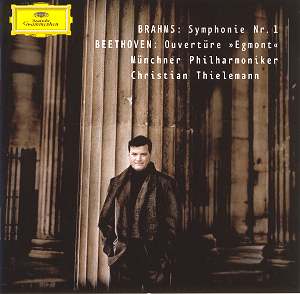
Ludvig van BEETHOVEN (1770-1827) Overture - Egmont, Op. 84 (1810) [8:58] Münchner
Philharmoniker/Christian Thielemann
rec. Philharmonie im Gasteig, Munich, June 2005. DDD DEUTSCHE
GRAMMOPHON 477 6404 [60:44]
Christian
Thielemann has so far proven to be a variable talent, on
disc at least. Since being contracted by Deutsche Grammophon
over a decade ago he has given us recordings of Beethoven,
Schumann, Bruckner, Mozart and Wagner. In other words, he
has been focusing almost exclusively on works from the Central
European tradition composed mainly within a single century.
Some have hailed him as the saviour of that tradition, an
individual who is uniquely ‘in touch’ with the spirit of
a time long since passed, the natural heir to Furtwängler.
Others have been baffled by the inconsistency and lack of
logic about his performances, appropriating the Furtwängler
model from the outside rather than from within.
Of
his previous releases, I have been particularly impressed
by his Schumann Second Symphony and Konzertstück (with
the Philharmonia, DG 453 4822) and his Vienna Phil Alpensinfonie (DG
469 5192). I am also still very much enamored of his DVD Arabella from
the Metropolitan Opera with Kiri Te Kanawa (DG 073 0059).
But if you lay these against a hopelessly distended and grotesque Heldenleben,
the rest of his Schumann cycle and his recent recordings
with the Munich Philharmonic, then you begin to see the paradox.
Thielemann can be very good when working with very good orchestras
who already have the music in their bones and - unlike the
conductor - in their souls.
Not so long ago Oehms released a series
of recordings of the Munich Philharmonic conducted by James
Levine, many of which revealed the orchestra to be of a
very high standard if not quite on the same level as their
compatriots the Bavarian Radio Symphony. Unfortunately,
the ‘live’ recordings here show them in a particularly
poor light. Whether this is more a result of Thielemann’s
flaccid, wayward direction or Deutsche Grammophon’s ill-managed
sonics one can only speculate.
The disc does open positively, with a dark,
brooding account of Beethoven’s Egmont Overture.
The opening chords reveal an impressively dark, rich sonority.
Yet there is no impetus at the start of each chord, no
real attack. Thielemann smoothes over the dramatic edges
of Beethoven’s writing as he will do (rather more damagingly)
in the Brahms that is to follow. The keening wind response
shortly after, taken very slowly, does draw one into the
story quite effectively and there is no disputing that
the succeeding allegro unfolds at a well-nigh perfect
tempo. And yet Thielemann still insists on underplaying
string articulation at key moments and then, perversely,
over-emphasising the brief chordal interjections to the
point of disrupting the flow of the music.
To his credit, Thielemann does uncover
some nice details, particularly in accompanimental passages,
generating considerable rhythmic tension at times. Similarly,
the coda is as exciting as one could hope for, with the
piccolo very tastefully controlled (it is clearly audible
but does not draw attention to itself). It was here, though,
that I first began to suspect that the Munich strings were
less than top drawer, with some alarming lapses of corporate
intonation towards the close.
Unfortunately, Thielemann’s account of
Brahms’ First Symphony is something of a disaster.
The opening un poco sostenuto is initially impressive;
the pacing is sound, and the ‘sickly’ response from the
upper strings appears to be a response to Brahms’ indication
of espress. e legato. Alas, as soon as the volume
decreases, so does Thielemann’s tempo, resulting in the
music becoming becalmed as early as bar 9, and at a virtual
stand-still by bar 13. As the opening material returns,
this time fortissimo (although you’d be hard-pushed
to notice any difference), the tempo is noticeably slower
than upon its first appearance. Such a drop in tension
in the early stages of this movement can be deadly, unless
the conductor whips up a storm in the succeeding allegro.
Predictably, Thielemann doesn’t. It is
not a case of his basic tempo being too slow, more that
he seems to carry Brahms’ legato indication from
the introduction into the main bulk of the movement. Principal
melodic material in the first violins becomes rhythmically
indistinct, the prominent semiquaver motif treated as a
poorly coordinated acciaccatura. At the close of
the exposition the high-lying, syncopated strings sound
far too smooth to even approach an agitato. Here
it also becomes obvious that the Munich strings as recorded
do not have the sheer heft for this kind of music. There
is no grit or bite to the sound, possibly due to DG’s muddy,
recessed recording. By the climax of the development, the
preponderance of legato phrasing has robbed the music of
any drama, and anyone hoping for emphatic horn and woodwind
triplets to enliven proceedings will be sorely disappointed.
The recapitulation fares rather better, due in part to
extra details in the orchestration, but by this point most
listeners will have lost interest.
In general terms, Thielemann’s handling
of tempo in this movement is wayward to say the least.
After commencing the allego at a sensible speed,
he then slows significantly for any chordal passage (such
as that beginning at bar 88), any moment of interesting
harmonic activity, or when the dynamic dips below forte.
I seem to recall that Richard Osborne, commenting on Thielemann’s
recording of Beethoven’s Fifth and Seventh symphonies (Gramophone,
3/1997) remarked that ‘more than once, the pulse lurches oddly, suggesting that
matching up takes was not easy. One wonders, indeed: has
Thielemann yet fully mastered the art of returning absolutely
to his given tempo?’. On the evidence of this recording,
this is a problem that afflicts even his live performances.
The effect is, of course, far less noticeable in Strauss
and Wagner, but Brahms’ structures are still inherently
classical and require a far more disciplined approach to
tempo relationships.
Matters improve in the central movements.
The Andante sostenuto begins slowly, but Thielemann
really does allow his string players to wallow. Indeed
the string sound here is so markedly different from the
lackluster monotony of the first movement that one is tempted
to believe that it was recorded at an entirely different
performance altogether. Thielemann presses ahead with an
unmarked stringendo towards the first climax and,
after that, the tempo settles at something a little more
flowing than the opening. Praise must be given to the principal
violin for the exquisite, sweetly singing solo work towards
the close of this movement and to the wind soloists for
some lovely playing. Thielemann stretches the tempo in
the final bars significantly but manages to hold the atmosphere.
The Un poco Allegretto e grazioso once again begins
at a sensible tempo, but is marred by Thielemann’s insistence
upon speeding up quite significantly whenever the music
becomes more animated, resulting in some awkward shifts
back to his original tempo.
Problems arise once more in the final movement.
There is more fire on display in this movement than in
the first, although string articulation is still smoothed
over in places.
The opening is fine, at once dramatic,
intense and mysterious. Thielemann resists the temptation
to slow significantly at the Più Andante, and his
players produce some wonderful, solemn sounds. It is with
the arrival of the Allegro no troppo ma con brio that
I take issue. Matters of tempo aside, Brahms marks the
dynamic as poco f. Whilst you can argue that, in
this context, poco f could imply anything even a
whisper louder than pianissimo, that was clearly
not Brahms’ intention. Thielemann gives us little more
than a piano here, robbing the chorale of any weight
or, indeed, ‘brio’. This pales somewhat into insignificance
when compared with how he manipulates tempo here. He begins
slowly (although by no means too slowly) but then accelerates
in stages until the fortissimo statement of the
same theme some thirty bars later. In no way is this implied
in the score and, in any case, the effect simply does not
work, draining the music of any dignity.
Having said that, once Thielemann does
actually arrive at his main tempo, it is a rather good
one. Even here though, many will find Thielemann’s frequent
tempo moderations distracting. His broadening for the climactic ‘chorale’ is
just about feasible, although it is somewhat crudely presented.
The final dash to the end of the movement suggests that
Thielemann may be more successful at ending a symphony
than beginning it.
As already suggested, Deutsche Grammophon’s
sound is another factor to be considered. Muddy, recessed
and lacking in internal detail, it does nothing to rescue
what must surely count as one of the ugliest, laziest and
most frustrating recordings of this work in recent years.
With a multitude of excellent performances already available,
this issue is somewhat unnecessary. That it arrives at
full price should be enough to put it out of contention
altogether. For less than the price of this disc, Günter
Wand’s superb early digital recordings of the complete
Brahms Symphonies can be purchased (RCA 74321 20283), a
cycle marked by its plain, unvarnished honesty and an understanding
of the idiom that seems to have escaped Thielemann completely.
One final point regarding the presentation
of the current issue demands to be made. As has become
the norm with issues of ‘live’ Thielemann recordings, the
booklet features an interview (or rather ‘apologia’) with
the conductor. My quotation of choice for this particular
release: ‘Here I slow down even earlier, even though there
is no ritardando marking in the score. A musicologist
might express his misgivings at this and point to the fact
that Brahms wrote the score out in full. I’m aware of this,
of course, but…I feel that Brahms allows us this freedom’.
Axel Brüggemann, author of the booklet notes, helpfully
points out that ‘in adopting this approach, Thielemann
comes very close to Brahms’ own compositional aesthetic’.
Considering this glowing endorsement of Thielemann’s unique
understanding of Brahms, it may seem churlish for a critic
to disagree.
Owen
E. Walton
Please support our advertisers below by clicking on the logos for further information.

























 Münchner
Philharmoniker/Christian Thielemann
Münchner
Philharmoniker/Christian Thielemann