Editorial Board
MusicWeb International
Founding Editor Rob Barnett Editor in Chief
John Quinn Contributing Editor Ralph Moore Webmaster
David Barker Postmaster
Jonathan Woolf MusicWeb Founder Len Mullenger
Volkmar
Andreae was born in Bern on 5 July 1879. During his studies
he excelled both as composer and conductor, and published
his first mature composition, the Piano Trio in F minor Opus
1, in 1901 when he was 22. Like others who might be discovering
his music for the first time, the question immediately arises, ‘why
haven’t we heard more?’ The booklet notes by Robert Matthew-Walker
point out that, as a conductor, his mixed career might have
militated against his acceptance as a composer as has happened
with many other composer-conductors. His catalogue is certainly
not huge, with a brace of symphonies and operas, plus a mixed
bag of other vocal and chamber music to his name. All of
this may have contributed to his neglect, but it would also
appear to be the case that his musical style made him something
of a dinosaur, or at the very least one of those unfortunate
enough to fall in between easily definable periods in music.
His is an idiom which sits within the post-Romantic German
tradition and the late language of Brahms: whose music – while
hardly high-Romantic in the mould of Liszt or Reger, is certainly
not that of an animal of the 20th century.
The Piano
Trio Op.1 appeared when Andreae was repetiteur at
the Munich Royal Opera. As a conductor he later promoted
the music of Bruckner, Mahler, Richard Strauss and Debussy,
and his recordings of several symphonies of Bruckner were
pioneering discs in their day. The attraction to Bruckner
appears in some of the technical fingerprints which analyses
reveal, but the overriding influence is that of Brahms.
Play the opening of the third movement Allegro ma non
troppo and you will have even knowledgeable friends
scratching their heads trying to work out who it is if not Brahms.
The music has a round, sonorous quality, and a lyrical
charm and power which stands on its own two feet throughout.
The string writing is well executed and thankfully lacking
in scrubbing and repetitiousness, and with a virtuoso piano
part this work deserves a place in the standard repertoire.
The
second Piano Trio Op.14 appeared thirteen years after
the first, and is in four movements rather than the First’s
three. There is an immediate feeling of greater individuality
about the music in this piece. Andreae’s language adopts
a mixture - something approaching French Impressionism yet
all the while holding on to a basis of Germanic seriousness.
The gestures are nothing if not striking however, and after
an almost Schubert-like opening theme the symphonic twelve
minutes of the first Allegro moderato movement are
filled with drama and expressiveness.
The
second movement, Molto Adagio, has a chorale-like
opening which promises something searching and emotive. Indeed
a fascinating succession of variations on themes, which grow
out of the piano’s harmonic basis, ensue. The inescapable
feel is late-Romanticism, with an extended crescendo towards
a central climax. In the second part of the movement the
music gently returns to a calm version of that with which
it began.
The
third movement, Presto, has a remarkable structure, beginning
quietly and very fast, before a much slower passage begins
an entirely different sonic world. A standard tripartite
form would lead expectations to a return to the Presto, but
the composer surprises with an even slower section which
modern ears might expect to lead attacca to a rousing
finale. The Presto eventually returns however, transformed
into an even lighter filigree. The final Allegro
con brio assai vivace, opens with a jaunty ‘hunting’ theme
whose calls, if slowed, could easily be taken for Bruckner.
The movement proceeds with numerous twists and variations
on the way: moods; light to elegiac to forcefully dramatic,
all on the turn of a Swiss franc.
So,
what is to be made of Volkmar Andreae on this showing? Bearing
in mind that the weather map of cultural trends and influences
moved with variable speed over the massive net cast by Austro-Germanic
musical tradition, it is hardly surprising that such music
was being created by young composers even up to the point
at which World War I shattered the lives of so many. Andreae’s
music is honest and executed with refinement and a genuinely
inventive spirit.
The
playing of the Locrian Ensemble is sensitive to the composer’s
idiom, and champions his cause in a way which, one would
hope, should increase his standing on the international concert
stage. The recording is nicely balanced and warmly colourful,
fairly close to the instruments, but without that glaring
sharpness in the strings which can sometimes be tiring on
the ears. If you like your chamber music with a Brahmsian
feel, not too heavily romantic and wallowing but with plenty
of expressive lyrical line and musical ‘oomph’, then this
release deserves your attention.
Dominy
Clements
Please support our advertisers below by clicking on the logos for further information.
























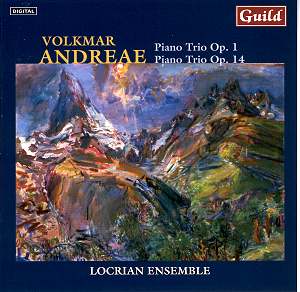

 Locrian
Ensemble: Rita Manning (violin); Justin Pearson (cello);
Kathy Rockhill (piano)
Locrian
Ensemble: Rita Manning (violin); Justin Pearson (cello);
Kathy Rockhill (piano)