Oliver
Knussen’s years in the United States were formative. I’m not
sure exactly when he encountered Charles Wuorinen’s music, but
he has been a leading exponent of it for many years. Thus the
London Sinfonietta’s affinity for Wuorinen draws vitality from
strong roots. Any performance they present of his music is going
to be worth hearing
This
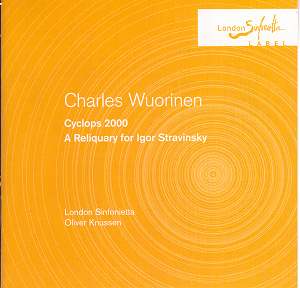
performance on this disc of “Reliquary for Igor Stravinsky”
is the session at the Henry Wood Hall from October 1994 which
on first release did so much to establish the work in the repertoire.
It is an important milestone. It captures an exciting moment
in the orchestra’s development and helped seal its reputation
as well as the composer’s. The orchestra is still cutting edge.
The work was first conducted by a young Michael Tilson-Thomas
and later adapted for ballet, but the Sinfonietta’s recording
is the classic reference. That’s why I have no hesitation in
recommending this new release, even for those who have the earlier
release. Because this release is on the Sinfonietta’s own label,
profits directly benefit the orchestra so that it can continue
its sterling work.
Reliquary
grew from a fragment
of notes by Stravinsky, which would have taken about one minute
to perform as is. Wuorinen adapts this basic material, developing
variations based loosely on Stravinsky’s late style. Thus, “reliquary”,
a relic embellished with reverence. Peter Lieberson has called
the piece “a structure built to contain sacred icons”. The piece
is set out in seven sections. The first sets out the basic Stravinskian
material in a fairly straightforward manner, to be developed
in the second part, entitled “Variation”. It’s marked by a dramatic,
explosive violin solo. The other strings shoot out strident
chords, which later evolve into crashing waves on cymbals. Wuorinen
consciously wrote these expansive chords to express in musical
form the diagonal lines Stravinsky drew on his manuscript notes.
The solo violin returns in the next section, “Lament”, this
time with less exuberance. The “diagonal” chordal swathes continue,
like shafts of light and colour. The final section, “Reliquary”
is most inventive of all. The chords here are painted by piano,
giving a more understated effect. Then they are taken up by
oboe and bassoon, before being returned to the strings. If you
listen carefully, there are subtle snatches reminiscent of Rite
of Spring as well as Stravinsky’s later style. This is a
gorgeous performance, .richly realised, and deserves its status
in the canon.
This
disc is recommended, too, because it also includes the world
premiere of Wuorinen’s “Cyclops 2000” recorded at the
Queen Elizabeth Hall in London in May 2001. The name is a play
on Cyclops, of ancient myth, who had one giant eye and could
only see straight ahead. Hence, it’s written on a single constant
metre. The real drama, though, comes from what Cyclops does
with his single eye, or rather what Wuorinen does, within the
constraints of the metre. The music proceeds in fits and starts,
jerking from side to side, switching from rapid tempo to moments
of still contemplation. Textures vary: sometimes soloists pulling
out from the ensemble, sometimes duetting and exchanging partners
in further duets. This gives the piece a strong sense of movement,
even though it rises from a simple, single line. Knussen’s conducting
draws together the disparate figures, so the piece moves forward
like a quirky, joyous procession, all elements moving in relation
to each other, always headed towards a goal. The piece was commissioned
by a financial publishing company at a time when the stock market
was running high. This was before September 11th.
In retrospect, its optimism and confidence seems sadly innocent.
Still, it’s a reminder that good music survives, no matter what
happens in the world.
Anne Ozorio

























 London Sinfonietta/Oliver Knussen