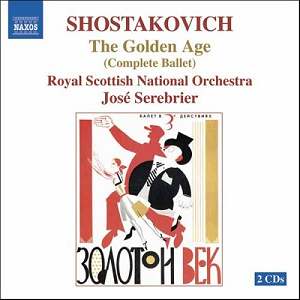
This Naxos double
has received a superb review from Anne Ozorio so mine will have
a slightly different spin – in the cricket sense.
For starters, José
Serebrier is a top rate conductor/composer with a sense of choice
and judgement second to none. He gets the very best from a youthful
RSNO without a fluff.
I usually criticise
engineers but Phil Rowlands and producer Tim Oldham deserve
as much praise as the conductor and orchestra. The latter are
on belting form in the superb acoustics of the Henry Wood Hall,
Glasgow with an almost Russian reverb time which Serebrier uses
well.
Anyone who appreciates
what orchestral sound can offer at its best through even moderate
hi-fi or mid-range headphones can expect a treat. Through up-market
gear and/or top-end ‘cans’ I recommend this release to show
what a full orchestra can do. Music teachers should rush out
and buy this Naxos double to show students how orchestras are
used and where instruments are placed, especially as the short
movements allow plenty of picking and choosing.
The main drawback
of full ballet music issues (even Tchaikovsky’s) is that some
of it simply supports the action and can be less than engaging
when standing alone. Parts of ‘The Age of Gold’ Op.22 certainly
have this problem.
The 24 year-old
Shostakovich was in good company as the entire Stravinsky ‘Firebird’
and Bartók’s ‘Miraculous Mandarin’ can cause a few yawns. That
is why the composers made suites of the musically most interesting
aspects. Ravel and Prokofiev did the same but young Dmitri S
- advised by his mentor Prokofiev - published a suite of items
1, 2, 9, 11 and 30 ahead of the premiere in 1930. Just to be
correct track 30 should be 31 in the otherwise excellent notes
mentioned immediately below.
There were peculiarly
Soviet reasons for this. The superb CD notes by Richard Whitehouse
hint at this but do not offer a full explanation. Experimental
music was just about tolerated in the early 1920s but Prokofiev
had been ‘told off’ a few times for being what the Soviets called
‘formalist’. Then again, he was too famous to be shot down -
and held dual nationality anyway. His protégé Shostakovich had
no such protection and when Lenin died in 1924 Stalin took control.
The concept of ‘Socialist Realism’ spread from the Kremlin and
the influence Andrei Zhdanov began, even though he was not made
Minister of Culture until 1934 after a few assassinations and
purges of intellectuals.
Making a five movement
suite was a clever way of ensuring that a modest edition would
get outside the USSR – but listening to this amazing full score
under Serebrier I wonder why Shostakovich stuck at five when
so much else is both gorgeous and important! Okay he was young
but a second suite could have been made after the Stalin era.
But then there was the irony of Stalin and Prokofiev dying on
the same day in 1953.
Ballet ‘plots’ are
often even more far-fetched than opera ones. This one by Alexander
Ivanovsky of film fame in the 1920s is so peculiar and particular
to its time that I shall not get bogged down in its speciality.
It’s a bit like watching a bunch of entomologists discussing
the mating habits of a beetle only found on an acre of land
in Upper Volta. Let us get down to the music.
As AO covers the
work so well as a free-standing opus I recommend this marvellous
Serebrier achievement in relation to what followed in the career
of DSCH and especially in the symphonies.
I could list every
dot ’n’ jot but this would make no sense unless listeners have
experience of the symphonies in some detail or at least are
becoming acquainted with them. There are however some aspects
of ‘The Age of Gold’ which simply cannot be overlooked in this
context. If the symphonies are the lock then this Op.22 is at
the very least a rough-hewn key.
On CD1, Track 4
has percussion ‘clacks’ used by Shostakovich in the 4th,
14th and 15th symphonies and that skeletal
device was clearly in the young composer’s subconscious.
Track 13 ‘Diva and
the Fascist’ has deep unease which looks forward to the 4th
symphony’s best cross-rhythmic sections in four separate places.
We just know that something is wrong and sinister when
Shostakovich uses this musical language. Serebrier’s supreme
interpretation of the famous ‘Dance of the Diva’ (CD 1 Track
9) is a perfect case of compare and contrast.
By the way, the
lovely Adagio for soprano saxophone and an economical orchestra
has been rendered by many in the Suite version. Serebrier simply
IS supreme in this prefiguring of the more gorgeous tunes Shostakovich
used in the 5th, 6th, 7th and
10th symphonies in orchestral garb. The ‘Suicide’
movement of the 14th for soprano and chamber orchestra
also uses very similar phrases. Serebrier is not a musician
for ‘bleeding chunks’ but sees things as a whole. That’s why
he makes this longest movement of Op.22 its understated glory.
CD 1 Track 13 has
touches of the 4th symphony as well as the piano
concertos, 17 has themes and harmonies we find in the 8th
and Track 19 uses ‘chaotic’ phrases found in the 2nd
and 3rd symphonies. Thus the composer was trying
out ideas he could use later - without saxophones - in times
of less freedom as Stalin tightened his grip. Stalin considered
saxophones decadent.
Track 19 is brief
but we learn so much from it about what came later. It is as
if the composer was confused and excited simultaneously. There
are even shades of a canonic ‘escape route’ (10th
symphony) as if the way out of emotional turmoil is logic. This
is human nature and Shostakovich appreciated it as a very young
man.
CD 2 Track 12 introduces
deep menace after a fair bit of orchestral merriment - yet always
with a great big question mark shown by the use of clever minor
inversions and oppositions to even simple themes. We never quite
know if the pure soviets or the fascist capitalists
are ‘right’ in what Shostakovich makes of Ivanovsky’s weird
plot. That said, the music from Track 12 to the end is full
of cheek but also reflects the serious side of the composer.
Practically it serves to announce his lifelong musical menu.
The very strange
opening of Track 13 only makes true sense if one knows the later
music. Then Shostakovich follows up - in this second longest
movement - with very large hints towards the seminal 4th
symphony and Lady Macbeth of Mtsensk – both of which
were banned by Stalin. Serebrier is the musician to present
this highly compressed statement in a clear way, especially
the composer’s return to the quiet opening before a cheeky fanfare
leading to track 14.
It’s all there in
just over six minutes: the Shostakovich trademark of clever
percussion with busy strings and a sub-text of woodwind and
brass. He also uses, for the second time in this work, an exact
quotation of the woodwind theme from Stravinsky’s ‘Petrushka’
denoting the hero puppet’s subversive and indestructible guile.
This casts doubt on the last movement, ‘Dance of Solidarity’
which stays in what to my ears is a rather hollow major key.
Shostakovich loved
his country and eschewed all chances to leave. On the other
hand he disliked the leadership so occasionally was forced to
compromise his art, yet never without sly digs lost on dim politicians.
The symphonies demonstrate this fully but, I admit, this full
version of ‘The Age of Gold’ surprised me in just how
much the composer packed into a ballet score serving a pretty
daft plot about ideology.
Serebrier’s genius
as a conductor/composer is to know his subject thoroughly so
if this masterly recording doesn’t attract a stack of prizes
I would be surprised.
This Naxos double
has no faults whatever – and I usually find something to whinge
about. Not this time because this recording shows understanding
of a great composer with the genius already in him as a young
man.
Stephen Hall
see also Reviews
by Anne Ozorio and Patrick
Waller