Editorial Board
MusicWeb International
Founding Editor Rob Barnett Editor in Chief
John Quinn Contributing Editor Ralph Moore Webmaster
David Barker Postmaster
Jonathan Woolf MusicWeb Founder Len Mullenger
Wolfgang Amadeus
MOZART (1756–1791): Elisabeth Schwarzkopf singt Mozart-Arien
1. Le nozze di Figaro: Giunse alfin il momento … Deh vieni, non tardar
2. Don Giovanni: Vedrai carino
3-4 Le nozze di Figaro: Porgi amor; Voi che sapete
5 Don Giovanni: Crudele? … Non mi dir
6 Le nozze di Figaro: Non so più cosa son
7 Idomeneo: Zeffiretti lusinghieri
8 Don Giovanni: Batti, batti, o bel Masetto
9 Le nozze di Figaro: Dove sono
10 Don Giovanni: In quali eccessi ... Mi tradi, quell’alma ingrata
11 Il re pastore: L’amerò sarò costante
12-13 Die Entführung aus dem Serail: Welcher Kummer herrscht in meiner
Seele; Martern aller Arten Elisabeth
Schwarzkopf (soprano), Philharmonia Orchestra/John Pritchard
(1–9), Josef Krips (10); Wiener Philharmoniker/Josef Krips
(11-12), Herbert von Karajan (13)
rec. London, 1 July (4, 8), 2 July (1, 2, 6), 4 July (3, 5), 9 September (9),
16 September (7) 1952; in Vienna, 23 October (13), October (12); 2 November (11)
1946, 26 September 1947 (10) PREISER
RECORDS 93444 [73:26]
Last year was Mozart year and we saw a steady flow of records,
both reissues and new recordings but there were few, if any,
to challenge these 55–60 year old recordings. Sonically they
are quite acceptable and the Vienna Philharmonic do actually
leap out of the speakers life-like in the long orchestral introduction
to Martern aller Arten, recorded in October 1946, more
lifelike than the Philharmonia recorded six years later. These
arias (tracks 1–9) were originally released on an early LP; I
don’t know if they were in the same order then as they are here.
Since they are not in chronological order according to recording
dates, nor organized according to operas, it seems that someone
at Preiser Records just pressed the random button on the computer.
But there ends my criticism. I can’t imagine better Mozart singing.
I can imagine Mozart singing that is different and maybe on the
same level, but not better. I know that there are listeners out
there who feel differently about Schwarzkopf, finding her artificial,
over-detailed, haughty; those listeners can stop reading here.
To those of you who are still with me I can report that she can be extremely
detailed, but more often than not she just pours out wonderful, natural singing,
demonstrating her sense of line and nuance. What is obvious from the very beginning
is her way of identification with the different characters, and I will come back
to this. Let me just give some background information about the singer, who retired
from the concert platform in 1979. She belonged to that “lost” generation of
singers whose early career coincided with World War II, which meant in most cases
that an international career was not possible until after 1945. By then Schwarzkopf
was already 30. Within a couple of years she was heard in London, Milan, Salzburg
and other important music centres. She also embarked upon a recording career
and some of her earliest records can be found on this disc. The good thing about
this delayed career was that when she finally became an international name she
was already a fully-fledged mature artist and this can be heard on these thirteen
arias.
She sang many different roles early in her career but gradually reduced them
to a handful, which she kept until she left the opera stage in 1967: the Marschallin
in Der Rosenkavalier, the Countess in Capriccio and the three great
Mozart parts – Donna Elvira in Don Giovanni, the Countess in Le nozze
di Figaro and Fiordiligi in Così fan tutte. Fiordiligi is absent from
this collection but there are two complete recordings, with Karajan and Karl
Böhm. Schwarzkopf was also one of the greatest Lieder singers ever and her care
for words and nuance was something she also brought to the opera stage, a characteristic
not liked by everyone.
The recital opens with Susanna’s aria from the second act of Le nozze di Figaro,
a part she sang in Salzburg in 1947. The recitative Giunse alfin il momento (At
last the moment is here), when she anticipates her marriage to Figaro, is very
detailed. Schwarzkopf colours her voice and wrings the last drop of meaning out
of every word – but who is Susanna? She belongs to the servants but she is no
simple lower class maid. She is a clever girl who is a confidante of the Countess
and she has intrigued against the Count. In other words she has a sharp intellect
and that is exactly what Schwarzkopf catches. The aria proper, on the other hand,
is a dreamy love song, longingly sung but still with dignity. Compare this to
Zerlina, the peasant girl in Don Giovanni. She is indeed an unsophisticated
girl. She knows nothing about the nobles and her first encounter with Don Giovanni
shows her innocence. Schwarzkopf’s interpretation of Zerlina’s two arias (tracks
2, 8) is distinctly different from her Susanna: simpler, more naïve. Returning
to Figaro we also hear her true role, The Countess. We hear an aristocrat with
noble bearing. Her voice is not absolutely rock-steady but that only shows that
this Countess is a vulnerable person. Dove sono (track 9) especially demonstrates
her marvellous pianissimo singing, spinning a thin thread of tone through most
of the aria, only to change gear to a full-voiced and thrilling end.
For the third Figaro role, the teenage boy Cherubino, she does indeed adopt a
boy-like tone, portraying him as the 17-year-old who really doesn’t understand
the signals his hormones send him. From Don Giovanni we also get Donna
Anna’s second act aria Non mi dir, so elegiac, so sad, but she also has
the required power for the concluding “Forse un giorno...”. This reminds us that
she was at about the time of this recording Bayreuth’s Eva in Die Meistersinger and
also sang Elisabeth and Elsa. Her Donna Elvira, memorably sung on Giulini’s complete
recording more than a decade later, is also excellently executed here (track
10) with that great Mozartean Josef Krips giving full support back in 1947. It
is indeed remarkable to notice that there is no discernible difference in voice
quality between 1947 and 1952, not even with the much later stereo recordings
from the early sixties. She managed to keep her voice intact for a very long
period, partly due to her wise choice of repertoire. I could go into detailed
descriptions of all the remaining arias, the wonderful Il re pastore is
beautifully sung, but I would like to urge prospective buyers to lend their ears
especially to the very last item, the long and notoriously difficult Martern
aller Arten from Die Entführung. She sang the part for some years
after the war but then abandonned it, which was a pity because it would have
been great to have a complete recording of it. Her singing here is as near to
perfection as one can possibly get in an imperfect world. This is probably the
most taxing of arias with its high-lying tessitura, its big leaps, its large
range downwards, its dramatic outbursts, long-held notes and, at the end, demanding
coloratura. And of course Karajan secures wonderful playing from the Vienna Philharmonic.
I hope I have made it clear that I admire the whole recital tremendously and
recommend it strongly to every listener with even a remote interest in Mozart-singing
- or singing in general.
Göran Forsling
Please support our advertisers below by clicking on the logos for further information.
























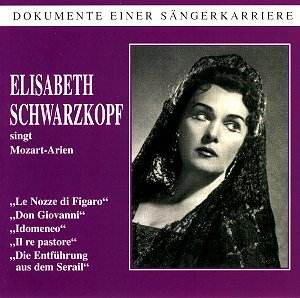

 Elisabeth
Schwarzkopf (soprano), Philharmonia Orchestra/John Pritchard
(1–9), Josef Krips (10); Wiener Philharmoniker/Josef Krips
(11-12), Herbert von Karajan (13)
Elisabeth
Schwarzkopf (soprano), Philharmonia Orchestra/John Pritchard
(1–9), Josef Krips (10); Wiener Philharmoniker/Josef Krips
(11-12), Herbert von Karajan (13)