Editorial Board
MusicWeb International
Founding Editor Rob Barnett Editor in Chief
John Quinn Contributing Editor Ralph Moore Webmaster
David Barker Postmaster
Jonathan Woolf MusicWeb Founder Len Mullenger
Wolfgang Amadeus
MOZART (1756-1791)
The Piano Concertos CD.1: [52:15]
Piano concerto No.9 in E flat major "Jeune
homme", KV.271 (1776) [31:34]
Piano concerto No.14 in E flat major, KV.449 (1784)
[20:39]
CD.2: [73:20]
Piano concerto No.11 in F major, KV.413 (1782/3)
[22:02]
Piano concerto No.15 in B flat major, KV.450 (1784)
[23:38]
Piano concerto No.19 in F major, KV.459 (1784)
[27:12]
CD 3: [68:28]
Piano concerto No.25 in C major, KV.503 (1786)
[29:09]
Piano concerto D major No. 26 "Coronation",
KV.537 (1786) [30:14]
Rondo A major, KV.386 (1782) [8:45]
CD 4: [77:21]
Piano concerto No.12 in A major, KV.414 (1782)
[24:41]
Piano concerto No.13 in C major, KV.415 (1782/3)
[26:49]
Piano concertoNo.21 in C major, KV.467 (1785) [25:39]
CD 5: [69:25]
Piano concerto No.5 in D major, KV.175 (1773) [21:46]
Double concerto No.10 in E flat major, KV.365 (1779)
[24:28]
Triple concerto No.8 in F major, KV.242 (1776)
[23:07]
CD.6: [71:59]
Piano concerto No.22 in E flat major, KV.482 (1785)
[33:17]
Piano concerto No.24 in C minor, KV.491 (1786)
[28:09]
Rondo D major, KV.382 (1782) [10:19]
CD.7: [75:31]
Piano concerto No.6 B major, KV.238 (1776) [19:46]
Piano concerto No 20 in D minor, KV.466 (1785)
[31:26]
Piano concerto No.23 in A major, KV.488 (1786)
[24:15]
CD.8: [73:56]
Piano concerto No.7 in C major, KV.246 (1776) [21:43]
Piano concerto No.16 in D major, KV.451 (1784)
[23:16]
Piano concerto No.17 in G major, KV.453 (1784)
[27:53]
CD.9: [61:49]
Piano concerto No.18 in B major, KV.456 (1784)
[32:49]
Piano concerto No.27 in B major, KV.595 (1791)
[28:58]
CD.10: [63:56]
Harpsichord concerto No. 1 in F major, KV.37 (1767)
[18:12]
Harpsichord concerto No.2 in B major, KV.39 (1767)
[16:48]
Harpsichord concerto No.3 in D major, KV.40 (1767)
[12:20]
Harpsichord concerto No.4 in G major, KV.41 (1767)
[13:29]
CD.11: [34:15]
Harpsichord concerto After J.C. Bach in D major,
KV.107 Nr.1 (1765) [14:19]
Harpsichord concerto After J.C. Bach in G major,
KV.107 Nr.2 (1765) [10:21]
Harpsichord concerto After J.C. Bach in E flat
major, KV.107 Nr.3 (1765) [9:33]
Viviana Sofronitzki
(forte piano and harpsichord)
Linda Nicholson (forte piano) in K242, K365
Mario Aschauer (forte piano) in K242
Musicae Antiquae Collegium Varsoviense/Tadeusz Karolak
rec. Warsaw, December 2004-March 2006.DDD
Forte pianos by Paul McNulty PRO MUSICA CAMERATA
041-051 [11 CDs: 52:15 + 73:20 + 68:28 + 77:21 + 69:25 + 71:59
+ 75:31 + 73:56 + 61:49 + 63:56 + 34:15]
The first thing
to say is that this is a notable achievement by all concerned.
To perform and record all Mozart’s piano concertos “in one go”
as it were, is a considerable task and the results here are
very refreshing and remarkably consistent throughout. There
have been of course sets of the complete concertos before and
I have Barenboim (twice) (EMI, Warner), Schiff (Decca) and Perahia
(Sony) as well as a compilation produced by Warner last year.
They all have their respective merits as well as occasional
deficiencies.
Unlike the present
collection the sets I have were recorded over a longer period
of time and separate discs were released before being packaged.
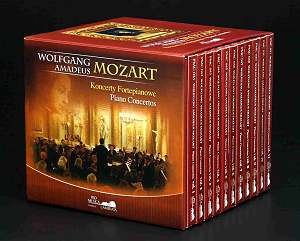
Mention should be made here of the very handsome box in which
all eleven volumes are placed: no slim-line package here. For
people like me with a space shortage this is a double-edged
sword!
There have been
“authentic” recordings previously - notably by Malcolm Bilson
under John Eliot Gardiner and the English Baroque (DG) but one
feature here is that we have all 27 plus juvenile works based
on J.C. Bach; Bilson and co, recorded in the late 1980s, start
at Number 5. Viviana Sofronitzki comes from a famous musical
family and is clearly highly proficient at the demanding forte
piano which would have been the instrument used at their original
performances; often led I believe by the composer at the keyboard.
Here the pianist is accompanied by Musicae Antiquae Collegium
Varsoviense who are from Warsaw and apparently have over half
a century of recording behind them. They are certainly a fine
set of musicians and the conductor Tadeusz Karolak shows great
empathy in his role. The forte piano is a replica of the Anton
Walter fortepiano by Paul McNulty and very good it sounds too.
The recordings are not placed in chronological order which might
have been advisable and especially so if the discs are available
separately.
The set begins the
"Jeune homme" from when Mozart was twenty. For the
general listener this is a good place to begin. It’s on quite
a big scale and the orchestral sound is clear, avoiding the
acidity of older “authentic” bands. Sofronitzki plays this extremely
proficiently and the forte piano works well with this piece;
this was a good beginning to my voyage. As my listening went
further through the set I became aware of various points. The
first of these was the imagination and originality of Mozart
and how he developed so quickly - some of these concertos were
written very close together. Secondly, that the Musicae Antiquae
Collegium Varsoviense are a very fine ensemble and I would love
to hear them in Haydn and Mozart symphonies. Thirdly, in the
mid-period works - up to say Number 19 - I felt convinced by
the approach and sound without yearning for a piano-forte. The
Hunting Rondo of Number 22 was also a case where the sound was
fine and although I will return to Perahia et al this
will be a version to play often. The early works also benefit
from being played on instruments adjacent to their composition
and Viviana Sofronitzki is as adept on the harpsichord in the
juvenilia as she is on the forte piano.
To get an idea of
this set’s strengths there is the last movement of Number 16 on
Viviana’s website
and whilst I got to love this via Barenboim and BPO (Warner) the
quality of this performance encouraged me to embark on the whole
eleven disc collection; a task which has been revelatory and highly
enjoyable. Beecham used to say everyone should listen to Mozart
fifteen minutes a day for five years! Starting my day with one
of these concertos has been uplifting. Take as a strong example;
K456, No.18 on Disc 8 - a splendid combination of orchestra and
soloist. The slow movement has echoes of some of Mozart’s darker
operatic moments and here I found the forte piano enhanced the
experience. The rondo with Mozart’s roguish fun, fiendish writing
for the keyboard and splendid wind playing saw me off to work
with a great feeling of wellbeing!
This collection
also includes the concertos for three and two pianos; the latter
has been an especial favourite since I saw Christopher Nupen’s
film “Double Concerto” featuring Ashkenazy and Barenboim playing
this in Croydon in about 1967. This piece was written about
the same time as the Sinfonia Concertante K 361 and has
similar qualities of charm and imaginative writing. This is
given a fine performance here and again the orchestral playing
is of the finest. If I say I prefer Gilels – father and daughter
(DG) - it is largely what one is used to but those drawn to
less romantic playing will probably prefer Viviana Sofronitzki
and Linda Nicholson. The “Triple concerto” is a less distinguished
piece but is again executed in lively fashion. It should be
pointed out that the speeds are fairly similar to modern practice
and never seem rushed as was the case in certain “authentic”
performances in the 1980s!
The mild problem
I have has been in the very familiar later concertos; for example
20, 24 and 27 where I felt slightly short-changed by the experience.
The forte piano, however expertly played, produces a certain
similarity of texture which becomes repetitive at times and
slightly detracts from the full delights of these works. Turning
to a very fine modern piano recording by Piotr Anderszewski
(Virgin) the speeds are very similar but the piano forte is
better equipped to deal with the emotion and force in the “Romanze”
of Number 20. Of course I’ve been listening to this work for
45 years and got used to a certain sound and style. Mozart would
have heard his works similar to these recordings but was he
not composing with a sound in his head which was beyond the
instruments of the day? Did not his and later Beethoven’s compositions
inspire manufactures to make greater sounding instruments? It’s
an unanswerable question but so long as no-one says there’s
a right way and a wrong way I am happy to listen to different
ways of interpreting these marvellous works.
Listening to this
collection has been very enjoyable, particularly with such a consistent
standard. I do commend this set to all interested in hearing this
great music on instruments of Mozart’s period and hope that we
may have the opportunity to hear these fine performers in this
country at some stage soon!
David R Dunsmore
Please support our advertisers below by clicking on the logos for further information.

























 Viviana Sofronitzki
(forte piano and harpsichord)
Viviana Sofronitzki
(forte piano and harpsichord)