Editorial Board
MusicWeb International
Founding Editor Rob Barnett Editor in Chief
John Quinn Contributing Editor Ralph Moore Webmaster
David Barker Postmaster
Jonathan Woolf MusicWeb Founder Len Mullenger
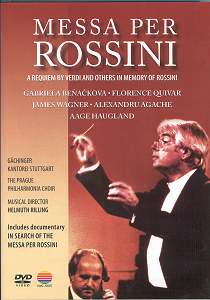
Messa per Rossini Antonio BUZZOLLA (1815-1871)
Requiem and Kyrie Antonio BAZZINI (1818-1897) Dies Irae Carlo PEDROTTI (1817-1893) Tuba Mirum Antonio CAGNONI (1828-1896)
Quid sum miser Federico RICCI (1809-1877) Recordare Jesu Pie Alessandro NINI (1805-1877)
Ingemisco Raimondo BOUCHERON (1800-1876)
Confutatis maledictis Carlo COCCIA (1782-1873)
Lacrimosa and Amen Gaetano GASPARI (1808-1881) Offertorio Pietro PLATANIA (1828-1907)
Sanctus Lauro ROSSI (1812-1885)
Agnus Dei Teodulo MABELLINI (1817-1897)
Lux aeterna Giuseppe VERDI (1813-1901)
Libera me Gabriel
Beňačkova (soprano); Florence Quivar
(mezzo); James Wagner (tenor); Alexandru Agache (baritone),
Aage Haugland (bass)
Gächinger Kantorei Stuttgart; The Prague Philharmonia Choir
Stuttgart Radio Symphony Orchestra/Helmuth Rilling
rec. 1989 (?), Evangelische Stadtkirche, Ellwangen, Württemberg
‘In Search of the Messa per Rossini’: Documentary directed
by Gabrielle Faust WARNER MUSIC VISION
50-51011 7396-2-0 [120:32]
On
the death of Rossini in 1868, Verdi approached the music
publisher Ricordi with the idea that thirteen of the leading
Italian composers of the day (including himself) should collaborate
in the composition of a Requiem Mass in honour of Rossini,
for performance in the church of San Petronio in Bologna
on the first anniversary of his death. The work was written
but, for a variety of undignified reasons, was not performed.
It then vanished from sight and memory so completely that
when it was occasionally mentioned it was often assumed that
it had never actually been written at all.
Some
hundred and twenty years later, the American musicologist
David Rosen located the score in the archives of Ricordi
and Helmuth Rilling took responsibility for the first performance
in Stuttgart in 1988. The story of the work’s origins, of
the arguments that prevented its performance in Bologna,
of its rediscovery and its first performance, are the subject
of an interesting documentary by Gabrielle Faust, included
on this DVD along with a complete performance of the work.
Naturally,
a work from the hands of thirteen different composers is
hardly likely to be one characterised by a high degree of
musical unity or by a consistently equal level of achievement.
But it is certainly not without considerable interest and
anyone with any curiosity about Italian music in the nineteenth
century will surely want to make its acquaintance. This is,
I believe, the same performance previously issued on CD – Hänssler
91.108.
The
composers invited to contribute movements to the Requiem
were representative figures in the Italian music of their
day. Of the 13 composers, 4 were born between 1800 and 1810,
6 between 1810 and 1820 and 2 in the 1820s. The one older
figure is Carlo Coccia, born in 1873.
Rilling
is a superb choral conductor and one can always be sure that
any performance under his direction will be well prepared
and idiomatically apt. That is certainly the case here; Rilling
takes the work seriously and presents it with utter commitment.
Antonio
Buzzolla was a composer and conductor, who studied with Donizetti
and Mercadante. His opera met with a good deal of success
(they include an Amleto of 1848). His settings of
Venetian dialect songs for voice and piano were very popular.
In 1855 he was made maestro di capella at St. Mark’s
in Venice and his experience in the writing of sacred music
is evident in his attractive Requiem and Kyrie, for full
choir, competently written, though thematically not especially
distinguished. Antonio Bazzini started out as a violinist,
encouraged by Paganini and attracting the praise of both
Schumann and Mendelssohn. Later he became Professor of Composition
at the Milan Conservatory – where his pupils included both
Mascagni and Puccini. His Dies Irae summons up a good deal
of the appropriate power and the chorus is heard at its best
here, bringing both subtlety and intensity to their performance
of the music, under Rilling’s precise but unpedantic direction.
In
his Tuba Mirum, Carlo Pedretti’s contribution is stirring
and demonstrates a vivid sense of colour and texture. Pedretti
was a very important figure in the musical world of Turin
where, for example, he conducted early Italian performances
of Wagner. This Tuba Mirum, which has more than a whiff of
the operatic about it, makes one want to hear more of Pedretti’s
work. Something of the same might be said for Antonio Cagnoni’s
Quid Sum Miser an expressive, intensely emotional piece,
in which the voices of Gabriel Beňačkova and Florence
Quivar blend very strikingly. Cagnoni wrote both operatic
and sacred works – he was maestro di capella at Vigevano
from 1856 and his operatic works were successful from the
1840s onwards; both musical traditions are evident in his
contribution here. The choral writing of Federico Ricci’s
Recordare Jesu Pie, on the other hand, is somewhat banal,
hard as Rilling tries to bring it to life. A fine, quasi
operatic interpretation by James Wagner makes a persuasive
case for Alessandro Nini’s Ingemisco. Nisi, again, was a
composer both of works for the operatic stage and for the
church (he was maestro di capella at S. Maria Maggiore
in Bergamo from 1847). Interestingly, he also spent some
years in the 1830s as director of the school of singing in
St. Petersburg. Boucheron’s Confutatis Maledictis is less
interesting, somewhat humdrum stuff, thoroughly competent
but with little sign of inspiration. Nor is Coccia’s Lacrimosa,
for the men of the choir, a very gripping piece, being rather
empty and insubstantial; his Amen, in which the women join
the men, is not, unfortunately much of an improvement.
Gaetano
Gaspari was a musicologist as well as a composer and, so
far as I can discover, worked almost exclusively in the realms
of sacred music. He held several posts in a variety of churches
before becoming maestro di capella at San Petronio
in Bologna in 1857. His Offertorium uses a quartet of soloists
(soprano, alto, tenor and bass), the interplay of voices
is very effective and the choral writing is well-shaped and
expressive. Some of Gaspari’s works on the history of music
have been republished in modern times. On this evidence his
own compositions are probably worth further exploration.
The Sanctus of Pietro Platania is a forceful piece, albeit
somewhat short of refinement, and gets full justice from
Rilling and the Chorus. Though Platania did work in the operatic
theatre, this Sanctus seems to hark back more completely
than most of the other contributions made to this Mass to
older traditions of church music. Lauro Rossi’s early career
as an operatic composer was succeeded by one as an impresario
who took touring companies to venues such as Havana and New
York. He later became director of the Milan Conservatory.
His Agnus Dei has a genuine sweetness, which stays the right
side of sentimentality and in this performance benefits from
the dignified tenderness and immaculate control of Florence
Quivar’s alto. Mabellini’s Lux Aeterna employs the trio of
male soloists quite effectively and, as a composition, has
a pleasing gravity without ever seeming more than very competent.
Throughout,
indeed, with one or two exceptions as noted above, this is
largely music characterised by a high level of competence
rather than by force of vision or individual voice. That
is not mean to damn with faint praises – the general level
is very high. But one’s sense that it falls short of the
very highest level is confirmed by the Libera Me. This, suddenly,
is the real thing. Yes, of course, it too is highly competent,
but it is much more too. With a few relatively minor differences
this is the piece we all know from Verdi’s Requiem of 1874.
Beňačkova is heard at something like her considerable
best here and a piece of such quality makes a fitting climax
to a work that is never less than interesting.
All
concerned in the performance interpret this Mass with commitment,
energy and considerable skill. It is special pleading by
Rilling when he claims that this rediscovered ‘committee-piece’ is “a
significant 19th century work in the realm of
sacred music”. It is not, except historically, a work of
major significance. It is, though, a fascinating conspectus
of the state of sacred music in Italy in the 1860s and a
rare chance to hear work by composers who will otherwise
remain mere names in textbooks for most of us. For this reason,
for the contribution of Rilling and his choir, and of the
soloists (especially Beňačkova, Quivar and Wagner),
this is a rewarding issue. The performance is well recorded
and filmed, architectural detail of the Evangelische Stadtkirche
in Ellwangen supplementing, but not distracting from, the
performance.
Glyn Pursglove
Please support our advertisers below by clicking on the logos for further information.

























 Gabriel
Beňačkova (soprano); Florence Quivar
(mezzo); James Wagner (tenor); Alexandru Agache (baritone),
Aage Haugland (bass)
Gabriel
Beňačkova (soprano); Florence Quivar
(mezzo); James Wagner (tenor); Alexandru Agache (baritone),
Aage Haugland (bass)  [120:32]