Editorial Board
MusicWeb International
Founding Editor Rob Barnett Editor in Chief
John Quinn Contributing Editor Ralph Moore Webmaster
David Barker Postmaster
Jonathan Woolf MusicWeb Founder Len Mullenger
Johann Wenzel KALLIWODA (1801-1866)
String Quartet No. 1 in E minor, Op. 61 (pub. 1835) [26:01]
String Quartet No. 2 in A major, Op. 62 (pub. 1836) [19:52]
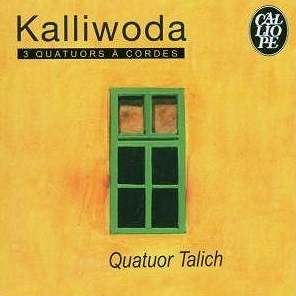
String Quartet No. 3 in G major, Op. 90 (pub. 1838) [30:13] Quatuor Talich (Talich Quartet):
(Jan Talich, violin; Petr Macecek, violin; Vladimir Bukac, viola; Petr Prause,
cello)
rec. March 2005, ArcoDiva Studio, Prague, Czech Republic. DDD CALLIOPE
CAL9357 [76:22]
I was delighted to receive this stunning and exciting Calliope
disc. Less than a year ago Kalliwoda was a composer completely
unknown to me. Thankfully, owing to a handful of recent recordings
from CPO, MDG, Orfeo and now Calliope, a quantity of Kalliwoda’s
music is now available in the catalogues.
The rehabilitation of Prague-born Kalliwoda follows in the
wake of a growing interest in the music of composers from
Bohemian
and surrounding regions. Currently the composers that are
holding my interest are Jan Dismas Zelenka (1679-1745); Jan
Vaclav Antonín Stamic (Stamitz) (1717-1757); Jiří Antonín
Benda (1722-1795); Josef Myslivecek (1737-81) and Jan Ladislav
Dusík (Dussek) (1760-1812).
Johann Wenzel Kalliwoda (Jan (Křtitel) Václav
Kalivoda) was one of the first violin students in the newly-founded
Prague
Conservatory. He attended there 1811-15. We are told that
his diploma states that he was an, “excellent
player solo or in an orchestra … shows great talent in
composition.” After graduating from the Conservatory
with honours he became in 1816 a member of the Prague Theatre
Orchestra until he left in 1821 to embark on a career as
a touring violinist visiting Switzerland, the Netherlands
and Germany. Eventually he decided in favour of security
and stability. For almost forty years, from 1822 until
his retirement in 1865, he was engaged as Maestro di
cappella (Kapellmeister) under Prince Karl Egon
II of Fürstenburg in Donaueschingen, Germany.
The court post at the Donaueschingen permitted Kalliwoda
the time to write a large number of compositions. He has
over 450
scores to his credit of which 244 were published with opus
numbers. He wrote in a wide variety of genres that included
two operas; ten masses; seven symphonies and 16 or 18 overtures.
He was held in high regard by many distinguished contemporaries.
Robert Schumann, who at one time championed Kalliwoda’s music,
dedicated to him his set of Six Intermezzi for piano,
Op. 4 (1832).
Kalliwoda’s reputation had spread abroad and his New Overture in
D was played at the founding and first concert of the
New York Philharmonic, then known as the ‘Philharmonic
Society’ of New York, held at the Apollo Rooms in Lower
Broadway on 7 December 1842. The programme of the Philharmonic
Society concert contained Beethoven’s Symphony No. 5 (referred
to as the Grand Symphony in C minor); Weber’s Oberon
Overture; a Quintet in D minor by Hummel; arias
and a duet from operas by Mozart; Beethoven and Weber and
that New Overture in D by Kalliwoda. Ureli Corelli
Hill, a conductor, violinist and president of the Philharmonic
Society of New York had been a pupil of the composer and
virtuoso violinist Louis Spohr in Kassel, Germany. It seems
likely that the prestigious New York performance under
what was almost certainly a provisional title came about
as a result of the association that Hill had with Spohr;
Kalliwoda would probably have known both Hill and Spohr.
Whether or not Kalliwoda’s New Overture in D was
especially commissioned by the Philharmonic Society is
a matter of conjecture.
The performers on this release are the distinguished Talich Quartet.
Founded in 1964 by Jan Talich senior during his studies at
the Prague Conservatory where Kalliwoda had also studied.
The Talich have developed into one of the foremost ensembles
in the world and they have been prolific in the recording
studio. Most notably they have recorded the complete string
quartets of Mozart on Calliope Cal 3241.8 and Beethoven on
Calliope Cal 3633.9 receiving many prizes including a Diapason
d`Or; Grand Prix du Disque; Diapason du Siècle and
a Gold Disque from Supraphon.
From the 1990s there has been a gradual change in the membership with
the line-up now comprising leader Jan Talich using a J.B.
Vuillaume (1845), second violinist Petr Macecek with a Francesco
Ruggieri (1694), violist Vladimir Bukac using a Lorenzo Guadagnini
(1742) and cellist Petr Prause playing a J. Gagliano (1795).
In addition to their specialist interpretations of Czech music, the
Talich have a broad-ranging repertoire, a spectrum that includes
the main works of the standard Classical repertoire and the
major 20th century pieces. I have especially enjoyed their
2001/03 Prague recordings of the complete Mendelssohn string
quartets on a 3 disc set on Calliope Cal 3311.3.
The present three string quartets were composed by Kalliwoda
at the behest of publisher Carl Gotthelf Böhme of Peters in Leipzig.
Böhme stipulated that the scores should be, “non-concertant
for the first violin, with the music nicely divided up among
the instruments, not heavy for any of them, and in the beautiful
style of Mozart.” In accordance with the conditions of
his assignment Kalliwoda shares out the music more equally
among the various instruments in the ‘Classical’ layout rather
than just focusing on the role of the first violin in the
manner of the Quatuor brillant. The writing for the
first violin part remains prominent but not at the expense
of the composition as a whole.
Kalliwoda was composing these string quartets circa 1835-38
contemporaneous with quartets from Cherubini, Spohr and Mendelssohn.
At this
time Mozart had completed his quartets some forty years previously;
Haydn’s quartets thirty years before and those of Beethoven
less than a decade earlier. Kalliwoda may well have known
these works. I was struck by how these quartets reminded
me of an amalgam of Haydn, Mozart and Mendelssohn. Whereas
the string quartets of Cherubini, composed 1814-37, seem
more influenced by Haydn and to a lesser degree by Mozart.
The opening work is the String Quartet No. 1 published
in 1835 and dedicated to Kalliwoda’s friend Joseph Graff
of Prague. In the lengthy opening movement Allegro moderato the
Talich display considerable self-assured playing giving an
air of suave nobility to the writing. The second movement Adagio is
a tender love song of rare beauty, that one could easily
imagine being sung like an aria. It is performed with consummate
control. Here Kalliwoda’s poetic lyricism embarks us on a
marvellous journey that I wish would never end. This Adagio has
been described as having an affinity with the Andante
cantabile of Mozart’s String Quartet No. 19 in C major,
K465 'Dissonance' (1785).
The third movement Allegro is a remarkably inventive and stunning Scherzo that
is played almost entirely pizzicato. The scampering
and good-humoured temperament is interrupted at 1:43-2:35
with an episode of folk-like melody with a strangely Celtic
character. I may stand corrected but Kalliwoda must surely
be one of the first composers to present a pizzicato movement
in a string quartet. The final movement marked Vivace is
performed by the Talich with an assured vitality, ending
the score in a mood of disquiet and a weighty element of
turmoil. With regard to the use of pizzicato in the
third movement I wonder if the composer had heard the episodes
of plucked strings in the opening movement of Haydn’s String
Quartet in E flat-major, Op. 74‘Harp’ (1809)
a device also employed by Mendelssohn in the Canzonetta of
his String Quartet in E flat major, Op. 12 (1829).
Published in 1836 the String Quartet No. 2 was dedicated to
Frantisek Max Knjze, his friend, a fellow musician and conductor
from Prague. The score opens with a substantial movement
marked Allegro vivace that is dominated by the sparkling
rhythms of the mazurka; evidently a characteristic
Kalliwoda tool. Here the Talich bring out a distinct Mendelssohnian
quality to this scampering and highly attractive movement.
The very short Scherzo, marked Presto is played
with a vigour that borders on the frenetic. I detected a
slight hesitancy from the leader in the opening section.
From 1:28-2:05 there is an operatic quality to the writing
with fluid and congenial melodies.
The first violin of Jan Talich takes centre-stage in the bittersweet Adagio (attacca)
with a delightful theme of passionate yearning. In the final
movement marked Vivace Kalliwoda’s rapid writing has
the quality of a Paganini Moto perpetuo. The Talich
alter the mood drastically between 1:07 and 2:26 to one of
languid tenderness. At 2:37 the swift opening tempo is repeated
delivering to the music a dramatic conclusion.
The final work on the set is the String Quartet No.
3 that was published in 1838 bearing the dedication
to Peter Josef von Lindpaintner, a composer and maître
de chapelle at the Stuttgart court. The lengthy opening
movement, marked Moderato is highly rhythmic and
performed by the Talich with lofty intensity. Especially
noticeable here is Kalliwoda’s weighty cello writing. There
are one or two untidy passages from the first violin in
the strenuous and demanding writing. In the hands of the
Talich the brisk and agitated tempo of the Scherzo marked Vivace was
evocative to me of a loose horse galloping wild through
wooded countryside. The Trio at 2:21-4:37 provides
a welcome respite and here it feels like the nervous stallion
is taking a refreshing drink from a cool stream before
galloping away to an uncertain freedom. In the third movement Adagio the
players communicate an underlying restive quality that
precludes the listener from feeling totally at ease. Bold
and vigorous themes dominate this helter-skelter and
ebullient closing movement where the melodies vary from
the gypsy-like to the martial.
A special feature in this movement is Kalliwoda’s occasional
use of harmonics.
The booklet notes are interesting and reasonably informative. However
the track-listing inadvertently reverses the second and third
tracks which should read: Adagio (track 2) followed
by the Allegro. Scherzo (track 3). Recorded
in 2005 at the ArcoDiva Studio in Prague the Calliope engineers
are to be heartily congratulated for providing clear, natural
and well balanced sound quality.
For those who wish to further explore Kalliwoda’s music a
quick check has revealed the following recordings. In addition
there
are several other multi-composer discs that include Kalliwoda
oboe and clarinet scores:
Overture No. 12; Introduction & Variations
for clarinet & orchestra; Introduction & Rondo
for horn & orchestra; Symphony No. 3 performed
by Dieter Klöcker (clarinet); Radovan Vlatkovic (horn);
Hamburg Symphony/Johannes Moesus on Musikproduktion Dabringhaus
and Grimm, MDG 329 1387-2 (see review).
Symphonies Nos. 5 & 6 performed by
Hofkapelle Stuttgart/Frieder Bernius on Orfeo C 677 061.
Symphonies Nos. 5 & 7; Overture
No. 16 performed on original instruments by the Das
Neue Orchester/Christoph Spering CPO 777 139-2 (see review).
These three string quartets from Kalliwoda are not ground-breaking
scores but are exciting discoveries that merit a place in
the chamber music repertoire. In excellent performances these
neglected but highly gratifying quartets demand to be heard
by a wide audience. Lovers of chamber music, especially admirers
of Haydn, Mozart and Mendelssohn, will be in their element
with this important Calliope release.
Michael Cookson
Please support our advertisers below by clicking on the logos for further information.

























 Quatuor Talich (Talich Quartet):
(Jan Talich, violin; Petr Macecek, violin; Vladimir Bukac, viola; Petr Prause,
cello)
Quatuor Talich (Talich Quartet):
(Jan Talich, violin; Petr Macecek, violin; Vladimir Bukac, viola; Petr Prause,
cello)