Editorial Board
MusicWeb International
Founding Editor Rob Barnett Editor in Chief
John Quinn Contributing Editor Ralph Moore Webmaster
David Barker Postmaster
Jonathan Woolf MusicWeb Founder Len Mullenger
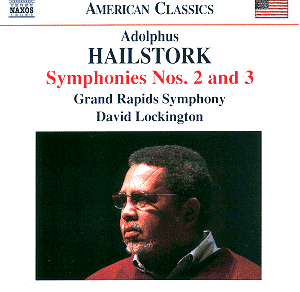
Adolphus HAILSTORK (b.1941)
Symphony No. 3: (i) Vivace [12:00] (ii) Moderato [12:04];
(iii) Scherzo [4:45] (iv) Finale: Moderato [11:55]
Symphony No. 2 (1999): (i) Allegro [8:00]; (ii) Grave [10:59];
Allegro con brio [4:43]; (iv) Adagio – Allegro [13:05] Grand Rapids
Symphony/David Lockington
rec. De Vos performance Hall, Michigan, 5November
2002 (No. 2); 23November 2003 (No. 3). DDD NAXOS AMERICAN CLASSICS
8.559295 [77:32]
Adolphus
Hailstork was a name previously unfamiliar to me. I volunteered
to review the disc partly out of curiosity and also because,
in my experience, the Naxos American Classics series hasn’t
yet produced a dud. And that hasn’t changed because these
two symphonies, the product of the last decade or so, are
certainly worth a place in the catalogue. Within the confines
of conventional structures and harmonies – which has the
benefit of making the music immediately approachable – Hailstork
manages to write symphonies that appeal without being trivial,
rather as George Lloyd did before him on the other side of
the Atlantic. Born in Rochester, New York he studied composition
in Michigan and lists Nadia Boulanger and David Diamond amongst
his teachers. Since 1977 he has held academic posts in Virginia.
The
Third Symphony is given before the second, presumably because
it is considerably lighter in feeling. To quote the composer,
a catchy trumpet tune is used “as the point of departure”.
This spawns some of the later material without being as all-encompassing
as the trumpet solo which opens Schmidt’s Fourth Symphony.
The movement is marked Vivace and is notable later
on for imaginative use of percussion, including the marimba.
The movement which follows feels slow but is actually marked Moderato,
and it is a gem. This is song-like, deeply felt and contains
some wonderful string writing. A scherzo follows attacca and
percussion are once again prominent, supporting the complex
rhythmic material. A central section is no trio but blues-derived.
The finale is by turns angular, reflective and then joyous
as the trumpet theme returns and is amplified to provide
a satisfying conclusion to a most attractive work.
The
Second Symphony is a tougher nut to crack but equally rewarding.
It was partly inspired by a visit to Ghana where the composer
saw the dungeons in which slaves were held before being shipped
to America. The composer wrote it whilst reflecting on the
struggle against slavery but it is not overtly programmatic.
The work is structurally similar to the third symphony – four
movements with the slow movement second – but there is also
a slow introduction to the finale beginning with a notable
and beautifully rendered clarinet solo. The opening Allegro is
initially frightening – the brass positively screams over
initially passive strings – and it then builds up considerable
momentum. The second movement is elegiac, a brooding cor
anglais solo framing some darkly powerful music which is
certainly evocative of dungeons. The dance-like third movement
offers some light relief but not to the exclusion of a feeling
of struggle. That feeling is ultimately only overcome at
the very end of the finale – an optimistic but hardly jubilant
close.
The
Grand Rapids Symphony hails from Michigan and their conductor
David Lockington from Britain although he has been resident
in the USA in 1978. They commissioned the Third Symphony
and have championed the music of this composer. Clearly a
fine orchestra, their playing is agile and clean, and Lockington’s
direction of both works is lucid.
The
recorded sound is rather good and serves the music well.
Liner notes are uncredited and on the brief side. The space
saved is given over to listing all the performing musicians,
quite a few of whom are designated “supplemental”, emphasising
the fairly large forces involved.
This
is a fine addition to the American Classics series. These
works push back no boundaries but support the notion that
the symphony may yet be alive and well.

























 Grand Rapids
Symphony/David Lockington
Grand Rapids
Symphony/David Lockington