Editorial Board
MusicWeb International
Founding Editor Rob Barnett Editor in Chief
John Quinn Contributing Editor Ralph Moore Webmaster
David Barker Postmaster
Jonathan Woolf MusicWeb Founder Len Mullenger
Ludwig van
BEETHOVEN (1770-1827)
Piano Concerto No. 1 in C, Op. 15 (1797/8) [32:47]
Piano Concerto No. 3 in C minor (1803) [34:51] Mikhail Pletnev
(piano)
Russian National Orchestra/Christian Gansch
rec. Live, Beethovenhalle, Bonn, 2 September 2006.DDD DEUTSCHE GRAMMOPHON
477 6415 [67:52]
Mikhail
Pletnev is nothing if not unpredictable. This live disc is
part of an ambitious project that will encompass
all of the concertos and symphonies for DG and if this is
anything to go by it will be a helter-skelter ride, by turns
frustrating and illuminating - mainly the former, for this
reviewer.
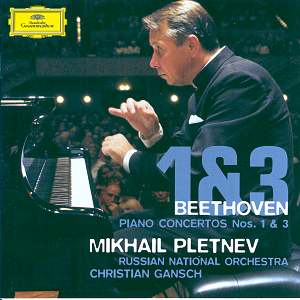
The orchestra, Pletnev's own RNO, plays superbly under Christan
Gansch although interestingly, and possibly tellingly, the
disc's cover shows Pletnev looking as if he is directing
an orchestra! Pletnev's entrance in Op. 15 is reminiscent
of Pollini's first account of the First Concerto, in that
he enters in a different tempo from the orchestral exposition.
It is disconcerting - from both pianists - implying the soloist
is on a different track from all surrounding him. In Pollini's
case, this is not so; things quickly right themselves. For
Pletnev, it is far more predictive. As one follows Pletnev
through the first movement's terrain, one is dazzled by his
at times exquisite musicality - try the balancing at 4'48
- and his tendency to pop off into his own dream-world. This
latter tendency is perhaps most marked in the cadenza - the
short, second one, also favoured by Argerich. But he can
also be wilful, seemingly contrary for the sake of it and
even studied; try the very end of the cadenza.
The opening of the Largo exemplifies Pletnev's idiosyncratic
approach. It is not the tempo so much, more the amount of
rubato Pletnev employs. Again, the orchestra is exemplary
but, again, Pletnev can be over-forceful, as if trying to
drag the listener round to his way of thinking. Try the point-making
of the repeated chords at 7'53. The finale is the best movement,
with plenty of life and a real sense of play that one does
not always associate with this pianist.
The Third Concerto finds Pletnev proclaiming his arrival
with scales that accelerate to their apex. Things get better
when the orchestra re-enters but there is still a tendency
for the pianist to luxuriate in his own ideas. Strangely
the cadenza fares better than expected as Pletnev trades
at least some of his interventionism for a sense of shape
and drama.
The Largo is positively dirge-like, although the orchestra
seems to have an idea about how to impart a sense of flow
to the occasion. The best part of the movement is when Pletnev
accompanies his woodwind colleagues, and takes the role of
accompanist.
The finale, as with the First Concerto, is the best movement.
Pletnev finds a prickly little counter-melody in the left-hand
semiquavers accompanying the principal theme which is almost
endearing on first flush. A pity the coda could not have
more sprightliness but that’s not a trait that figures highly
in Pletnev's make-up.
David Gutman's booklet notes are illuminating, quoting Pletnev
from an unknown source - was there an interview as the basis?
Pletnev's use of a Blüthner works well, its jewel-like treble
suiting his playing well. The recording is top-drawer stuff.
Ultimately, though, these are thought-provoking performances
but not revelatory ones. I have heard Pletnev distort scores
far more than he does here - at the Barbican in 2003, for example - but that is no justification. It
takes a great musician to take risks of the sort Pletnev
takes to be fully convincing; nothing less is good enough.
Bernstein manages it, in his DVD account of Mozart 17 on
EuroArts 2072098, directing the Vienna Philharmonic, for
example. But Bernstein as a musician is, after all, in a
different league.
Colin
Clarke
Please support our advertisers below by clicking on the logos for further information.

























 Mikhail Pletnev
(piano)
Mikhail Pletnev
(piano)