English-born, Australian-resident
Edgar Bainton wrote three symphonies
as did Rutland Boughton.
The Bainton Second
Symphony is available on Chandos
but was recorded on an Australian LP
before that. The conductor was Joseph
Post. His First Symphony or at least
its first movement, Genesis,
is on ClassicO.
Boughton's Second and
Third symphonies were on a long-deleted
BBC Radio Classics CD (15656 91892)
while the Third can still be easily
tracked down on Hyperion Helios CDH55019
previously at full price CDA66343.
Bainton's Third
Symphony is a work of potently sustained
atmosphere - given to impressionistic
textures. At various times I was put
in mind of other late romantic works
such as Bax's Spring Fire, Alfvén's
Symphony No. 4, the second movement
of the Moeran Symphony, the melancholic
aspects of Bantock's Pierrot of the
Minute and the dream-visionary textures
of RVW's A London Symphony. This
phantasmal and refulgent yet delicately
orchestrated work is in four movements.
Throughout them the imagery of the sea
is to the fore - the composer died while
swimming in the sea. A more physical
energy - suggestive of a war dance -
enlivens the finale although it is by
no means as possessed and feral as the
ancient live version recorded in grindingly
distressed sound at the premiere by
the Sydney SO conducted by Sir Bernard
Heinze on BROLGA LP BZM12. Dutton
nevertheless provide an intensely sympathetic
performance as is to be expected from
this conductor and from an orchestra
that has a long broadcast tradition
of revivals. If you are looking for
a large-scale visionary-impressionistic
Baxian symphony then look no further.
This is a treasurable work full of ineffable
beauty and wild insight. Unique.
It is perhaps typical
of Boughton that even as early
as 1905 he selected Cromwell as the
subject for his First Symphony.
One can imagine his younger colleague
Alan Bush making a similar choice. Neglected
as unfashionable and politically unacceptable
because of his communist beliefs for
most of his life Boughton wrote a symphony
that was buried even deeper than the
rest of his oeuvre. It had to wait until
2005 for its premiere. Attempts at concert
performances in 1905-6 with the Liverpool
Phil, the RCM and the LSO all came to
nothing. The lack of performing materials
hardly helped. Paul Adrian Rooke has
put that right no doubt after many hours
slaving over the manuscript and Sibelius
software.
The four movements
of the Boughton are: 1. A character
study; 2. Cromwell's letter to
his wife after the battle of Dunbar;
3. March of the Puritans; 4.
Death scene. The first movement
is a dramatic fusion of the idioms of
Elgar and Tchaikovsky. The latter's
influence carries over into the touching
music of the second movement with its
Romeo and Juliet textures. The
March of the Puritans could easily
have been queasy but Boughton produces
a creditable Elgarian nobility with
Beethoven-style stabbing fate motifs
along the way. The finale includes a
setting of Cromwell's last prayer sung
here with grave fervour by Roderick
Williams. The work ends in a convincing
sunset glow with a remarkably inventive
sinuous paraph from the solo violin
signalling the end of this fine symphony.
The complementary notes
are by Garry Humphreys (Bainton) and
Paul Adrian Rooke (Boughton). The latter
edited and transcribed the Cromwell
symphony from manuscript; a service
he has also performed for Boughton's
masterly opera The Queen of Cornwall.
The connection is even closer because
Rooke directed the world premiere in
a Hitchin SO concert on 26 November
2005. I hope we will hear Rooke recording
as a conductor in repertoire of this
rarity and strength. It is worth noting
that he has written two muscular and
imaginative symphonies of real emotional
reach. We need to cherish gifted and
completely committed conductors of Mr
Rooke’s insight as we do others who
to date have never attracted national
attention. Others to watch and mark
include the fiery and imaginative John
Longstaff currently working with the
Sheffield Symphony Orchestra, John Gibbons
and the Ealing Symphony Orchestra, Christopher
Fifield and further afield John McLaughlin
Williams.
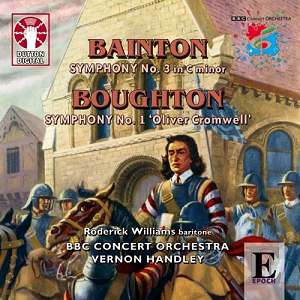
Again I must congratulate
Dutton on the distinctive visual identity
they establish with their booklets and
inserts. Their use of British Transport
poster details and the like is a welcome
hallmark of the Epoch series.
The recording is fine
- open and detailed yet warm-toned.
This is a much needed
project resplendently carried off by
all concerned. The Bainton work is the
stronger of the two works and especially
for this reason the disc deserves to
do extremely well.
It comes as no surprise to see Vernon
Handley pioneering these works on compact
disc. He is already familiar with the
Bainton Second from the Chandos recoridng
and the Boughton Third from the Hyperion
- now Helios. However let's not underestimate
the sheer solid work in getting to grips
with the mass of notes and the differing
nuancing and style of these two highly
individual composers. Then comes the
alchemy of drawing the sound of a piece
of music from a score that will have
been unknown to this orchestra. The
whole process has been not merely achieved
but triumphantly realised. Handley seems
tireless in his imaginative dedication
and later this year we will hear his
Chandos recording of Bantock's choral-orchestral
epic Omar Khayyam. In terms of getting
to grips with new scores is there any
other conductor as productively insightful
and tenacious. I live in hopes that
one day he will be able to realise his
desert island mission of recording Prokofiev's
Sixth Symphony.
Rob Barnett
Edgar
Bainton Society













 Roderick Williams (bar) (Boughton)