To many readers of
MusicWeb International the name Zarathustra
will perhaps most readily evoke thoughts
of Richard Strauss and his symphonic
poem Also Sprach Zarathustra
of 1894. Strauss’s composition, of course,
draws on Nietzsche’s appropriation of
Zarathustra in his remarkable text,
also entitled Also Sprach Zarathustra,
written between 1883 and 1885.
The historical Zarathustra
– sometimes referred to by the Greek
form of his name, Zoroaster – was a
religious prophet of quite extraordinary
importance, the influence of whose ideas
has extended, though place and time,
to a degree that is nowadays seriously
underestimated in most quarters. Actual
adherents to the faith he established
– usually known in the West as Zoroastrianism
– are not especially numerous. There
are perhaps 100,000 Zoroastrians in
India - especially in Bombay, where
they are often referred to as Parsis;
there are some 15-20,000 in Iran, notably
in and around the desert cities of Yazd
and Kirman; there are smaller communities
in Pakistan, and in Europe and North
America.
Zoroaster lived in
Eastern Iran, probably in the 6th
century B.C. His teachings have a serious
claim to be thought of as the earliest
formulation of a monotheistic religion.
Certainly his ideas exerted a real influence
on later monotheistic creeds such as
Judaism, Christianity and Islam, especially
as regards ideas about the Last Judgement,
Heaven and Hell and the resurrection
of the dead. Zoroaster appears to have
been the first religious teacher to
promulgate such ideas. His ideas, and
their expression by his followers, shaped
much later religious iconography – notably
that of the angels. Central to Zoroastrianism
was the idea that the creator Ahura
Mazda was opposed by a kind of twin
spirit, Angrya Mainyu, a source of violence
and evil. Man is free to choose between
these two spirits; but Good will eventually
triumph. The potential dualism of Zoroaster’s
thinking perhaps lay behind such later
religious movements as Mithraism and
the Manichaeans; perhaps even, through
indirect channels, behind such medieval
Christian heresies as the Cathars.
The student of Zoroaster
and his - often unacknowledged - influence
is reasonably well served by modern
scholars. The great English scholar
Mary Boyce wrote with both learning
and direct experience of the Zoroastrians
around Yazd, in a series of publications
which included Zoroastrians: Their
Religious Beliefs and Practices
(1979) and her History of Zoroastrianism
(3 volumes: 1975, 1982 and 1991). The
opening sentence of the first of these
makes what may initially sound like
an improbable claim: "Zoroastrianism
is the oldest of the revealed world-religions,
and it has probably had more influence
on mankind, directly and indirectly,
than any other single faith". Aspects
of Zoroaster’s influence in the West
- to leave aside what modern scholars
now detect as its influence on modern
Buddhism - are discussed in books such
as The Image of Zoroaster: The Persian
Mage through European Eyes by Jenny
Rose (2000), J. Duchesne-Guillemin’s
The Western Response to Zoroaster
(1958) and, for readers of German, M.
Stausberg’s Faszination Zarathustra
(1998). A good place to start is Paul
Kriwaczek’s excellent In Search of
Zarathustra: The First Prophet
and the Ideas that Changed the World
(2002), an intelligent, well-written
and wide-ranging account of a journey
of personal discovery (currently available
as an Orion paperback).
Now we have Sina Vodjani’s
account – in three media – of his own
odyssey towards Zoroaster and Zoroastrianism.
Vodjani, son of an Iranian father and
a French mother, was born in Iran (in
1954), in the beautiful city of Isfahan,
and grew up in Tehran, San Francisco
and Paris. Now living in Germany, he
started his musical career singing pop
songs and French chansons. He later
studied classical and flamenco guitar.
Much interested in religious traditions,
he is not only a composer, but also
a professional photographer and a widely
exhibited painter. His extensive travels
have taken him to India and Nepal amongst
many other countries. He has made previous
CDs on Buddhist themes, fusing oriental
materials, including the prayer chants
of Buddhist priests, with modern rhythms
and sounds.
Here his music is to
be found on both an SACD and as accompaniment
to a DVD (each has a playing time of
72:05). The titles are as follows:
Prelude [1:33]
Choupan [6:58]
Ashem Vohu [6:46]
Dear Friend [4:57]
Sacred Fire [5:04]
Don’t Sleep [6:11]
Persepolis [6:07]
Chak Chak [8:09]
Dashti [5:24]
Wings of Love [6:45]
Be the One [1:56]
Emptiness [1:39]
Zarathustra [3:04]
Ahura & The Rising
Sun [4:14]
Asha [3:15]
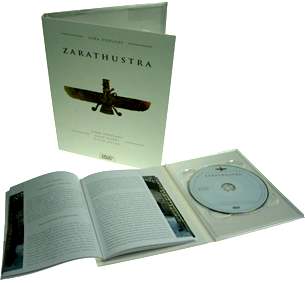
Both discs are embedded
in the inside of the back cover of this
very beautifully produced book. Vodjani’s
text is relatively brief – and is presented
in both German and English. Certainly
it is no substitute for any of the kinds
of volumes mentioned earlier. It presents
a short overview of Zarathustra’s teachings
and says something of his significance.
It stresses the idea that "Zoroaster
did not need to provide evidence of
miracles or similar mystic events to
spread his message; he appealed directly
to the intellect, logic and common sense
of his listeners". Emphasis is
also placed on the role of ‘Asha’ in
Zoroaster’s thought, defined here "that
which conforms", a kind of universal
law of creation, the principle which
unites all things in harmony. Human
understanding of ‘Asha’ can be approached
through meditation and imagination,
but also through obedience to the code
of good thoughts, good works, good deeds"
– the code which Vodjani’s book carries
as its subtitle.
The greater part of
Vodjani’s book is taken up by some quite
magnificent photographs of many aspects
of Iranian life – photographs of people
and buildings, including mosques as
well as Zoroastrian buildings, photographs
of the often stunning landscape, mountains
and lakes, salt deserts and meadows;
there are images of bazaars and bakeries
and many aspects of Iranian life. By
including pictures of Islamic life and
buildings, Vodjani perhaps intends to
make the point that beneath the obvious
Islamicisation of Iranian life there
is a substratum of Zoroastrian tradition
and mindset – Zoroastrianism was, after
all, the official religion of the great
empire of ancient Persia – which survive
still, and which even now condition
many dimensions of life in Iran, helping
to define and create its people’s sense
of their national identity. That, at
least, is the impression I have carried
away from the time I have spent in Iran.
Vodjani’s photographs
are often magnificent – indeed they
are perhaps the best reason for getting
hold of the book. There are large-scale
shots of landscapes, and beautifully
detailed studies of architectural or
decorative details; there are gorgeous
pictures of flower meadows and unpretentious
pictures of bakers at work.
About Vodjani’s music
I have slightly more mixed feelings.
At times it is little more than mood
music and sometimes the insistent sounds
of synthesiser and (politely) rockish
beats rather overwhelm any very fully
Iranian feeling. Yet there are some
lovely passages played on the ney
(the traditional Iranian flute) and
the oud (ancestor of the lute).
There are passages from the gathas
(the Zoroastrian hymns). As is evidently
Vodjani’s method all are fused and laid
on top of one another; there are moments
when Persian words and English words
are sung almost simultaneously – so
that neither is fully audible. Vodjani
is obviously a musician of considerable
talent – but for my tastes I would have
preferred to have heard his musical
ideas, his musical impressions, separate
from the traditional sounds and elements,
rather than fused in this way. Still,
I have no wish to deny that there are
some beautiful and attractive moments.
The music works especially well as soundtrack
to the DVD. The musicians involved should
certainly be credited. They are: Mobed
Mehraban Firouzgary, Mobed Sirus Hormazdi
(Avesta Prayer Recitation); Roma Majumdar
(bansouri flute); Pasha Hanjani (ney
flute); Ali Pajuheshgar (oud); Shahriar
Monazami (komancheh); Hamid Saeik Bahai
(daf); Sina Vodjani (guitars, sitar,
tar, setar, piano, bass). The whole
was mixed and engineered by Vodjani,
also using Persian vocals from samples
provided by the Iran Music association.
The images which this
music accompanies on the DVD are often
very beautiful and always very interesting.
There is, though, one significant drawback.
There are not – or if they are there
I couldn’t find them – captions of any
sort, so that much remains unidentified
and unexplained. I am fortunate enough
to have travelled fairly widely in Iran,
and to have a wife who grew up in Kirman,
one of the Zoroastrian centres in Iran.
I was, therefore, able to identify and
put a name to much of what I saw, in
terms of places and buildings, and to
recognise the significance of some of
the activities filmed. But not all viewers
will be able to do so, and it is a shame
that what is, in so many ways, a striking
panorama of Iranian life and landscape
– concentrating on the Zoroastrian thread,
but showing much else too – should leave
some viewers puzzled rather than informed.
All viewers will surely enjoy the visual
feast put before them – whether in looking
at the fabulous decorative patterns
on the mosques of Isfahan - one of them,
though this isn’t mentioned, built on
the site of an earlier fire-temple -
or getting a rare glimpse inside an
active Zoroastrian fire-temple and the
streets and corners of the Zoroastrian
quarter of Yazd; the great bridges of
Isfahan, the Sī
o SéPol and the Pol-é
Khājū;
the glorious central meidūn
(or square) of Isfahan - though the
city is nowhere identified on the DVD;
tea-houses, wild-life, flowers, craftsmen
at work, superb landscapes and much,
much else. The whole DVD is richly enjoyable.
Sian Vodjani’s Zarathustra
offers an introduction to Zoroaster
and Zoroastrianism which may well whet
readers’ and viewers’ appetites for
more. Those whose interest is stirred
will certainly want to read more, so
as to get beyond the necessarily simplified
view which Vodjani’s brief text has
to settle for. But his evocation – especially
visually, in the photographs and the
images on the DVD, and in the best of
the music on the SACD – of a world very
unfamiliar to most in the west and increasingly
demonised and falsely represented by
those in power in the west, can be warmly
recommended.
Glyn Pursglove