Editorial Board
MusicWeb International
Founding Editor Rob Barnett Editor in Chief
John Quinn Contributing Editor Ralph Moore Webmaster
David Barker Postmaster
Jonathan Woolf MusicWeb Founder Len Mullenger
Albert ROUSSEL (1869-1937)
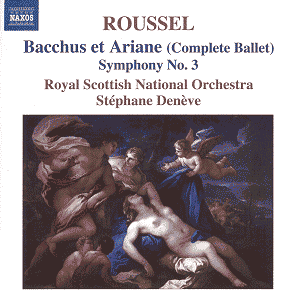
Symphony No. 3 in G minor, Op. 42 (1929) [25:31] Bacchus et Ariane, Op. 43 (1930) [37:37] Royal Scottish
National Orchestra/Stéphane Denève
rec. Henry Wood Hall, Glasgow, 17-18 October 2006 (Symphony); 2-4 May 2006 (Bacchus).DDD NAXOS 8.570245 [63:08]
The works on this disc are two of Roussel's most popular.
They sit next to each other in his chronology. The Third
Symphony was a Boston Symphony commission for its fiftieth
anniversary season - a particularly fertile season for commissions,
as it included Stravinsky's Symphony of Psalms,
Honegger's First and Prokofiev's Fourth!
Roussel's Neo-Classicism as heard in the Third Symphony is
not of the particularly gentle variety. There are themes
of great suavité, it is true, but there is also an internal drive to the
music. This verges on the pounding at times and it speaks
of matters of greater import. There are some delightful wind
solos, which are given life and beauty by the RSNO's unnamed
principals.
The ten-minute Adagio - by far the work's longest movement
- dares to venture into deep emotional regions before swerving
towards the cafés of Paris after around three minutes. Spiky
woodwind imitations are, in this performance at least, guaranteed
to raise a smile, while the climax - just after the eight-minute
mark - brings with it a complementary shudder.
If you want a coupling of this symphony with its successor,
the Fourth, perhaps you should lean towards that still-underrated
conductor Cluytens with the French National Radio Orchestra.
This is on Testament SBT1239, where you will also get some
excerpts from Bacchus as
well as the Sinfonietta. The Vivace third movement lasts
hardly any time at all (2:59) yet is chock-full of open-air
delights and is not without a whiff of tomfoolery. The finale
is busy but there is never any hint of rush. Only very occasionally
do the first violins in their upper register sound strained,
but it does not make for uncomfortable listening. The solo
violin, though, is as sweet as anyone could wish for – a
shame that the player is uncredited.
The ballet Bacchus
et Ariane is
divided into two suites. They are presented here with detailed
tracking and titles in French with English translations.
The Prélude is as rhythmically insistent as the opening
of the Symphony before suddenly letting in an infectious
jauntiness that informs also the 'Games of the Young Men
and Maidens'. After the playful, woodwind-dominated 'Dance
of the Labyrinth', the arrival of Bacchus is graphically
depicted by whirling woodwind; strangely enough this part
reminded me of sections of Bartók's Miraculous
Mandarin.
His later dance, shortly before the end of the first Suite,
is at once delicate and yet ever so slightly clumsy – imagine
a cow dancing on eggshells!
Suite 1 ends with Bacchus tenderly setting Ariadne down on
the rock, while Suite 2 opens with a tender depiction of
her sleep. The music of this second part of the ballet is
astonishingly sensual, even erotic and here the first violins
seem able to negotiate their upper registers beautifully.
Roussel provides some openly descriptive music before the
next set number, 'Le baiser', whereupon a glow seems to suffuse
the music from within. Parts of the brief 'L'enchantement
dionysiaque' are distinctly Straussian - evoking Alpensinfonie in particular. Sensuality reaches its apogee
here. The dance of Ariadne and Bacchus is more animated,
tramping around in almost bestial fashion. Then comes a Bacchanale
and, finally, a coronation for Ariadne that winds the ballet
up in energetic fashion.
Denève persuades his Scottish forces to play with real affection
and, where appropriate, real force. Although Martinon on the Erato Anniversary label couples Bacchus with an equally apposite partner - the ballet Aeneas, from 1935 - this new Naxos carves a niche firmly for itself
on any serious record collector's shelves. The recording
(Tim Handley) is fabulous; there is plenty of depth and definition.
Reviews
from previous months Join the mailing list and receive a hyperlinked weekly update on the
discs reviewed. details We welcome feedback on our reviews. Please use the Bulletin
Board
Please paste in the first line of your comments the URL of the review to
which you refer.













 Royal Scottish
National Orchestra/Stéphane Denève
Royal Scottish
National Orchestra/Stéphane Denève