Among
20th century clarinet concertos Carl Nielsen’s must
be counted as one of the foremost. Copland, Hindemith and Malcolm
Arnold No. 2 also spring to mind, all three incidentally dedicated
to Benny Goodman and recorded by Martin Fröst a decade ago (BIS-CD-893).
The Copland is probably the most frequently recorded but Nielsen
also pops up from time to time. My first – and only – recording
was the old 78 rpm version, originally on Columbia, with French
clarinettist Louis Cahuzac and the Royal Danish Orchestra under
John Frandsen. It was re-issued, in harness with some Nielsen
symphonies of the same vintage, in a cassette box many years
ago and in due time it was made unplayable through the not infrequent
state of things called tape salad. If I remember correctly this
was the first recording of the work and it was regarded for
several years as the definitive one.
From
the beginning the concerto was quite coldly received and during
Nielsen’s lifetime it was only performed six times, including
a private performance. It is moulded in one movement but divided
in three clearly discernable parts: Allegretto un poco –
a short Poco adagio – and the finale the longest
and in itself divided in three parts: Allegro non troppo
– Adagio – Allegro vivace. The opening has something of
baroque over it but seen through 20th century glasses
and it gradually become wilder, more rhythmic and with Nielsen’s
characteristic snare-drum providing extra spicing, at the same
time reminding us of Nielsen’s time as a military musician.
The Adagio has a solemn cathedral atmosphere but with
a heavily contrasting central section with insistent rhythms
and that snare-drum again, which also appears in the last part,
with its frequently shifting moods. Nielsen also gives the bassoon
some solo opportunities, as he does the trombone in the flute
concerto. It is also in this part that the clarinet has its
richest opportunities, both as a warm melody instrument and
as lithe virtuoso. After some martial drumming the composition
gradually dies away.
Kalevi
Aho has for quite some time attracted attention for his compositions
of large-scale works, among which are four operas, thirteen
symphonies and twelve concertos. The clarinet concerto, which
like Nielsen’s is in one continuous movement, was commissioned
by Martin Fröst, premiered in London on 22 April 2006 and recorded
in Lahti two months later. It starts Tempestoso with
aggressive wind chords forming the backdrop to the clarinets
virtuoso explorations of the instruments possibilities. A recurring
feature is the clarinet’s glissando up to its highest reaches,
where high strings take over and bring the music even higher.
The cadenza, marked Tranquillo is built on tremolo effects,
giving the impression of fluttering wings, giving associations
to insects: Insect Life being the title of one of Aho’s
operas. The third ‘movement’ is rhythmically intricate and requires
virtuoso playing from both soloist and orchestra. Aho points
out in the liner notes that it also sets the conductor to severe
test, the time signature changing almost every bar. This is
highly engaging and accessible music, adrenaline producing.
As repose from all the volcanic energy the following Adagio
is slow and meditative, very beautiful. The Epilogo,
marked misterioso, is also slow, the soloist required
to produce multiphonic sounds, evocative, otherworldly and,
yes, mysterious. Like Nielsen’s concerto it also fades away,
leaving the listener filled with warmth and contemplation.
Having
listened to the work twice in two consecutive days I am convinced
that this is a major composition which in all fairness should
be heard in concert halls all over the world and with Martin
Fröst’s fame it certainly will. It isn’t actually difficult
music – for the listener. There is so much beauty – and that
irresistible energy.
Martin
Fröst is a superb player with honeyed tone – or wildly screaming,
all the time aided by technique that lets him do whatever the
composer wants. Everything sound so easy and even the fastest
passages are executed almost casually. The Lahti Symphony Orchestra
under its longstanding principal conductor is a front-rank ensemble
and with the composer present during the recording sessions
we can rest assured that what we hear is what Kalevi Aho wished.
I didn’t even mention the playing in the Nielsen concerto but
I can hardly imagine it being better performed. A BIS recording
is seldom disappointing sound-wise and having listened to it
both in SACD mode and through two-channel headphones I have
no qualms to recommend it on sonic ground.
A
clear winner on all accounts and Aho’s concerto is pre-destined
to be a standard work.
Göran
Forsling












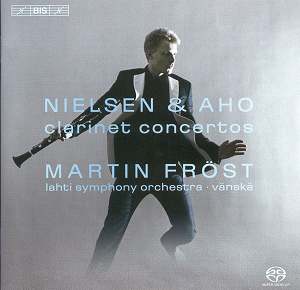

 Martin Fröst
(clarinet)
Martin Fröst
(clarinet) [54:00]